
Fool's Mate mirror version: mate in 2 moves
What is this mate?
This mirror version of Fool’s Mate is one of the best-known quick mates in chess. Why is it a “fool’s” mate? Because it only happens when White plays in a completely reckless way: pushing two kingside pawns for no reason and leaving the king totally exposed.
The good news is that if you’re playing Black and White falls for this mistake, you can deliver checkmate on move two.
How this mate happens
The idea is simple. White opens dangerous gaps around their own king before developing a single piece. Two pawn moves are enough to ruin the position.
Let’s go through it step by step.
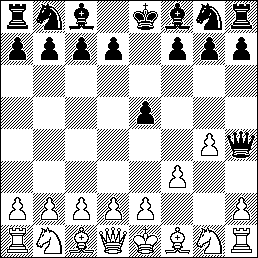
Step 1: White’s first mistake
White plays 1.g4, a move that doesn’t develop any piece and weakens the h4-e1 diagonal. In normal games you’ll never see this, but among beginners it happens more than you’d think.
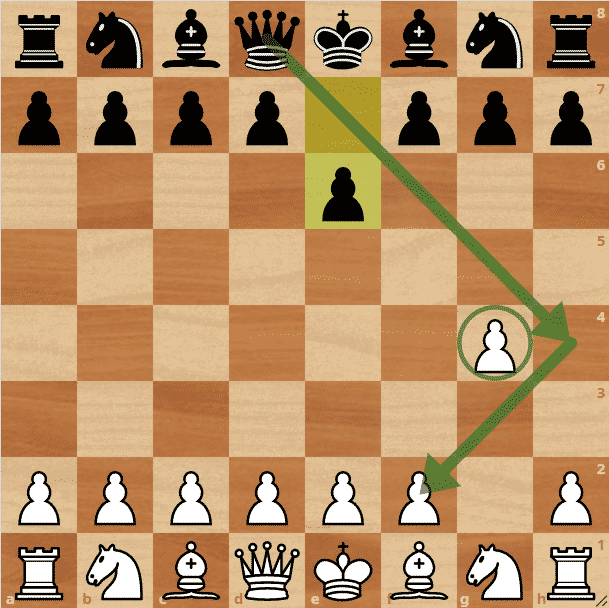
What would you do here with Black? Any sensible developing move is good, but what comes next opens something even more interesting.
Step 2: the second mistake decides everything
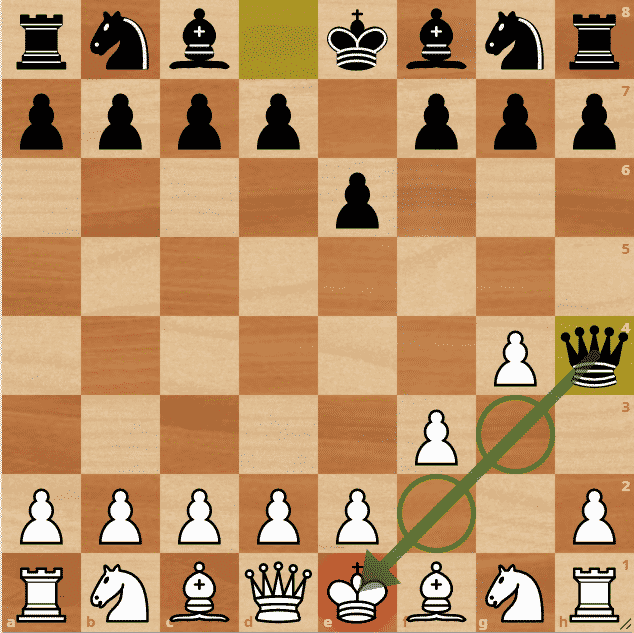
White insists and plays 2.f3, weakening the diagonal even further and taking the f3 square away from the knight. Now Black’s queen has a direct line to the white king.
2…Qh4# — checkmate. The queen arrives on h4, the king has no escape, and no piece can block it. Game over in two moves.
3. Practice this mate
You play Black. White makes the mistakes g4 and f3. Punish them by delivering mate with Qh4#.
Once you see the pattern once, you’ll recognize it forever. This mate isn’t magic: it’s the direct consequence of pushing castling pawns for no reason.
How is it similar to Scholar’s Mate and Fool’s Mate?
All three are quick mates that share the same lesson: if you neglect your king in the first moves, your opponent can mate you before you finish developing your pieces.
- Fool’s Mate mates in two moves with the queen going to h5 (or h4), after opening the kingside with the f and g pawns.
- Scholar’s Mate uses the queen and bishop to attack f7, the weakest point in the starting position.
- This mate is similar to Fool’s Mate but from the other flank: White opens the diagonal with g4 and f3, and Black finishes with Qh4#.
Studying all three together helps you understand why piece development and king safety are the two absolute priorities in the opening.
How to avoid this mate
Prevention is as simple as it gets: don’t move the pawns in front of your king without a reason. Before playing g4 or f3, ask yourself which piece you’re activating with it. If the answer is “none,” it’s probably a mistake.
And if you ever play Black and your opponent starts with 1.g4 — remember this article. You have a golden opportunity to deliver checkmate in two moves before your opponent realizes what they’ve done.
To avoid both this mate and the most typical mating patterns, always apply this rule: before moving the pawn in front of your castled king, make sure you’re not opening lines for the enemy queen.
Preguntas frecuentes
What is this mirror version of Fool's Mate?
It's the fastest possible checkmate in chess: White gets mated on move 2 with Qh4#, after opening the kingside with g4 and f3.
How many moves does it take?
Only 2 White moves: 1.g4 and 2.f3 are enough to allow 2...Qh4#. It's the mirror version of the standard Fool's Mate, played on the other flank.
How do you avoid it?
Don't push g4 or f3 in front of your king without a reason. If White does it anyway, Black should punish it with Qh4#.