30 Typical Checkmate Patterns in Chess: complete guide
Learning to deliver checkmate isn’t just about memorizing moves. It’s about recognizing a shape on the board and acting before your opponent notices. That’s what I’m going to teach you here.
Let’s go through the 30 most important mating patterns in chess, from the simplest to some that will surprise you. Once you know them all, your game will take a huge leap forward. Ready?
Anastasia’s Mate
Anastasia’s Mate is one of those mates that, the first time you see it, makes you say: “how didn’t I see that before?” The idea is simple: the enemy king ends up trapped on the edge of the board, blocked by its own pieces, and a knight working with a rook (or queen) closes off every exit.
Notice how the knight controls key squares while the rook aims straight at the king. There’s no escape.
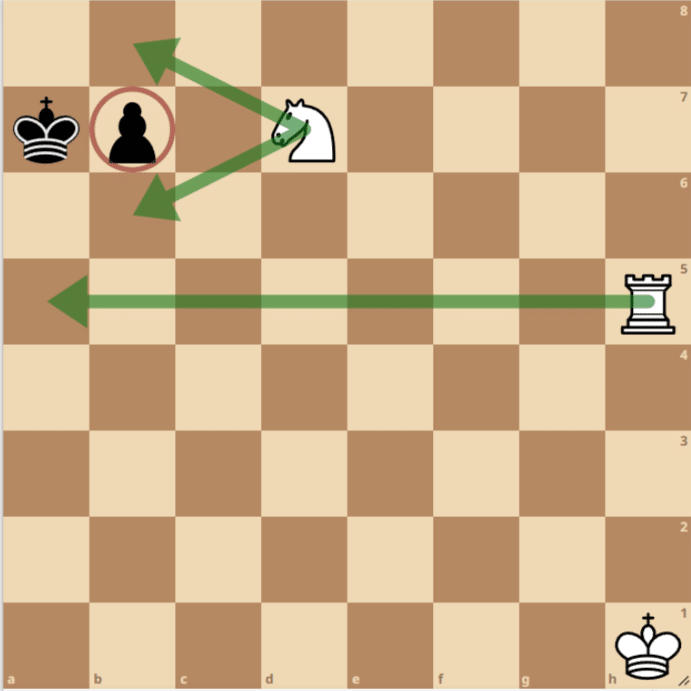
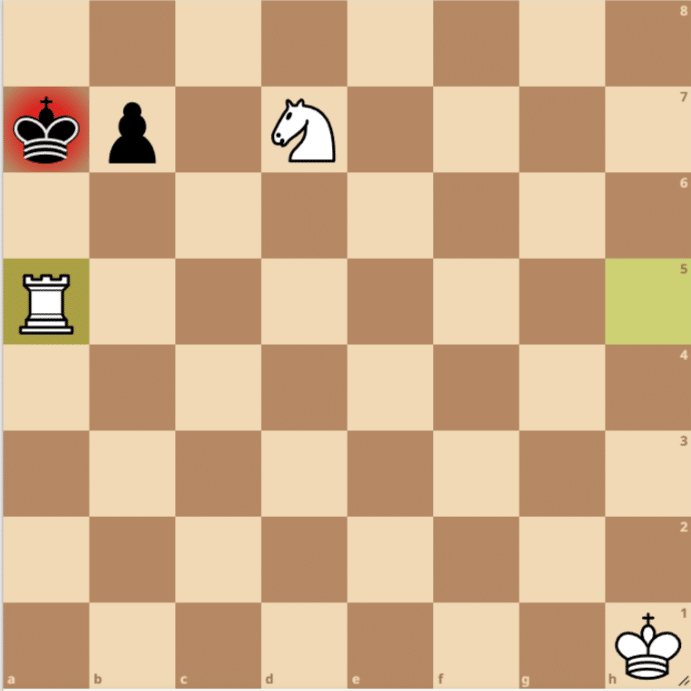
If you want to see more examples of this pattern, I explain it in detail in the Anastasia’s Mate article.
Anderssen’s Mate
Anderssen’s Mate carries the name of the great chess player Adolf Anderssen, famous for his brilliant combinations. The idea here is that a rook and a pawn coordinate to trap the enemy king. The pawn closes off the escape squares and the rook delivers the final blow.
A perfect demonstration that you don’t need powerful pieces to deliver mate: they just need to work together.
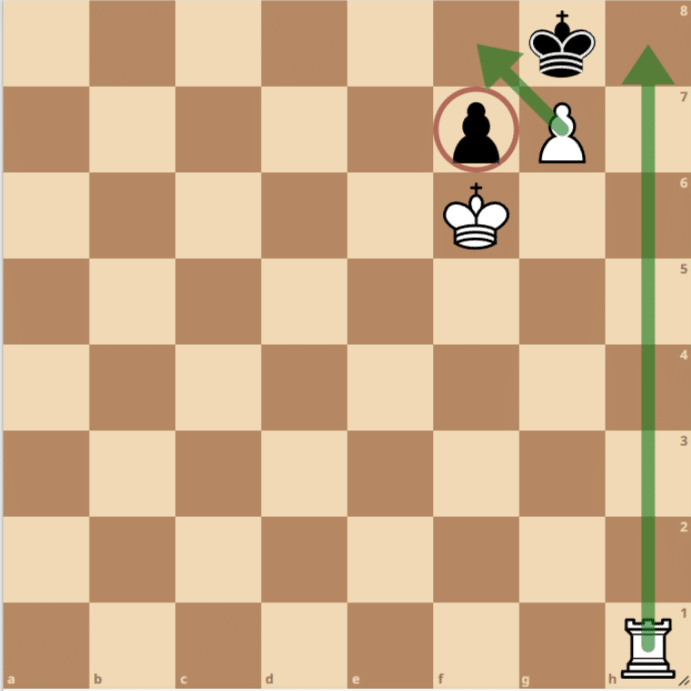
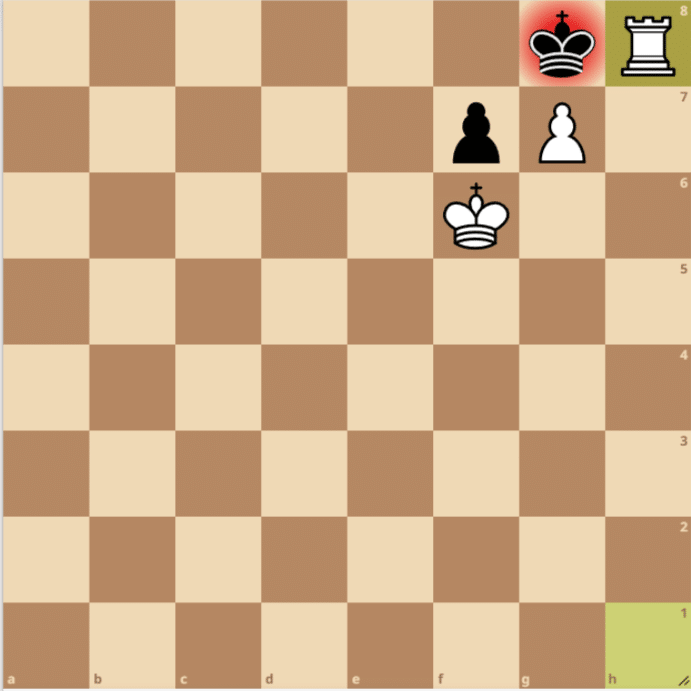
I go into more examples in the Anderssen’s Mate article.
Arabian Mate
The Arabian Mate is one of the oldest patterns in chess. The idea? A knight and a rook corner the king in a corner of the board. When the king reaches the corner, its movement options are minimal, and the knight — with its L-shaped move — covers exactly the squares the rook can’t cover.
It’s an elegant, precise pattern, and very hard to defend once it’s set up.
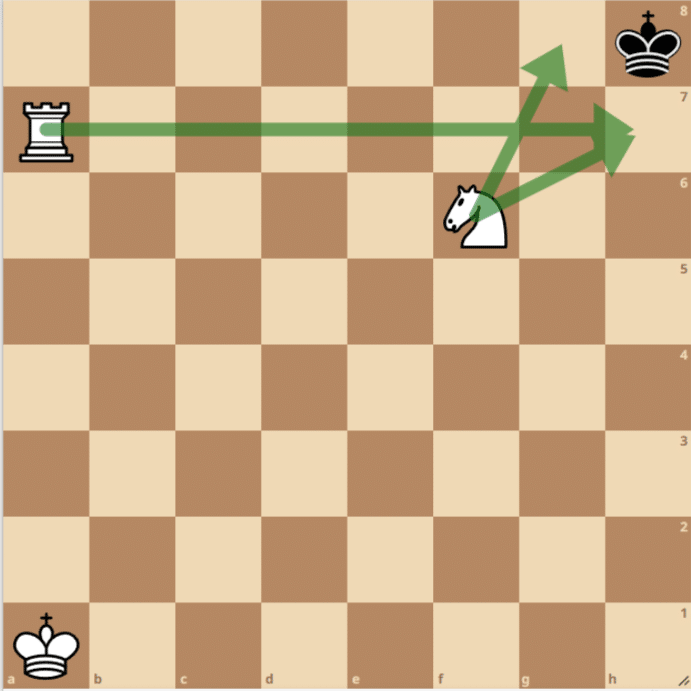
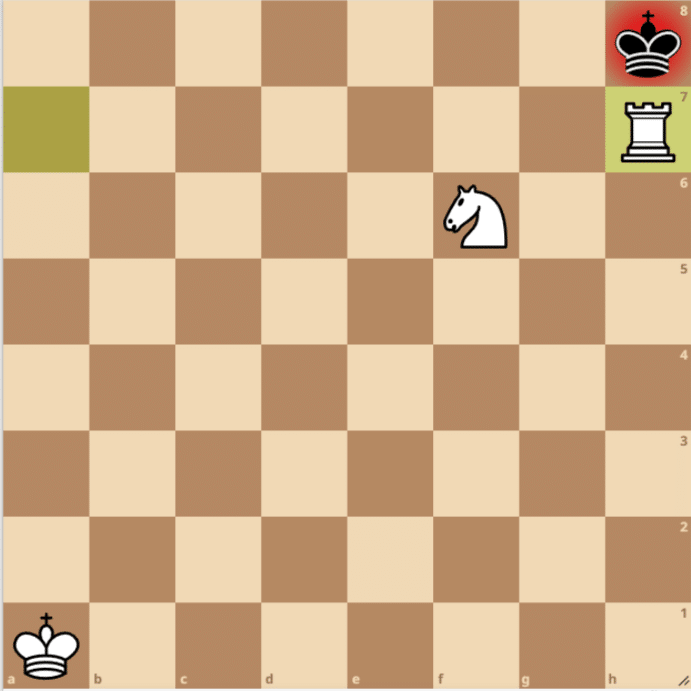
More examples in the Arabian Mate article.
Back-Rank Mate
This is the first one you should learn. Back-rank mate happens when the king is boxed in behind its own row of pawns and can’t move. A rook or queen enters the last rank and delivers checkmate. The king can’t move up because its own pawns prevent it.
Why is it called “back-rank”? Because the king is confined to that corridor between its pawns and the edge of the board. No way out.
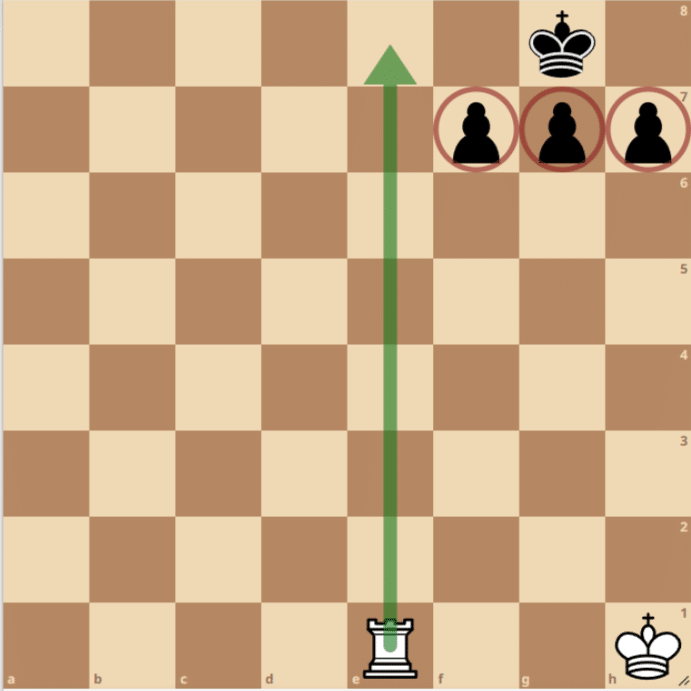
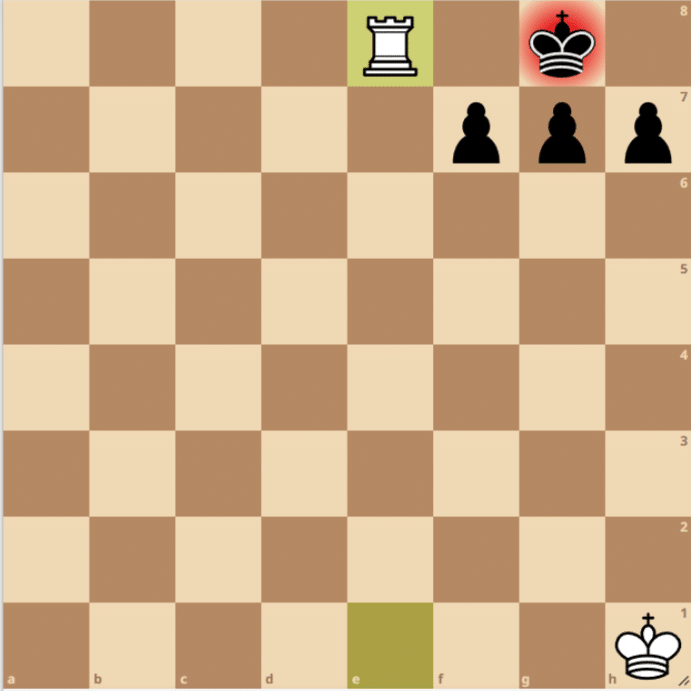
Everything about this pattern in the back-rank mate article.
Crossbow Mate
Crossbow Mate combines the queen and bishop to close the net on the enemy king. Don’t confuse it with Boden’s Mate: here the queen and bishop act on perpendicular lines and diagonals in coordination, forming that “crossbow” that fires at the king with no way to dodge.
It’s a lesser-known pattern, but very effective once you see it coming.
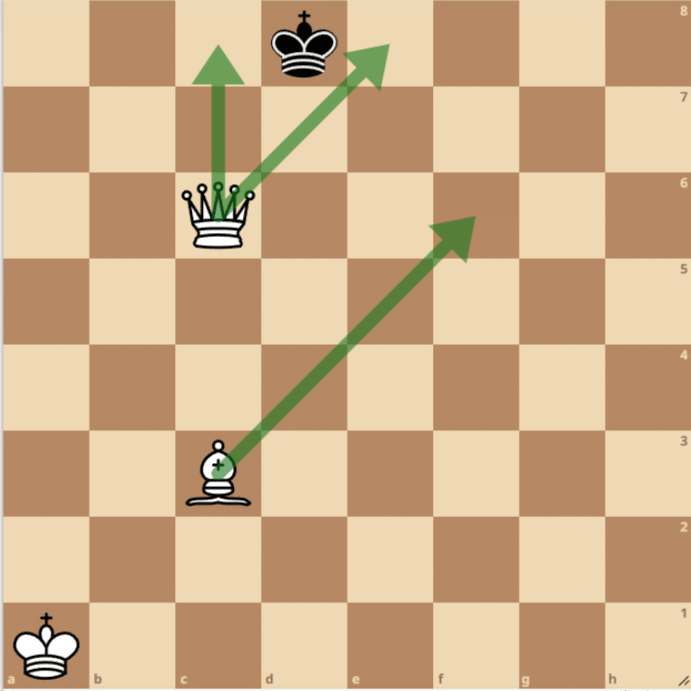
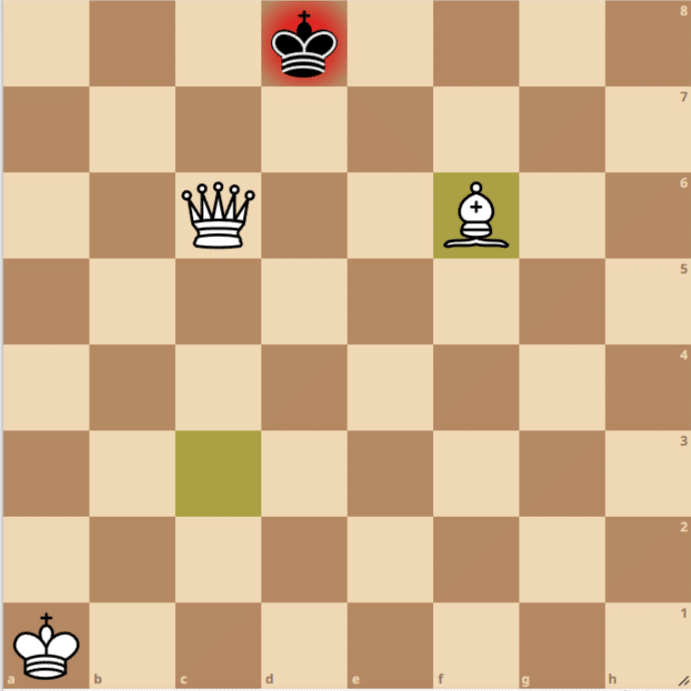
I’ll tell you more about this pattern in the crossbow mate article.
Blackburne’s Mate
Blackburne’s Mate carries the name of the English master Joseph Henry Blackburne, nicknamed “the Black Death” for his aggressive style. In this pattern, two bishops and a knight join forces to deliver mate to the enemy king. Three minor pieces that, well coordinated, can be devastating.
When you see your opponent’s king unprotected and those pieces available, remember this pattern.
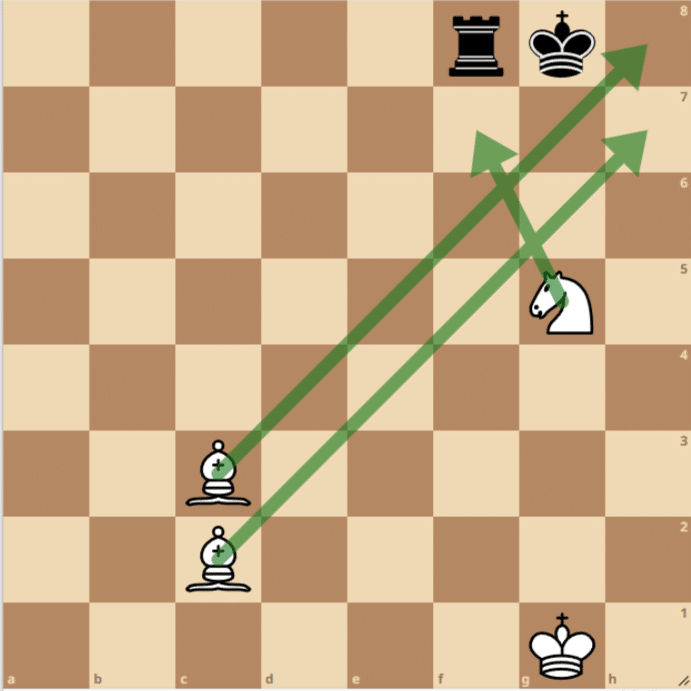
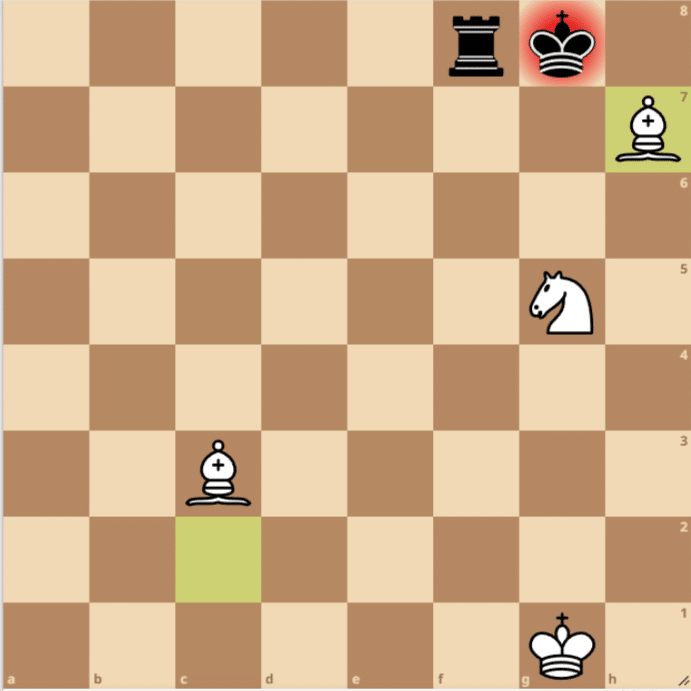
More examples in the Blackburne’s Mate article.
Blind Swine Mate
Blind Swine Mate shows the power of two rooks installed on the seventh rank. From there they wreak havoc: attacking pawns, limiting the king, and coordinating the final mate. The nickname “blind swine” comes from how destructive those two rooks can be moving along the seventh rank.
If you ever manage to place your two rooks on that rank, now you know what to look for.
Boden’s Mate
Boden’s Mate is one of the most spectacular in chess. Two bishops cross on opposite diagonals to deliver checkmate to the king. What makes it especially brilliant is that it often requires a prior queen sacrifice to open those diagonals.
Samuel Boden demonstrated it in 1853, and ever since this pattern has carried his name. A tactical gem.
Corner Mate
Corner Mate happens when the enemy king ends up trapped in one of the four corners of the board. A knight backed by the queen or rook delivers the final blow. The king in the corner only has two possible escape squares, and the knight — with its very special move — can cover them perfectly.
If you ever drive the enemy king into a corner, think of this pattern.
Epaulette Mate
Epaulette Mate is curious: the name comes from the shoulder decorations on military uniforms, which represent the rooks. The enemy king ends up trapped by its own rooks, and that situation allows a direct checkmate. A case where the opponent’s own pieces turn against them.
Cozio’s Mate
Cozio’s Mate demonstrates the mobility of the queen. The enemy king ends up boxed in among its own pieces, with no free squares, and the queen exploits that immobility to deliver mate. It’s a pattern of coordination and making the most of limited space.
Damiano’s Mate
Damiano’s Mate is pure tactics. It appears when there’s a pawn on g6 (for White) or g3 (for Black), and the queen reaches h7 (or h2) to deliver checkmate. What makes this pattern special is the sacrifice that usually prepares it: you often have to give up material to open the position and activate that queen-pawn combination.
Elegant, surprising, and very effective in fast games.
David and Goliath Mate
The story says it all: David, with a simple stone, defeats the giant Goliath. In chess, the David and Goliath Mate happens when a humble pawn delivers the final checkmate to the enemy king. A piece that seems insignificant at first can become the star of the finish.
Is there anything more motivating than winning with a pawn?
Greco’s Mate
Greco’s Mate carries the name of Gioachino Greco, one of the first chess analysts of the 17th century. In this pattern, a bishop and a rook work together to deliver mate to the king in the corner of the board. It’s a classic, very clean pattern in which the two pieces split the work: the bishop controls the diagonals and the rook acts on the ranks.
Hook Mate
Hook Mate is visual: the final position looks like a hook, hence the name. A pawn, a knight, and a rook join forces to deliver checkmate. It’s a good example of how pieces of different value can combine to achieve a result none of them could get alone.
Once you see it on the board, you’ll recognize it instantly.
Corridor Mate (Box of Death)
The queen and rook form a “box” that traps the enemy king with no exit. The Box of Death is a systematic pursuit: the major pieces keep shrinking the king’s space, rank by rank or file by file, until it has nowhere to go. Very useful in endgames with active major pieces.
Lawnmower Mate
Lawnmower Mate is exactly what it sounds like: two rooks, a rook and a queen, or two queens sweep the board rank by rank, like a lawnmower, until they trap the king. It’s the same principle as mate with two rooks against the king. Systematic, but effective.
Once you master this pattern, endgames with major pieces will become much simpler.
Lolli’s Mate
Lolli’s Mate is a very specific pawn-and-queen combination. The pawn advances to f6 (White) or f3 (Black) and blocks the long diagonal, controlling key squares. The queen then reaches h6 (or h3) and delivers checkmate. It looks simple, but it takes preparation. If your opponent doesn’t see it coming, it’s deadly.
Max Lange’s Mate
Max Lange’s Mate combines the queen and bishop to deliver mate to the enemy king. Max Lange was a 19th-century German master who contributed enormously to the study of openings and tactics. This pattern carries his name for the elegance with which he executed it.
Mayet’s Mate
Mayet’s Mate involves a bishop and a rook working together, but with an extra ingredient: the opponent’s own pawns limit their king’s movement. Carl Mayet was a master of the Berlin School in the 19th century. A perfect example of how the defender can become their own worst enemy.
Morphy’s Mate
Paul Morphy is considered by many the first modern genius of chess. The pattern that bears his name happens when a bishop and a rook deliver checkmate to the king in the corner of the board. Clean, direct, brilliant: everything Morphy was as a player.
Opera Mate
The Opera Mate is one of the most famous in history. Paul Morphy executed it in 1858 against the Duke of Brunswick and Count Isouard, in a box at a Paris opera house. Morphy sacrificed pieces without hesitation to activate his rooks and bishop, and delivered mate in just a few moves.
Notice how coordination between pieces can be more powerful than the amount of material.
Pillsbury’s Mate
Pillsbury’s Mate is very similar to Morphy’s Mate, with one key difference: here it’s the rook that delivers the final checkmate, not the bishop. Harry Nelson Pillsbury was a great American master of the late 19th century, famous for his tactical depth. A pattern worth comparing with Morphy’s to understand the differences.
Reti’s Mate
Reti’s Mate carries the name of the great Czech grandmaster Richard Reti. In this pattern, a bishop and a rook deliver checkmate by exploiting the limitations the opponent’s own pieces impose on their king. Reti was a hyper-positional player who understood the board like few others: it’s no surprise that this highly positional mate carries his name.
Hook (Coz) Mate
Hook (Coz) Mate is one of the most surprising in chess. The enemy king ends up completely surrounded by its own pieces, with not a single free square, and a knight delivers the final checkmate. Why is it called that in Spanish (“de la coz,” meaning “the kick”)? Because the knight strikes unexpectedly, like a kick.
It’s a perfect demonstration of the knight’s power in closed spaces.
Smothered Mate
Smothered Mate is possibly the most elegant of all. The enemy king is surrounded by its own pieces — literally smothered — and a knight delivers the final checkmate. There’s nothing the opponent can do: their own army has it locked in.
Can you believe you can lose because of your own pieces? With this pattern, yes.
Vukovic’s Mate
Vukovic’s Mate carries the name of the Yugoslav master Vladimir Vukovic, author of a classic treatise on chess attacks. The idea: a rook delivers checkmate to the king blocked on the edge of the board, helped by a knight and often a pawn. The opponent’s own pieces cover their escape squares.
A very practical pattern that appears frequently in real games.
Diagonal Back-Rank Mate
Diagonal back-rank mate is a variant of the back-rank mate. The difference is that here whoever delivers mate doesn’t act on a rank or file, but on a diagonal: it’s the queen or bishop that closes the net. The king remains trapped among its own pieces, but the blow comes along a diagonal instead of the last rank.
A pattern that shows the “corridor” can take many shapes.
Preguntas frecuentes
How many mating patterns are there in chess?
Theorists have cataloged more than 30 named checkmate patterns. The most important for any player are: back-rank mate, ladder mate, Boden's Mate, Anastasia's Mate, Legal's Mate, smothered mate, and Scholar's Mate.
Why is it important to learn mating patterns?
Recognizing a mating pattern lets you execute it (or avoid it) far sooner than calculating move by move. A player who knows the patterns reacts in seconds; one who doesn't may take minutes without ever seeing it.
What is the easiest mating pattern to learn?
The back-rank mate is the easiest because the idea is very simple: the rook enters the last rank when the king is blocked in by its own pawns. After that, Scholar's Mate and Legal's Mate are the most accessible for beginners.