How the rook moves in chess
The rook is one of the most powerful pieces on the board. It’s usually the last to enter play, but when it does, it changes the game. If you want to understand how the pieces move, the rook is one of the best starting points: its movement is simple and its impact is huge.
How does the rook move?
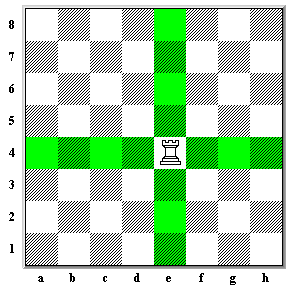
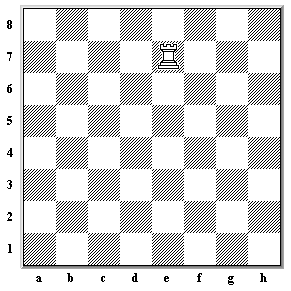
The rook moves in a straight line: horizontal or vertical, as many squares as you want. Forward, backward, left, or right. No distance limit. What it does have is an important restriction: it can’t jump over other pieces. If there’s a piece in its path, it stops there.
Look at the image: the rook marks all the squares it can reach from the center of the board.
When your own pieces block it
What happens if there are friendly pieces in its path? The rook can’t pass through. In the next diagram you’ll see how its range shrinks when white pieces close off some lines. It can only reach the highlighted squares.
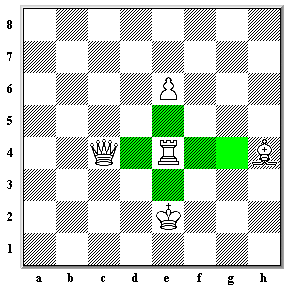
That’s why one of the big challenges with a rook is opening lines for it. The more open files and ranks it has, the stronger it becomes.
How does the rook capture?
Capturing works just like moving: the rook advances along its line to the square where the enemy piece stands, removes it from the board, and takes its place.
In the following diagram, White can capture the bishop with the rook. The rook moves to the bishop’s square and it disappears from the game.
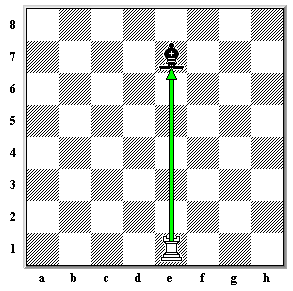
Here it is step by step: the rook captures the bishop and ends up exactly on that square.
What is the rook worth?
The rook is worth 5 points. For comparison: the bishop and knight are each worth about 3 points; the queen, 9. The rook sits in a middle spot, but a very relevant one. If you want a full comparison, I explain everything about piece values.
Why is it worth more than a bishop or knight? Because it controls entire lines of the board — files and ranks — from any position. A bishop, on the other hand, always stays on squares of the same color. The rook has no such limitation.
The rook is also the star of castling, the special move that lets you put your king safely away while activating a rook at the same time. It’s one of the most important moves of the opening: if you don’t know it yet, I’d recommend reading that article before moving on.
The rook in the endgame
When few pieces remain on the board, the rook shines especially bright. In rook endgames it’s essential to place it on open files, attack the opponent’s pawns, and coordinate with the king to achieve checkmate.
Once you master how it moves and grasp its value, you’ll understand why great players take such care of their rooks from the start of the game. Don’t worry if it seems hard to activate them at first: with practice, you’ll spot open lines almost without thinking.
Ready to continue? Let’s look at the next piece: the pawn, the most modest one… but the one with the most surprises.
Preguntas frecuentes
How does the rook move?
The rook moves any number of squares in a straight line: horizontal or vertical. It can't jump over other pieces.
What is the rook worth?
The rook is worth about 5 points, more than a bishop (3) or knight (3), but less than a queen (9).
What is castling?
A special move where the king moves two squares toward the rook and the rook jumps to the other side of the king. It's only possible if neither piece has moved before and the squares in between are free and unthreatened.