
Rules of chess: complete guide for beginners
Click any piece to see its legal moves highlighted.
Chess has a fascinating history that’s less well known than it seems. We know a few legends about the origin of chess: they all agree on placing its birthplace in Asia, in a very distant past. But what really matters to you right now isn’t the history — it’s learning to play. Let’s go through the most important rules of chess, step by step.
The rules of chess
The board
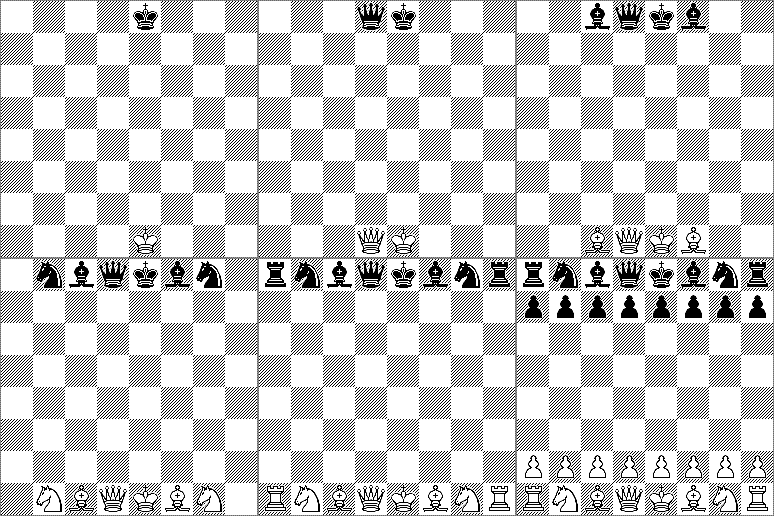
Everything starts with the chess board. It’s the battlefield where everything happens. It has 64 squares: 8 ranks and 8 files forming a large square. We call each of those squares a square. They alternate between light and dark, and that’s no coincidence: it helps you orient yourself and understand how pieces move.
The pieces
Each player controls an army of 16 pieces: 1 king, 1 queen, 2 rooks, 2 bishops, 2 knights and 8 pawns. One side plays White and the other Black. White always moves first. The color of your pieces determines your side; there are no exceptions.
Piece movement
Here comes the essential part: how each of the pieces moves. Let’s go through them one by one.
Pawn movement
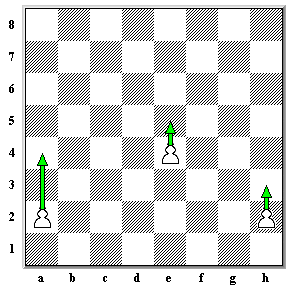
The pawn advances one square forward. Only on its first move can it advance two. It never moves backward. And there’s an important detail: the pawn doesn’t capture forward, but diagonally. To learn more about captures and promotion, check out the articles on how captures work and how to promote a pawn.
Rook movement
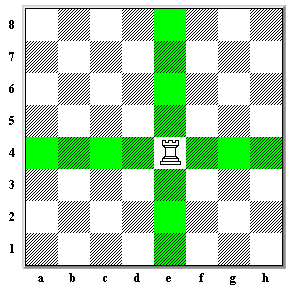
The rook moves in a straight line: horizontally or vertically, any number of squares, forward or backward. If there’s an enemy piece in its path, it can capture it by stopping on that square. More info on how the rook moves and how the rook captures.
Knight movement
The knight moves in an L-shape: two squares in one direction and one perpendicular. It’s the only piece that can jump over others. It changes the color of its square with every move. See it in detail in knight movement.

Bishop movement
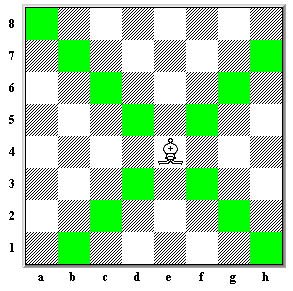
The bishop moves diagonally any number of squares. Each player has two bishops: one that always travels on light squares and another that always travels on dark squares. That’s why they can never meet. More on bishop movements.
Queen movement
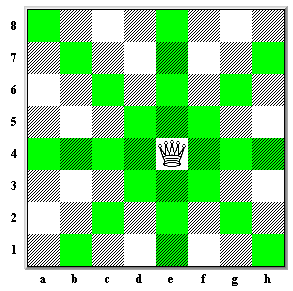
The queen is the most powerful piece on the board. Why? Because it combines the movement of the rook and the bishop: it moves in a straight line and diagonally, any number of squares. Use it carefully: losing it in the opening usually costs the game. More on queen movements.
King movement
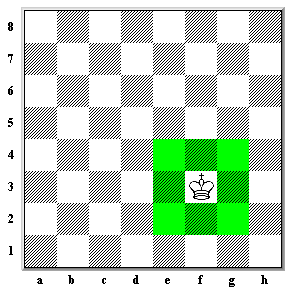
The king moves one square in any direction. Just one, but in any direction. It’s the most important piece on the board because if it’s caught, you lose. That’s why, as soon as it’s in danger, you must get it out of there immediately. Everything you need to know is in king movements, and later in the articles about check and checkmate.
Capturing
All pieces can be captured except the king. Its life is sacred: it’s never physically captured, but if you can’t get it to safety, you lose the game. That’s checkmate.
How does capturing work? Any piece that can move to a square occupied by an enemy piece can capture it, removing it from the board and taking its place. There’s one exception: the pawn, which only captures diagonally forward, not in the direction it advances. Also, the king can capture any enemy piece as long as that piece isn’t defended by another.
Practice two key rules
Knowing the theory helps, but these two rules stick much better once you play them out on the board: getting out of check and promoting a pawn.
You play White. The king on a1 is in check from the black rook on a2. Find the only legal move to get to safety.
You play White. Advance the pawn from a7 to a8 and complete the promotion. In most positions, promoting to a queen is the correct move.
If you want to go deeper into these two situations, check out the complete guides on illegal moves and pawn promotion.
Generic FIDE rules
Now let’s go through the chess rules written by FIDE, the international chess federation. These standards apply in any official tournament.
Moving the pieces
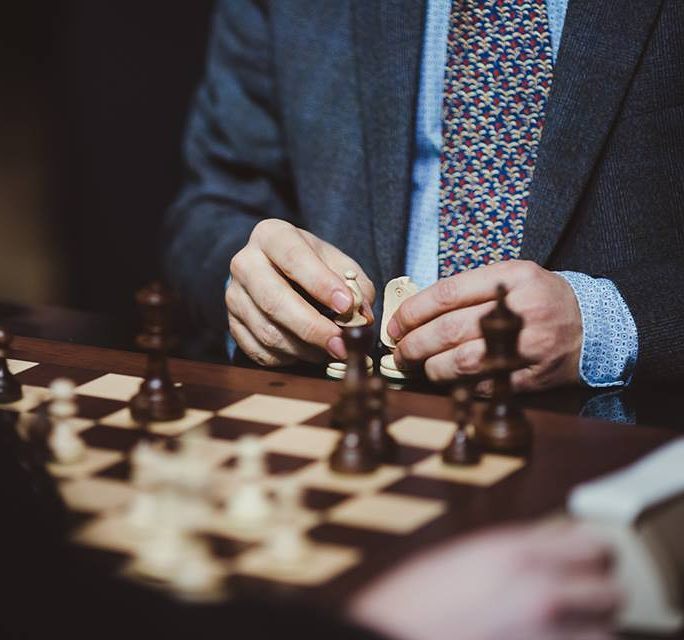
If you touch a piece intending to move it, you’re required to move it. If you touch an enemy piece, you must capture it if possible. There’s an exception: if you say “adjust” before touching the piece, you can reposition it without moving. Every move is made with one hand, and you must press the clock with that same hand.
Ending the game
Winning the game
You win the game in three ways:
- You give checkmate to the enemy king: the king is in check and can’t escape.
- Your opponent resigns.
- Their clock runs out.
Drawn game
Not every game has a winner. Draws are the tie result, and they can happen for several reasons:
- Stalemate: your opponent has no legal move and their king isn’t in check. This is called stalemate and it’s a draw, not a win.
- Dead position: neither side has enough material to deliver checkmate (for example, king and knight versus king).
- Mutual agreement: both players can agree to a draw at any time.
- The 50-move rule: if no piece has been captured and no pawn moved in the last 50 moves, either player can claim a draw.
- Threefold repetition: if the same position occurs three times, the game is a draw.
Competition rules
The chess clock
The chess clock has two connected displays: when one runs, the other is paused. Every time you move, you press the clock with the same hand. Each display has a flag: if yours falls, you lose on time.
The clock is usually placed to the right of Black, although the arbiter can change this.
Irregularities
If a piece is displaced from its square during the game, the position must be restored to before the irregularity. If it can’t be determined what it was, play continues from the last identifiable position. The arbiter can penalize the responsible player.
Points
The scoring system is simple:
- Win: 1 point
- Loss: 0 points
- Draw: ½ point for each player
Player conduct
During the game it’s forbidden to consult notes, electronic devices, or receive outside advice. You also can’t distract or bother your opponent. Leaving the playing area requires the arbiter’s permission.
Nowadays, carrying a switched-on phone into the playing venue can directly result in losing the game.
FIDE 2024 rules
To stay up to date on the full rulebook and its yearly updates, you can visit the FIDE website. We’ve provided the updated FIDE 2024 rulebook in PDF.
Once you master these basic rules, the next step is learning to record your games with algebraic notation. That way you can study your mistakes, follow grandmaster games, and improve much faster.
Going to play in a club or tournament? There’s a handful of extra rules that don’t show up online and are worth knowing: the touch-move rule, how to claim a draw, what happens with an illegal move, how to use the clock… I cover them all in the guide to physical and tournament chess rules and, on what’s expected of you at the board, in how to behave in chess and its traditions.
Preguntas frecuentes
How do you play chess?
Chess is played between two players on an 8x8 board. White moves first. Each piece moves differently. The goal is to checkmate the opponent's king.
How many pieces does each player have in chess?
Each player starts with 16 pieces: 1 king, 1 queen, 2 rooks, 2 bishops, 2 knights and 8 pawns.
What is check in chess?
Check is when the king is directly threatened by an enemy piece. Upon receiving check, the player must get out of it on the next move: by moving the king, blocking the attack, or capturing the attacking piece.
When does a chess game end?
The game ends by: checkmate (the king can't escape check), a draw (stalemate, repetition, mutual agreement, insufficient material) or a player's resignation.
What is castling in chess?
Castling is a special move in which the king moves two squares toward a rook and the rook jumps to the other side. It's only possible if neither the king nor the rook has moved before and the king isn't in check.
What is en passant capture?
En passant capture allows you to capture an opponent's pawn that just advanced two squares, as if it had only advanced one. It can only be done on the very next turn after the advance.