
Semi-closed Openings: 1.d4 with Nf6 — Indian defenses and more
What is a semi-closed opening?
Imagine you’re playing Black and your opponent opens with 1.d4. The most direct reply would be 1…d5, also occupying the center with a pawn. But there’s another philosophy: don’t dispute the center right now, but surround it and attack it with pieces. That’s exactly what semi-closed openings do.
Instead of playing d5, Black replies with 1…Nf6: the knight comes into play and starts pressing e4 right away. It’s a hypermodern approach: give up the center to your opponent so you can later tear it down.
Why does it work? Because a big pawn center is strong, but it’s also a target. If Black manages to attack it at the right moment, that center turns into a weakness.
What are the semi-closed openings?
Let’s organize them into two groups. The first, and richest, is the family of Indian systems: everything that starts with 1.d4 Nf6. From there, dozens of variations sprout with very different characters.
Semi-closed openings: d4 Nf6
These are all the ones where Black replies to 1.d4 with 1…Nf6. A single move that opens the door to a huge world of possibilities.
Benko Gambit or Volga Gambit
The Benko Gambit, also called the Volga Gambit, is one of the most creative ideas in this group. Black sacrifices the b5 pawn in exchange for opening files and diagonals on the queenside. They’re not looking to recover the pawn right away: they’re after an initiative that can last the whole game.
It’s a perfect opening if you like applying constant pressure and making your opponent feel uncomfortable from the start.
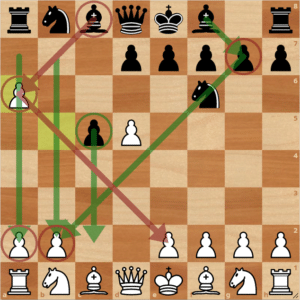
If you want to learn more about this opening, you can go to “Learn the Volga Benko Gambit”.
Besides the Benko Gambit, we have all these openings that we’ll keep covering little by little:
- Benoni Defense (modern / Indo-Benoni)
- Budapest Defense
- Catalan Opening
- Nimzo-Indian Defense
- Queen’s Indian Defense
- Blumenfeld Counter Gambit
- Bogo-Indian Defense
- Döry Defense
- Neo-Indian Attack
- Old Indian Defense
- Grünfeld Defense
- King’s Indian Defense
- Mexican Defense
- Torre Attack
- Trompowsky Attack
Other semi-closed openings
Outside the 1…Nf6 universe there are more semi-closed systems. Some are rare, others have their fans. Here’s the list so you know the full picture:
- Polish Defense
- Englund Gambit
- English Defense
- Keres Defense (Kangaroo Defense)
- Old Benoni Defense
- Wade Defense
- Dutch Defense
- Queen’s Knight Defense
Preguntas frecuentes
What are semi-closed openings?
Semi-closed openings are replies to 1.d4 where Black doesn't immediately play d5, but starts with Nf6 (or, in some cases, g6 without Nf6). They include the Indian defenses — King's Indian, Nimzo-Indian, Grünfeld, Queen's Indian — and the Benko/Volga Gambit.
What's the difference between semi-closed and closed openings?
In pure closed openings (1.d4 d5), both sides occupy the center with pawns. In semi-closed openings (1.d4 Nf6), Black doesn't dispute the center directly with pawns but attacks it with pieces — a hypermodern approach.
Which semi-closed opening is best to start with?
The Nimzo-Indian Defense (1.d4 Nf6 2.c4 e6 3.Nc3 Bb4) is the most recommended for intermediate players: the idea is clear (pin the knight) and the positions are balanced. The King's Indian (3...g6 4.e4 d6) is more tactical and a favorite of attacking players.