The Double Check in Chess: the most powerful tactic
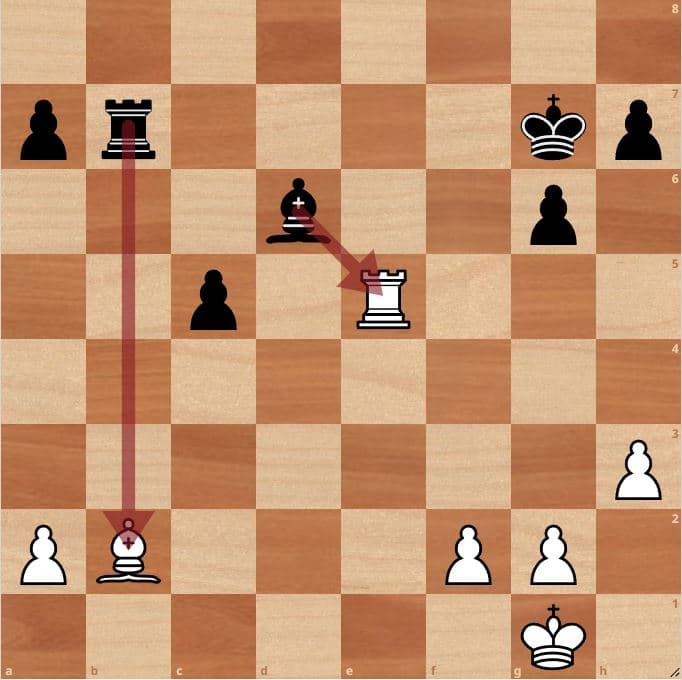
The double check is the most powerful tactic that exists in chess. Let me be blunt: when the king is attacked by two pieces at once, there’s no escape possible from either of them. The king must move, no exceptions. And when it moves, it often falls directly into checkmate.
Why the double check is unstoppable
Let’s see why this move is so devastating. Against a normal check you have three options:
- Move the king to a safe square.
- Block the check by interposing a piece between the attacker and the king.
- Capture the piece giving check.
And against a double check? You only have one: move the king. Think about it: you can’t block two checks at the same time, because on each turn you only move one piece. And you can’t capture two attackers in one blow. If the king has no escape squares, it’s immediate checkmate.
The mechanism of the double check
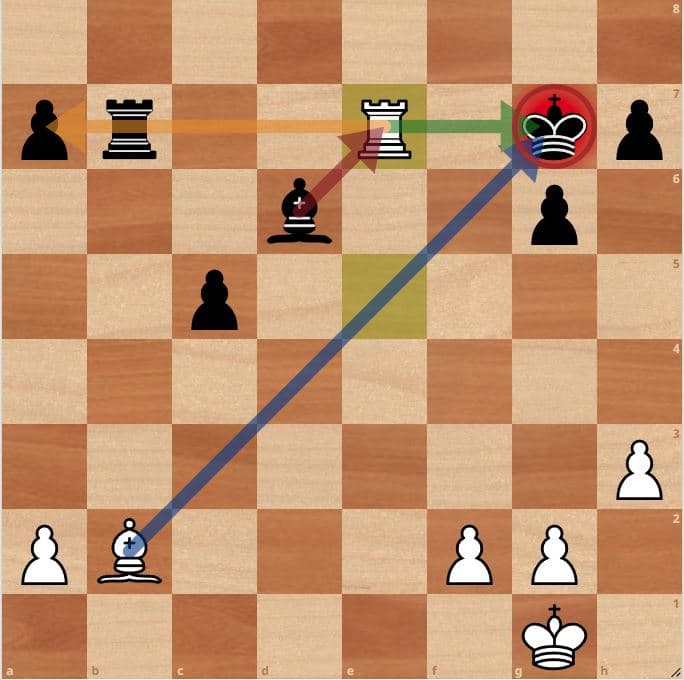
Notice how it’s produced. A double check always comes from a discovered attack: a piece moves and unmasks the attack of a second piece that was behind it. If the piece that moves also gives check on its own, you have a double check. Two attackers in a single move.
You play White. The knight on e4 blocks the rook on e1, which points at the black king on e8. Move the knight to d6: the knight attacks e8 with its L-shaped move AND the rook is free to attack e8 along the e-file. Double check!
Why d6 creates the double check
After Nd6 (the knight jumps from e4 to d6), two things happen at once:
- Check from the knight: Nd6 attacks e8 through its L-shaped move (+1 file +2 ranks = e8 ✓)
- Check from the rook: Re1 now has the e-file open all the way to e8, where the king is ✓
- Double check confirmed: two pieces attack the king on e8 simultaneously
- The king can’t block either of the two checks
- The king must move (to d7, d8, or f8 — f7 is also covered, by the knight on d6 — and on the next move, the attacker can deliver mate or win decisive material)
Do you see the elegance? With a single move you’ve created a hopeless situation.
Historical examples of the double check
The double check appears in some of the most brilliant combinations in history. Let me tell you about two that will stick with you.
Morphy and the devastating double check
Paul Morphy, the first tactical genius of modern chess, repeatedly used the double check to annihilate his opponents. In his famous “Opera Game” (Paris, 1858), the final mate was only possible thanks to a sequence that included a double check. A lesson in how active pieces trump raw numbers.
The double check and the smothered mate
One of the most elegant combinations you’ll ever see: a queen sacrifice to trap the king with its own pieces, followed by a knight double check that delivers mate. The king can’t escape because its own pieces block every square. Once you master this, you’ll be able to spot this kind of finish several moves in advance.
How to create a double check
To set up a double check you need three ingredients. Let’s go one by one:
- An active piece (bishop, rook, or queen) pointing at the opponent’s king but blocked by one of your own pieces.
- The blocking piece that can move to a square from which it ALSO attacks the king.
- A destination square where the moving piece gives check as it moves.
The most classic combination is knight + rook: the knight blocks the rook’s file; when it jumps and gives check, the rook also attacks the king. A perfect double attack with a single move.
Warning signs: when a double check might be possible
How do you know when to look for it? Here are the three key signs:
- You have a rook or bishop pointing toward the opponent’s king, with one of your own pieces in between.
- That intermediate piece can move to a square that gives check.
- The opponent’s king has few escape squares.
When you see these three conditions together, stop and look for the double check. It could be the winning move you were looking for. Once you learn to spot it, you’ll find it in far more games than you’d expect.
Related tactics: The Discovered Attack · The Smothered Mate · The Fork
Preguntas frecuentes
What is a double check in chess?
A double check is when the king is put in check by two pieces at the same time in a single move. This happens when a piece moves and 'unmasks' the attack of a second piece that was behind it (a discovered attack on the king). The king can't block two checks at once — it can only move.
Why can't a double check be blocked?
Because to block a check you need to interpose a piece between the king and the attacker. But with two pieces attacking simultaneously, you'd need to interpose TWO pieces on the same turn — which is impossible (only one piece can move per turn). The only defense is to move the king.
Does a double check always lead to checkmate?
Not always, but often yes. When the king has few escape squares, the double check can be immediately decisive. The move that delivers the double check is usually the second-to-last move before mate, because the king, after moving, ends up on a square where the next move delivers mate.
What's the difference between double check and discovered double check?
They're synonymous terms. The double check (also called a discovered double check) always involves two pieces attacking the king simultaneously, the product of a move where one piece moves and unmasks the check of another.