The Pin in Chess: the piece that can't move
The pin is one of the most powerful tactics you’ll find on the board. I’ll show you now, and once you master it, you’ll start seeing it everywhere.
The idea is simple: an opponent’s piece is “pinned” to its square because if it moves, it exposes a more valuable piece — or the king itself. The pinned piece loses all its effectiveness. It can’t advance. It can’t attack. It can’t defend. It’s trapped.
The mechanics of the pin
How does a pin happen? You need three elements in a straight line:
- A pinning piece — the bishop, rook, or queen, which are the ones that attack in a line.
- A pinned piece — any opponent’s piece standing in front.
- A more valuable piece — or the king — behind the pinned piece.
Notice this: the pinning piece attacks the pinned piece. If the pinned piece moves, the pinning piece attacks the valuable piece that was behind it directly. The opponent doesn’t want that. That’s why it doesn’t move. That’s why it’s pinned.
The absolute pin: the most powerful
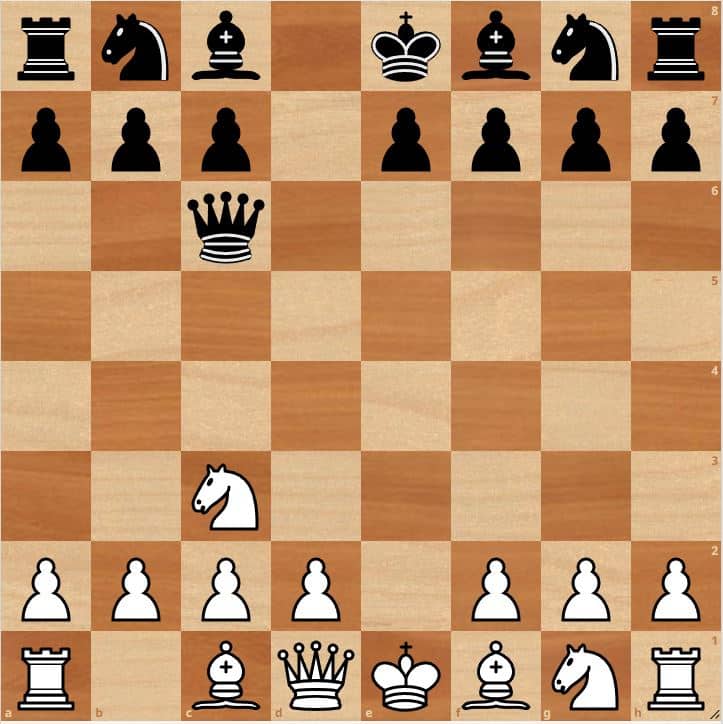
In the absolute pin, the piece behind is the king. And here’s where it gets interesting: since the king can never be left in check, the pinned piece can’t move at all. Doing so would be an illegal move.
Let’s practice it directly with a real example.
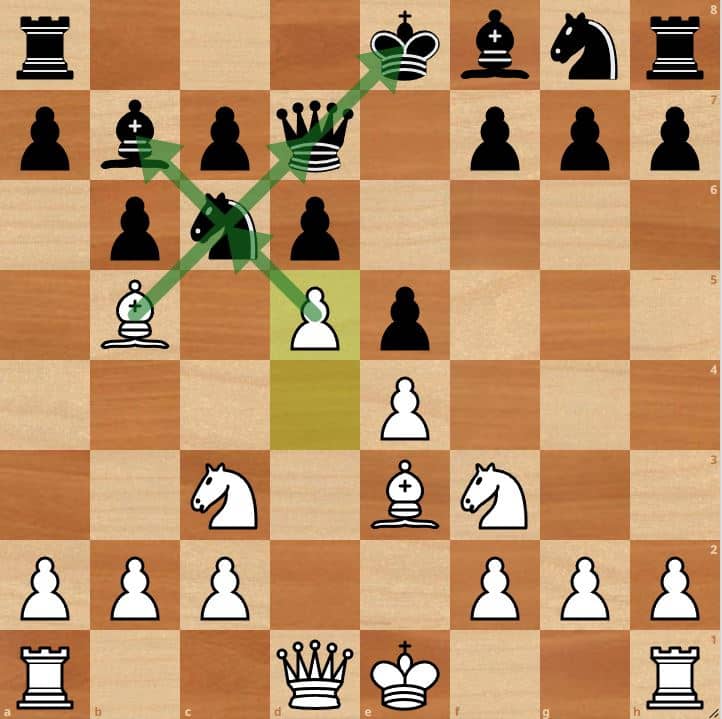
You play White. The bishop on b2 pins the black knight on e5 to the black king on h8: the knight can't move without leaving the king in check. The white knight on f3 can capture the pinned piece without it being recaptured.
Why the black knight can’t recapture
After Nxe5 (the white knight captures on e5), why can’t the opponent recover the knight? Here’s the key:
- The black knight was pinned by the bishop on b2 to the king on h8, along the b2-e5-h8 diagonal.
- If the black knight had recaptured, the king on h8 would be left in check from the bishop on b2 — with the b2-c3-d4-e5-f6-g7-h8 diagonal now open.
- Since the king can’t be left in check, the black knight CANNOT recapture.
- White wins a knight — 3 points — with no compensation for the opponent.
That’s the absolute pin in action. Free material thanks to a piece that can’t move.
The relative pin
The relative pin works the same way, but the piece behind isn’t the king but a valuable piece — the queen or a rook.
Technically the pinned piece can move. But if it does, the opponent loses that valuable piece. And that’s almost always very costly.
A classic example: white rook on e1, black knight on e5 “pinned” to the black queen on e8. The knight can move, yes — but as soon as it does, the rook takes the queen on e8. The opponent knows this. That’s why the knight stays put.
How to exploit a pin
You have one of the opponent’s pieces pinned on the board. Now what? Let’s look at the most effective ways to capitalize on it.
1. Attack the pinned piece with lower-value pieces
A pinned piece can’t escape. So you can attack it with a pawn or a less valuable piece, knowing the opponent can’t respond by moving it. Many times material is surrendered with no way to stop it.
2. Pile up more attackers than the opponent can defend with
Do you have two attackers on the pinned piece while the opponent only has one defender that can’t move? You win material without hesitation.
3. Double the pressure with bishop and queen
When the bishop and queen attack the same pinned piece together, the pressure becomes irresistible. It’s one of the most common combinations for finishing off a positional advantage.
How to defend against a pin
Now let’s go to the other side of the board. What do you do when you’re the one who’s pinned?
| Method | When to use it |
|---|---|
| Move the piece behind (the king or the valuable piece) | When you have time and the gained material is worth the maneuver |
| Interpose another piece | When you can put something between the bishop/rook and the pinned piece |
| Attack the pinning piece | With a lower-value piece to force it to leave |
| Break the diagonal/file | With a pawn advance or another positional resource |
Remember not every pin is fatal. Many times you can break it with one of these ideas. What matters is that you don’t ignore it — an ignored pin turns into lost material.
Related tactics: The Fork · The Skewer · The Discovered Attack
Preguntas frecuentes
What is a pin in chess?
A pin is a tactic where an opponent's piece is immobilized because if it moves, it exposes a more valuable piece (or the king) to a direct attack from the attacking piece. The attacking piece (bishop, rook, or queen) 'pins' the defending piece in place.
What's the difference between an absolute pin and a relative pin?
In an absolute pin, the pinned piece can't move under any circumstance because it would expose the king to check (an illegal move). In a relative pin, the pinned piece can technically move, but doing so exposes a more valuable piece (queen, rook) that you don't want to lose.
Which pieces can execute pins?
Only pieces that attack in a straight line or diagonal can create pins: the bishop (diagonals), the rook (ranks and files), and the queen (any direction). The knight can't create pins because its L-shaped move can't 'pass through' a piece.
How do you break a pin?
There are several ways to break a pin: 1) Move the more valuable piece behind it. 2) Interpose another piece between the pinning piece and the pinned one. 3) Attack the pinning piece with a lower-value piece to force it to move or be captured. 4) If the pinned piece is the castled pawn, advance a pawn to kick out the pinning bishop.