
The Decoy in Chess: lure the opponent to their doom
The decoy — also known as attraction — is one of the most spectacular tactics in chess. Both terms describe exactly the same thing: you offer something — usually a sacrifice — to force an enemy piece to land on the square you want. Once it’s there, you exploit it with a second tactic. The opponent takes the bait and falls into the trap.
Does it sound like fishing? Because that’s exactly what it is. You cast the bait, the fish bites, and you reel in the line.
How the decoy works
The mechanism has two stages:
- The attraction sacrifice (the bait). You offer a piece on a key square. The opponent captures it — because it’s free, because it’s check, or because they have no other option. It looks like a gift, but it’s a trap.
- The exploitation (the blow). Once the enemy piece is on that square, you execute the real threat: a fork, a pin, a discovered check, a mate, or any other winning combination.
The magic is that the opponent has no choice. If the sacrifice comes with check, they have to respond to the check. If the offered piece attacks something vital, they have to capture it. And by doing so, they fall exactly where you wanted them.
The tactical structure of the decoy
Every well-built attraction has three elements:
| Element | What it is |
|---|---|
| The sacrificed piece | What you offer the opponent to lure their piece |
| The lured piece | The king, queen, or another piece that captures and moves to the trap square |
| The final blow | The tactical idea that activates once the piece is on the trap square |
Without all three elements, there’s no decoy. Only when all three fit together is the combination perfect.
The king decoy
The most common case. You sacrifice a piece with check to force the king to move to a square where it becomes exposed. Let’s look at the most common combinations:
Decoy + knight fork
You sacrifice the queen on a square adjacent to the king. The king captures it. And then your knight jumps to the fork square, attacking the king and another valuable piece at the same time. The king has to move, and you capture the piece left exposed.
Decoy + mate
You sacrifice a piece to pull the king out of its castled position. Once in the open, the king is exposed to a mating attack with your remaining pieces. Many of the most famous mates in history began with a decoy.
Decoy into a pin
You offer material so an enemy piece lands on a line where it becomes pinned. For example: you sacrifice a pawn so the enemy knight captures and ends up on the same diagonal as its king, where your bishop pins it.
Classic example: attraction with discovered check
Look at this example that perfectly illustrates how the decoy works:
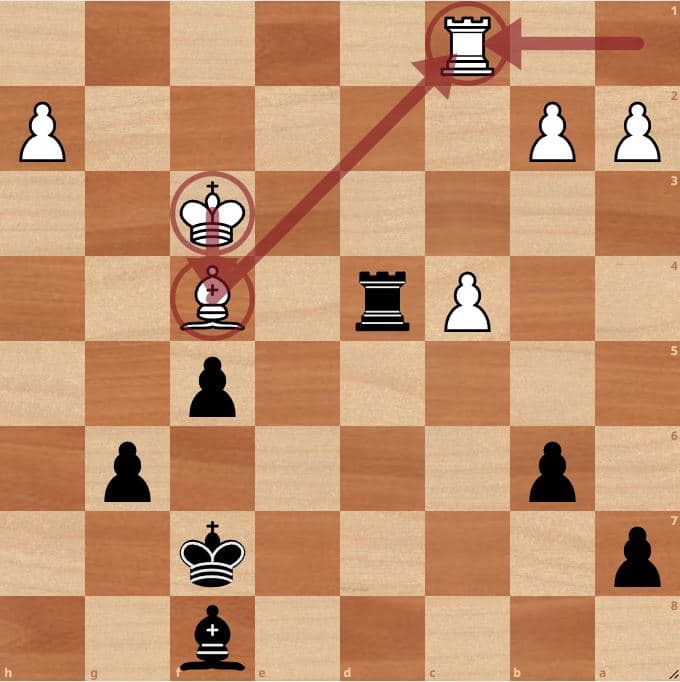
Black has a tactical idea: if they manage to lure the white king to f4, they can give check with the bishop on h6 and win the white rook on c1 with the discovered attack.
How do they achieve it? With a rook sacrifice:
1… Rxf4!
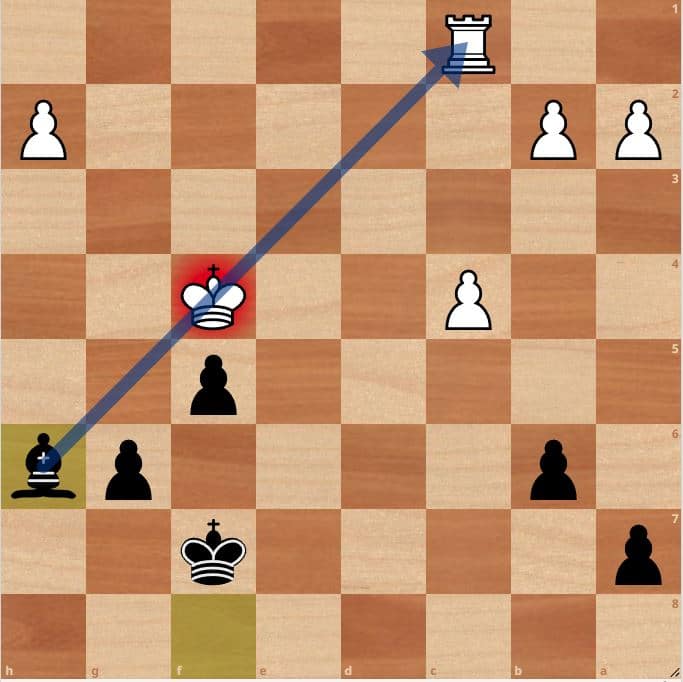
The white king takes the rook with 2. Kxf4 (no choice if it wants to win material). But now it’s exactly where Black wants it:
2… Bh6+
The bishop gives check to the king on f4 and at the same time reveals the black rook’s attack on the white rook on c1. The king has to move (3. Kf3) and Black captures the rook: 3… Bxc1.
Result: Black won the white rook with a rook sacrifice and a discovered check. The king was lured to f4 to make all of this possible.
The signs of a decoy
How do you detect a decoy in the position? Look for these clues:
- A key square is empty. If you see that a specific square would be perfect for executing a fork or a mate, ask yourself: can I force the opponent to go there?
- Your knight has a potential fork square. You just need the king or a valuable enemy piece to reach the right square.
- The enemy king is near dangerous squares. If the king is one step away from becoming exposed, a sacrifice with check could be the push it needs.
- You have a “spare” piece. A piece you can sacrifice without losing the game, because what you gain afterward more than compensates.
- Poorly positioned enemy pieces — especially kings in the center or uncoordinated queens. Ask yourself: what would happen if that piece were on another square? If the answer is “I win it with a fork or a discovered attack,” you have the clue.
Why the decoy is so effective
The decoy works because it exploits greed. When the opponent sees they can capture material, in many cases they do it without properly calculating the consequences. And at that moment, the trap closes.
This makes it especially dangerous in fast and blitz games, where there’s less time to calculate the consequences of an apparently obvious capture.
The art of calculating the decoy
The decoy requires foresight. It’s not enough to see that you can sacrifice a piece — you have to see what happens after the sacrifice. And that requires concrete calculation.
Step 1: Identify the target square. Where do you want the enemy piece to be?
Step 2: Can you force it there? With check? With a threat it can’t ignore?
Step 3: What happens next? Do you have the tactic ready to exploit the new position?
If all three steps work, you have a decoy. If any of them fails, don’t sacrifice — look for another idea.
Famous decoys in history
The great masters have built immortal games with decoys. The queen sacrifice to lure the king to a mating square is a recurring theme in the games of Mikhail Tal, Bobby Fischer, and Garry Kasparov. Every time you see a spectacular sacrifice in a masterful game, ask yourself: was it a decoy? Often the answer is yes.
The key to mastering the decoy is practicing tactical vision. The more tactics exercises you solve, the faster you’ll spot the trap square and the sacrifice that leads the opponent there.
Related tactics: The Fork · Deflection · The Pin · The Discovered Attack · The Skewer
Preguntas frecuentes
What is a decoy or attraction in chess?
The decoy (also called attraction) is a tactic that forces an enemy piece to move to a specific square where it becomes vulnerable. It's usually achieved with a sacrifice: you offer a piece that the opponent is forced to capture, and by doing so falls into a trap (fork, pin, mate, or another combination).
What's the difference between a decoy and deflection?
A decoy attracts an enemy piece TOWARD a specific square where it will be exploited. Deflection pulls a defending piece AWAY FROM the square it defends. The decoy says 'come here,' deflection says 'get out of here.' They're complementary tactics.
Why does the decoy usually require a sacrifice?
Because nobody voluntarily moves a piece to a dangerous square. To force the opponent to go where you want, you need to offer them something irresistible — usually a sacrificed piece they can't refuse (because it's a capture with check, or because the material is too tempting).
Which pieces are usually used as 'bait' in the decoy?
Any piece can be the decoy, but it's most common to sacrifice a rook or a bishop to lure the opponent's king or queen to a square where it's left defenseless. The king is the most frequent target because once it's lured in, the next move can be checkmate.
How do you recognize a decoy opportunity?
Look for situations where the opponent's king or queen can be moved to a square they wouldn't normally visit. If you have a piece you can sacrifice on that square, and the opponent's capture creates a winning threat (discovered check, fork, mate), you have a decoy.