
Controlling the center in chess: dominate e4, d4, e5 and d5
Why do masters fight so hard over four squares in the middle of the board? Because whoever controls the center controls the game. It’s the first principle of strategy, and today I’ll show you how to apply it.
What the center is
The center is four squares: e4, d4, e5 and d5. Right at the heart of the board. Around it sits the extended center (from c3 to f6), which also matters, but the four in the middle are what truly counts.
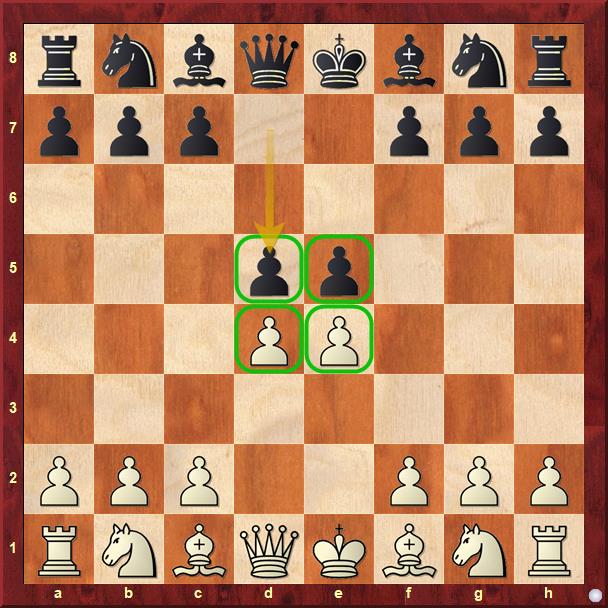
Keep this image in mind: the center is a crossroads. Whoever dominates it decides which way the traffic flows.
Why it matters so much
Let’s get to the underlying reason, and then look at an example.
A piece in the center reaches more squares and gets to any part of the board faster. Look at the knight:
- In the center (say, on e5) it controls eight squares.
- In a corner (on a1) it controls only two.
The same piece is worth four times as much just because of where it stands! That’s true for almost all pieces: a centralized bishop sweeps both long diagonals; the queen in the center threatens in every direction. That’s why we say the center gives mobility and space, while also taking room away from the opponent to maneuver.
How to control the center
There are three ways, and it’s worth combining them:
- Occupy it with pawns. A pawn on e4 or d4 plants your flag in the center and takes squares away from enemy pieces.
- Support it with pieces. Occupying isn’t enough: if nobody defends that central pawn, the opponent knocks it down. Develop your knights and bishops aiming at the center.
- Pressure it from a distance. You don’t always need to occupy it with pawns. You can watch it from afar with a fianchetto and strike later. That’s the modern idea you’ll see in the Grünfeld Defense or the King’s Indian.
Practice: plant and strike the center
Let’s see it on the board. Play White: occupy the center with a pawn, develop the knight aiming at the center, and strike again with the second pawn.
You play White. Occupy the center with e4, develop the knight to f3 (attacking e5), and strike the center again with d4.
See the idea? You didn’t just bring pieces out: every move contested the center. That’s the difference between developing for the sake of it and developing with a plan.
Mistakes that cost games
When you’re starting out, it’s easy to forget about the center. These are the most common slip-ups:
- Bringing the queen out too early. It looks active, but the opponent chases it with pieces that also happen to occupy… the center.
- Pushing flank pawns during the opening (like a4 or h4) while the center goes unattended. Every move counts: spend it in the middle, not on the edges.
- Moving the same piece twice in the opening instead of developing a new one toward the center.
A simple rule for your first moves: does this move contest the center or help a piece do so? If the answer is no, think twice.
The center, the foundation for everything else
Control of the center isn’t an isolated trick: it’s the ground on which a good opening and a good middlegame are built. From here come space, initiative, and often tactical combinations, because the side with more space coordinates its pieces better.
Once you master this idea, you’ll look at every game differently. Before thinking about attacking, you’ll ask yourself: who commands the center? And almost always, the answer will tell you who’s winning.
Useful links
Preguntas frecuentes
Which are the central squares in chess?
The center is formed by four squares: e4, d4, e5 and d5. Around them there's an extended center (from c3 to f6) that also matters. Whoever commands those squares usually commands the game.
Why is controlling the center so important?
Because from the center your pieces reach more squares and move from one flank to the other in fewer moves. A centralized piece is worth more than the same piece stuck in a corner, and your opponent has less room to maneuver.
Do you always have to occupy the center with pawns?
No. Occupying it with pawns is the classical approach, but you can also control it from a distance with pieces (the hypermodern fianchetto idea). What you should never do is leave it free for the opponent.