
Fianchetto in chess: what it is and how to use it
Definition of a fianchetto in chess
Have you ever seen a player move the pawn on b2 or g2 just one square and then place the bishop right behind it? That’s the fianchetto. It’s one of the most elegant resources in positional chess: you place your bishop on the long diagonal, and from there it controls the board from corner to corner.
It’s not a beginner’s move, even though it looks like one. Grandmasters use it constantly because it combines development, central control, and king safety into a single, coherent plan.
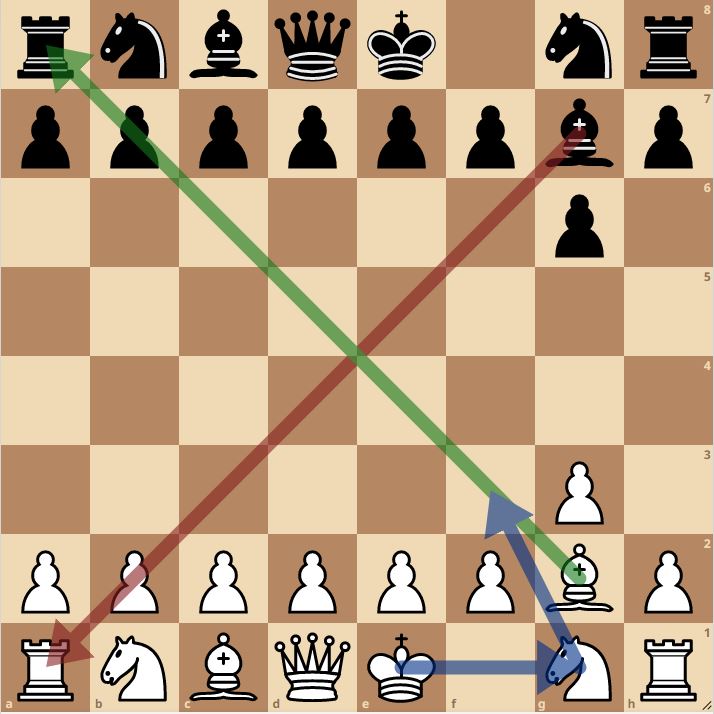
If you play regularly, you’ll run into the fianchetto in most of your games. That’s why it’s worth understanding well: both to use it yourself and to know how to attack it when your opponent sets it up.
How do you play the fianchetto?
Let’s go step by step, since it’s very simple.
- Advance the knight pawn one square. With White you can play b2 or g2; with Black, b7 or g7.
- On the next move, develop the bishop to the square that pawn left.
That’s it — you’ve completed the fianchetto. The bishop ends up on b2, g2, b7, or g7 depending on the case, aiming along the entire long diagonal.
Now, there’s one detail you can’t ignore: central pawns are your fianchettoed bishop’s best friend and worst enemy. If pawns get placed in front of it on the same diagonal, they block it. A bishop shut in for many moves is almost like playing a piece down.
After the fianchetto, it’s typical to develop the knight that was behind the bishop and complete castling on that side. That way the king ends up well protected, with the fianchetto pawn structure as a shield.
How do you attack a fianchetto?
A castled fianchetto position can be very tough to crack. The pawns cover the dark squares, the bishop controls the light ones, and the king is comfortable behind that wall. For example, reaching h7 from outside is complicated.
So is it unbreakable? No. There’s a recipe that works very well.
The weaknesses created by the g2-g3 (or g7-g6) advance are the f3 and h3 squares, which are left uncovered by pawns. You can exploit them in these ways:
- Sneaking pieces into those gaps, especially knights, which generate direct pressure from f3 or h3.
- Pushing the h-pawn to open the file and attack head-on.
- Eliminating the fianchettoed bishop. Without it, only holes remain where the king is exposed.
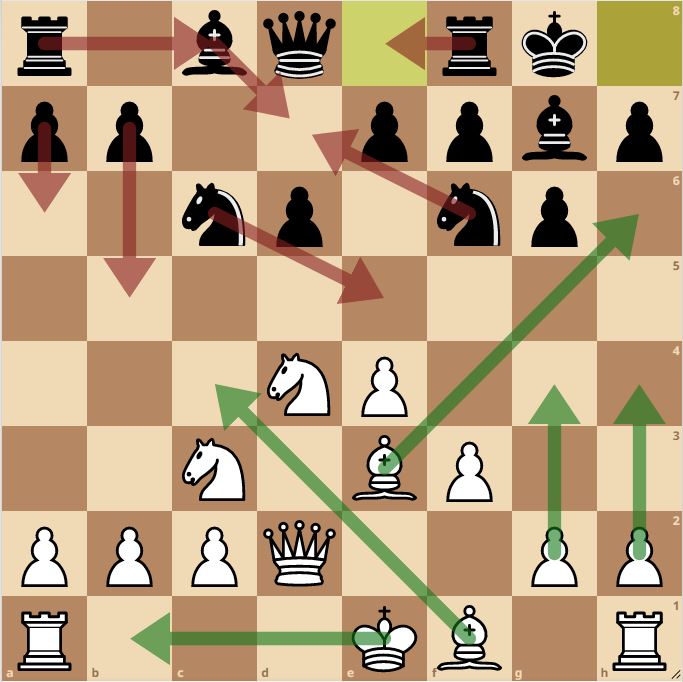
Let’s go with a real example: the queen and bishop coordinated alongside the h-pawn are the most dangerous pieces for attacking this kind of structure. The following example is from the Sicilian, Dragon variation / Yugoslav Attack:
1 e4 c5 2. Nf3 d6 3. d4 cxd4 4. Nxd4 Nc6 5. Nc3 g6 6. Be3 Bg7 7. Qd2 Nf6 8. f3 O-O 9. Bc4 Bd7 10. O-O-O Rc8 11. Bb3 Ne5 12. Kb1 Re8 13. h4 h5 14. g4
This attacking setup isn’t quick to build, but it works like clockwork. If you want to practice it, here’s the study: https://lichess.org/study/jIyy9LVQ
Openings played with a fianchetto
Fianchettoes appear frequently in closed queen’s pawn openings, and there’s a fianchetto variation for White in each of the Indian defenses (semi-closed openings). Knowing these openings will give you a solid, versatile repertoire from the very first move.
Here are some fianchetto openings worth knowing:
- King’s Indian: 1. d4 Nf6 2. c4 g6 3. Nc3 Bg7 4. Nf3 O-O 5. g3
- Grünfeld: 1. d4 Nf6 2. c4 g6 3. g3 d5
- Queen’s Indian: 1. d4 Nf6 2. c4 e6 3. Nf3 b6 4. g3
- Nimzo-Indian: 1. d4 Nf6 2. c4 e6 3. Nc3 Bb4 4. g3
- Closed Sicilian: 1. e4 c5 2. Nc3 Nc6 3. g3 g6
- Open Sicilian: 1. e4 c5 2. Nf3 e6 3. d4 cxd4 4. Nxd4 Nf6 5. Nc3 d6 (Scheveningen Variation) 6. g3
- Sicilian: 1. e4 c5 2. Nf3 e6 3. b3
- Sicilian Dragon: 1. e4 c5 2. Nf3 d6 3. d4 cxd4 4. Nxd4 Nf6 5. Nc3 g6
Once you master the fianchetto, you’ll start seeing it everywhere. And best of all: you’ll know exactly what to do whether you have it or your opponent does.
Here’s more content that will help you:
- How to play the Italian Game
- How to play the Ruy Lopez opening
- Of course, our free chess course
- The value of chess pieces
Preguntas frecuentes
What is a fianchetto in chess?
A fianchetto is developing the bishop to the second square on the knight's file (b2 or g2 for White; b7 or g7 for Black), after advancing the knight pawn one square. It places the bishop on the long diagonal and allows important central or flank control.
In which openings is the fianchetto used?
The fianchetto appears in openings like the London System (Bf4 + no Bb2), the King's Indian Defense (Bg7), the Nimzo-Indian with fianchetto, the Réti System (Bg2), and the queenside with Bb2. It's common in positional and flank openings.