
English Opening: controlling the center from the flank
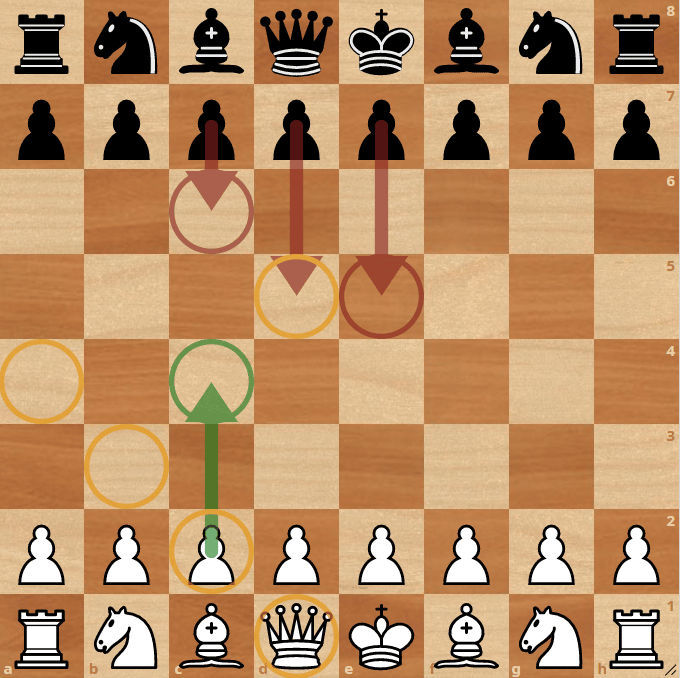
The English Opening is a flank opening: instead of occupying the center with a pawn from the first move, White controls it from a distance and keeps a lot of flexibility. That’s why it’s so popular with positional players and with those who want to escape the more forced lines of the king’s pawn.
Can you imagine controlling the center without even placing a pawn on it? That’s exactly what the English offers you. Its name comes from Howard Staunton, one of the great figures of 19th-century English chess. Over time it became a complete repertoire system, and today it’s still common in the hands of world champions.
Who is the English Opening good for?
I recommend it if you enjoy long-term plans, transpositions and flexible structures. The English Opening doesn’t demand as much concrete memorization as other openings, but it does require you to understand very well where your pieces should go.
If you’re just starting out, you might find it easier to first learn an open opening like the Italian. Still, the sooner you get familiar with the English, the better: it will teach you to think about indirect control of the center, one of the most powerful ideas in modern chess.
How do you play the English Opening?
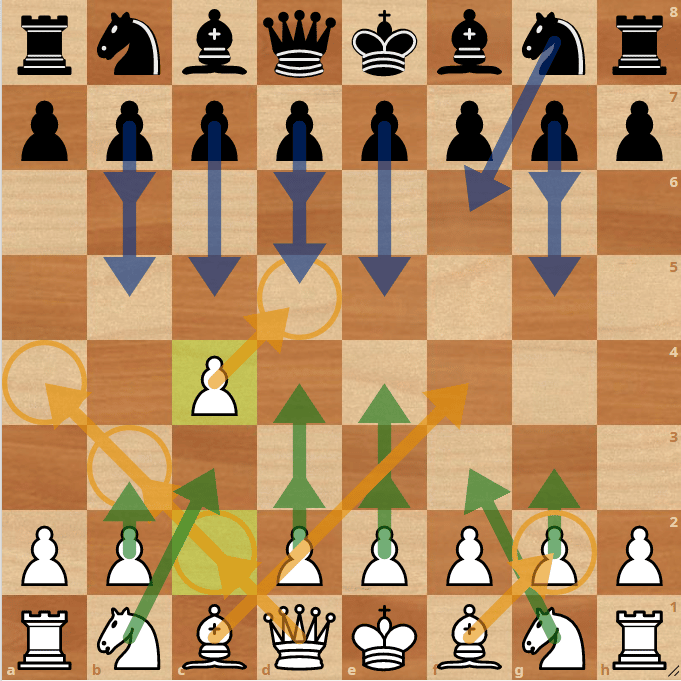
You play White. After 1.c4 e5 (Reversed Sicilian), you develop Nc3 and Nf3 (classical development). Black continues with Nc6 and d5 (trying to equalize). The g3+Bg2 fianchetto setup is the most popular continuation.
Let’s look at what happens in this variation. You start with 1.c4 and Black responds with 1…e5 — this is called the Reversed Sicilian because the structure is the same as in the Sicilian, but with colors swapped. Then you develop your knights with Nc3 and Nf3, Black replies with Nc6 and d5 trying to equalize, and you finish with g3 and Bg2 for the bishop fianchetto on g2.
The general idea is simple: first you control the center from the flank, then you develop your knights and decide whether you want that fianchetto setup or a more classical structure. The English stands out because it doesn’t force you to declare your whole plan in the first two moves.
What plans usually come up?
With the English you’ll mainly deal with these three ideas:
- Pressure on the center without needing to expose it too soon.
- Flexible development: you can change structure depending on Black’s reply.
- Positional play with the option to speed up if your opponent gets uncoordinated.
And what can Black do? Many things: copy your structure, try to occupy the center quickly, or set up their own fianchetto schemes. That variety is exactly what makes the English so attractive: two games rarely look completely alike.
Strengths and risks
Let me be direct. The English has three clear advantages:
- Flexibility: it lets you adapt your plan to whatever Black does.
- Less forced theory than many open openings.
- Great fit for strategic players who prefer improving their pieces over launching an immediate attack.
Its main risk is that, if you play too slowly, your opponent can equalize comfortably. That’s why I recommend studying it as a system of ideas rather than just a sequence of moves. Once you understand the underlying logic, you’ll enjoy this opening a great deal.
Analiza partidas de esta apertura
Pega cualquier PGN para reproducir y estudiar partidas paso a paso. Encuentralas en Lichess o Chess.com.
Preguntas frecuentes
What is the English Opening?
The English Opening starts with 1.c4. Instead of occupying the center directly with e4 or d4, White controls d5 indirectly from the flank. It's a flexible opening that can transpose into many different variations depending on Black's replies.
Why is it called the English Opening?
It was popularized by Howard Staunton, England's strongest player of the 19th century, who used it in his decisive game against Saint-Amant in 1843. Staunton didn't invent it, but he was the first to give it international popularity.
Is the English Opening hard to learn?
It has a steeper learning curve than the Italian because the position is more closed and the ideas less immediate. It's recommended for intermediate players (1400+) who want to expand their repertoire and avoid open-opening theory.