How the knight moves in chess
The knight is probably the piece that confuses beginners the most. If you already know how the pieces move in general, the knight is the one that breaks all the patterns. And used well, that makes it your best ally.
How does the knight move?
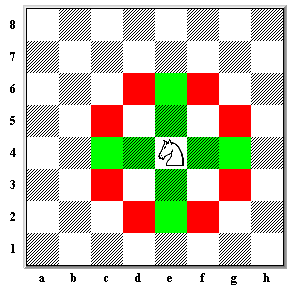
The knight moves in an L-shape. Two squares in one direction and one perpendicular. Or the other way around: one square in one direction and two perpendicular. Always tracing that “L,” in any of its eight possible orientations.
Look at the diagram: the marked squares are every possible destination from that position.
There’s something else you should know: the knight changes the color of its square on every move. If it’s on a light square, it will land on a dark one. And vice versa. Always. No exceptions.
The knight jumps over pieces
Here’s the knight’s big advantage over the rest. The rook, the bishop, or the queen need a clear path to move. The knight doesn’t.
The knight is the only piece that can jump over other pieces. It doesn’t matter if there’s a pawn in the middle, or several pieces stacked up: the knight ignores them and lands directly on its destination.
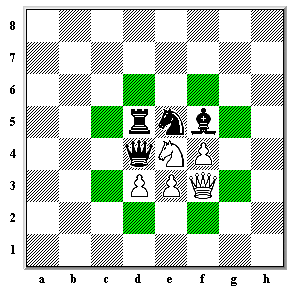
See what happens in the image? The knight jumps over pieces that would block any other piece. That makes it especially dangerous in closed positions.
How does the knight capture?
The knight captures the same way it moves: it lands on the destination square tracing the L and, if there’s an enemy piece there, removes it from the board.
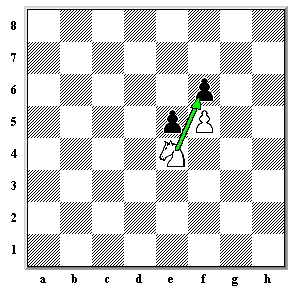
How the knight eats in chess
Let’s go through a capture example. The knight captures the pawn in the following diagram, landing on its square after tracing its characteristic L.
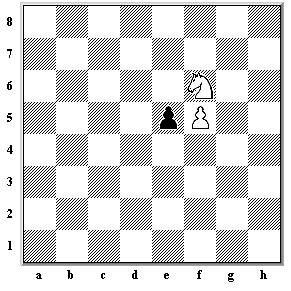
That’s exactly how the knight eats in chess. No detours: it arrives, lands, captures.
The knight’s value in chess
You can check piece values in detail, but here’s the summary: the knight is worth about 3 points, the same as the bishop.
Why “about”? Because the real value depends on the position. In open games, with long free diagonals, the bishop tends to be superior. But in closed positions — with blocked pawns shutting down the board — the knight shines: it can jump over that whole structure and reach any point on the board.
This rivalry runs so deep that there’s a whole branch of study devoted to it: bishop versus knight endgames.
One last tip: always bring the knight toward the center. From a central square like e4 or d5, the knight controls up to 8 squares. From a corner, only 2. The edge of the board is the worst place for a knight.
And a tactic you absolutely must know: the fork. The knight is the most feared piece for executing it, because it attacks two pieces at once from its L-shaped position. Once you master this idea, you’ll start seeing threats that used to go unnoticed.
Preguntas frecuentes
How does the knight move?
In an L-shape: two squares in one direction and one perpendicular (or vice versa). It's the only piece that can jump over other pieces without a clear path.
What is the knight worth?
About 3 points, the same as a bishop. In closed positions with blocked pawns the knight is usually stronger than a bishop, because it can jump over the pawn structure.
How many squares does the knight control from the center of the board?
From a central square like e4 or d5, the knight can reach up to 8 different squares. From a corner, only 2. That's why you should bring the knight toward the center and avoid the edge of the board.