
How the queen moves in chess
The queen is the most powerful piece on the board. Master her and you’ll notice the difference in every game. But careful: precisely because she’s worth so much, you need to know when to bring her out and when to keep her covered.
If you’re still starting out, I’d recommend first reading how the pieces move to get the basics clear.
How does the queen move?
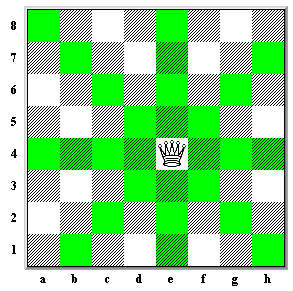
The queen combines the moves of the rook and the bishop in a single piece. What does that mean? She can move in any direction — horizontal, vertical, or diagonal — as many squares as she wants in a single move.
Look at the image: from the center of the board, the queen reaches more than half the available squares. That’s why she’s so feared.
An important limitation
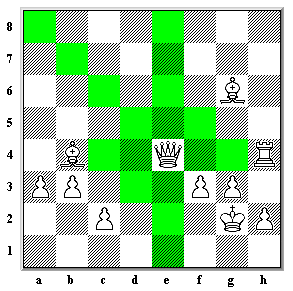
Like other long-range pieces, the queen can’t jump over other pieces. If there’s a piece in her way — friend or foe — she stops.
Look at the following image and you’ll see how her path gets cut short as soon as she hits an obstacle.
How does the queen capture?
The queen captures the same way she moves: she advances toward the enemy piece and takes its square, removing it from the board.
In this example you have a decision to make. Do you capture the bishop or the rook? Think it over before checking the answer.
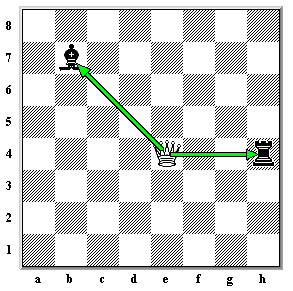
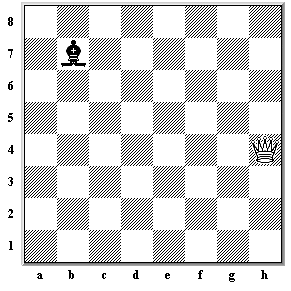
The correct answer is to capture the rook. Why? Because the rook is worth more. Which brings us straight to the next point.
The queen’s value
If you want to understand what the queen is worth, check the piece value guide. In short: the queen is worth 9 points, more than any other piece on the board.
To put it in perspective:
- The rook is worth 5 points.
- The bishop and knight are worth 3 points each.
- The pawn is worth 1 point.
The queen nearly doubles the rook’s value. That’s why losing her without enough compensation usually means losing the game.
How to use the queen: common mistakes
Let’s go through the two most common mistakes beginners make.
1. Bringing the queen out too early. In the opening, if you bring your queen out too soon, your opponent can attack her with lower-value pieces and force you to move her over and over. You lose tempo and your opponent gains development. There are specific openings where the queen comes out early — like the Queen’s Gambit — but those are exceptions with their own logic.
2. Using her as a lone attacker. The queen is lethal when acting in coordination with other pieces. Alone, she can be dodged or trapped. With support from the knight, the rook, or the bishop, she becomes a real checkmate threat.
The queen in the endgame
When few pieces remain on the board, the queen shines especially bright. She can give check from afar, cover multiple lines, and support a pawn’s promotion.
Speaking of promotion: if you manage to get a pawn to the last rank, you can turn it into a queen. It’s one of the most exciting moments in chess. I explain how it works in the article on pawn promotion.
Once you master the queen and coordinate her with the king, you’ll have the tools to close out many games that used to slip away.
Preguntas frecuentes
How does the queen move?
The queen combines the moves of the rook and the bishop: it moves any number of squares in any direction (horizontal, vertical, or diagonal).
What is the queen worth?
The queen is worth about 9 points, nearly double a rook (5) and three times a bishop or knight (3).
When is the queen used in the opening?
Usually the queen doesn't come out in the opening (it can be attacked and lose time). It develops once the center is open and there are concrete opportunities.
What happens if I capture the opponent's queen?
Capturing the opponent's queen is a decisive advantage: you gain 9 points of material. In most games, a queen advantage is enough to win.