
Garry Kasparov: biography, ELO and best games
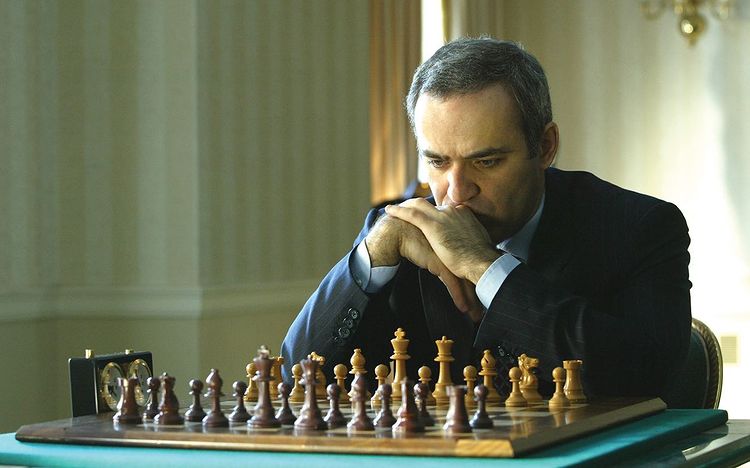
- País
- 🇷🇺 Russia
- Título
- Gran Maestro (GM)
- Nacimiento
- 13 April 1963, Baku (Soviet Azerbaijan)
- Estado
- retirado
- Último ELO
- 2812 · mar 2005 (retirement)
- ELO máximo
- 2851 · jul 1999
- Campeón del mundo
- 1985–2000 (classical)
If there’s one name that symbolizes the greatness of modern chess, it’s Garry Kasparov. World champion for 15 years, the player with the highest ELO in history for over a decade, and the man whose rivalry with Anatoly Karpov became legend. A career without parallel.
Who is Garry Kasparov
Born in 1963 in Baku, then part of the Soviet Union, Kasparov was a child prodigy. His father died when he was seven, and it was his mother who drove his chess education. He learned by reading his father’s books and soon caught the attention of Soviet coaches.
At 17 he was already a Grandmaster. At 22, in 1985, the youngest ever to win the World Championship, defeating then-champion Anatoly Karpov in Moscow. That was the start of one of the most epic rivalries in sport.
Kasparov vs. Karpov: five world championships
The history of chess in the 1980s and 90s can’t be understood without the Kasparov-Karpov duel. They faced each other in five world championships between 1985 and 1990:
| Year | Venue | Result |
|---|---|---|
| 1985 | Moscow | Kasparov wins the title (13-11) |
| 1986 | London / Leningrad | Kasparov retains (12.5-11.5) |
| 1987 | Seville | Tied 12-12, Kasparov retains |
| 1990 | New York / Lyon | Kasparov retains (12.5-11.5) |
Four world championships in five years. Two players of completely opposite styles: Karpov’s technical precision against Kasparov’s tactical power and scientific preparation. A confrontation that was also political, between the old guard of the Soviet system and the new generation.
His ELO: the highest in history for 13 years
In July 1999 Kasparov reached 2851 points, the highest mark ever recorded up to then. That record stood for 13 years, until Magnus Carlsen surpassed it in 2013.
But the most impressive figure isn’t the peak: it’s the consistency. Kasparov was the first to cross the 2800-point barrier, in 1990, and stayed in that absolute elite zone for more than a decade.
Kasparov vs. Deep Blue
In 1996 Kasparov beat Deep Blue, IBM’s supercomputer, 4-2. The following year, in 1997, the rematch changed history: he lost 2.5-3.5 to the improved version of the machine, in the first great symbol that artificial intelligence could surpass the best human player.
Kasparov always maintained that some of Deep Blue’s moves in that second series were suspiciously creative to be pure brute-force calculation. Either way, the cultural impact of those games was enormous: they marked a before and after in the public perception of the relationship between chess and technology.
The break with FIDE and the final years
In 1993, in disagreement with FIDE’s management, Kasparov split off and created the PCA (Professional Chess Association), playing his championship outside the official body. He won that match against Nigel Short and remained widely recognized as the classical champion.
In 2000 he lost the title to Vladimir Kramnik (6.5-8.5), a defeat that shocked the world. Kasparov, who had never lost a championship match, couldn’t win a single game in that series.
He kept competing at the highest level until March 2005, when he announced his retirement at 41. His rating at the time was 2812, still the seventh highest in history. Since then he has dedicated much of his time to political activism for democracy in Russia and to promoting chess as an educational tool.
His legacy on the board
Kasparov transformed how chess is prepared. He was the first to systematically use game databases and computer power to deepen opening theory. Every opponent had to prepare in a way no one had ever seen before.
As a player, he stands out for tactical universality: he could resolve closed positions with a technician’s patience and then launch a combinational attack impossible for his rival to calculate. His book series My Great Predecessors (five volumes) remains a reference for any chess player wanting to study the history of the game.
What you can learn from his style
If you want to study Kasparov, start with his king pawn openings (1.e4). He was known for taking the Ruy López and the Sicilian into extremely deep theoretical territory, and for the depth of his home preparation.
But the most valuable thing isn’t the openings: it’s his handling of the initiative. Kasparov rarely stayed still. If he had no attack, he created imbalances. If he had an advantage, he converted it with crushing efficiency. Watching how he turns seemingly level positions into wins is a masterclass in continuous pressure.
His best games
👉 Relive Garry Kasparov’s best games, including his Immortal against Topalov from 1999 in Wijk aan Zee.
Keep exploring
- The 10 best players in history
- World chess champions
- What is ELO and how is it calculated
- All players
Preguntas frecuentes
Why is Kasparov considered the best of all time?
Kasparov was world number 1 for 255 months, the longest record to date. His peak ELO of 2851 was the highest in history for 13 years. He defended the world title five times against Karpov and maintained unprecedented tournament dominance for more than 20 years.
How long was Kasparov world number 1?
Kasparov was FIDE's world number 1 from 1984 until his retirement in 2005, a total of 255 months at the top. Only Magnus Carlsen surpasses him in total time as the world's top-ranked player.
Why did Kasparov lose to Deep Blue in 1997?
In 1997 Kasparov lost 2.5-3.5 to IBM's Deep Blue supercomputer. He himself attributed the defeat to isolated mistakes in key games and the difficulty of adapting to an opponent that never got tired or nervous. In 1996 he had beaten the earlier version of Deep Blue 4-2, which makes that historic clash even more special.