
Judit Polgár: the best female chess player in history
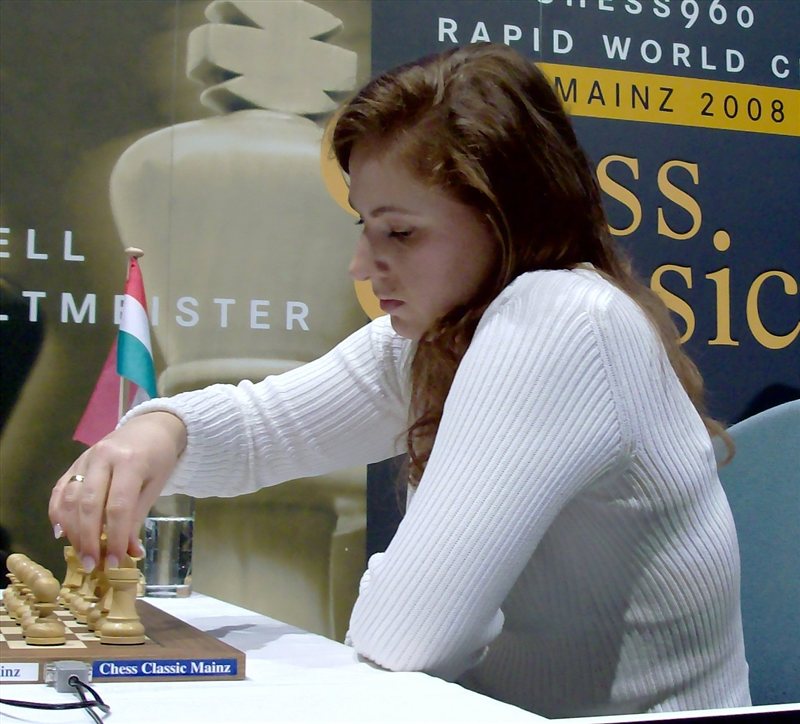
- País
- 🇭🇺 Hungary
- Título
- Gran Maestra (GM)
- Nacimiento
- July 23, 1976, Budapest (Hungary)
- Estado
- retirado
- Último ELO
- 2675 · sep 2014 (retired)
- ELO máximo
- 2735 · jul 2005
In the chess world, Judit Polgár is in a category of her own. Not the “best female player,” not “the exception that proves the rule”: simply one of the best chess players in history, measured by the same yardstick as any male GM. Her numbers say it all.
Who Judit Polgár is
She was born in 1976 in Budapest, the youngest of the three Polgár sisters. Her father, László Polgár, had a theory: genius is not born, it’s made. And he decided to prove it by raising his three daughters — Zsuzsa, Zsófia, and Judit — with a method of intensive study from early childhood, with chess as the central pillar.
The results spoke for themselves. In December 1991, at 15 years, 4 months, and 28 days old, Judit became a Grandmaster — the same title awarded to the best male players — breaking the precocity record previously held by Bobby Fischer. And she did it always in the open section: she never wanted the fast track of the women’s circuit.
An unprecedented career
Polgár’s trajectory is unique in chess history. She reached world number 8 in 2005, the only woman ever to enter the top 10 of FIDE’s general ranking. That same year she reached her all-time high ELO of 2735, a figure no other female player has matched since.
Before that, in 2003, she was the first woman to surpass 2700 points — a barrier that in the men’s world only a few elite grandmasters had crossed.
Victories that made history
What’s most impressive isn’t the numbers: it’s the opponents. Judit Polgár defeated several world champions in classical games, something unprecedented for a female player:
- Anatoly Karpov (former world champion), in 1992
- Boris Spassky (former world champion), on several occasions
- Viswanathan Anand (world champion 2007–2013), in multiple tournaments
- Garry Kasparov (world number 1 for 20 years), in Wijk aan Zee 2002
That victory over Kasparov — who had claimed in the past that women couldn’t reach the top of chess — was especially symbolic. Kasparov publicly acknowledged her as an absolute elite player.
Why she never competed for the women’s title
Judit Polgár made a decision from the start: not to participate in the Women’s World Championship. Not out of arrogance, but on principle. She believed dividing chess by sex lowered the level of demand. Her arena was the open circuit, where the only criterion was ELO.
That choice deprived her of formal world titles, but gave her something more valuable: the definitive proof that a woman could compete on equal terms with the best on the planet.
Retirement and legacy
In August 2014 she announced her retirement from professional chess to devote herself to her family and to her educational program Chess in Schools, through which she promotes chess as a pedagogical tool throughout Hungary and beyond.
Her legacy goes far beyond the board. She changed the narrative about what a woman can achieve in chess. Every time a coach says “women play differently,” Judit Polgár’s name is the best possible answer.
What you can learn from her play
Polgár had a very offensive style: she loved king’s pawn openings (1.e4) and tactical positions where precise calculation made the difference. She combined the depth of preparation typical of the Soviet school with a boldness for attack reminiscent of Mikhail Tal.
If you want to study her play, look for her games at the Chess Olympiads representing Hungary, and especially her wins against former world champions. They’re a masterclass in attacking chess at the highest level.
Keep exploring
- The 10 best chess players in history
- Chess world champions
- What is ELO and how is it calculated
- All players
Preguntas frecuentes
Why is Judit Polgár so special in chess history?
Because she is the only woman to have entered the world top 10 of chess (ranked #8 in 2005) and the only one to surpass 2700 ELO points. She did it, moreover, without ever playing the Women's World Championship, always competing in the open section alongside the best players in the world.
When did Judit Polgár retire from chess?
Judit Polgár announced her retirement in August 2014, shortly before competing in that year's Chess Olympiad with the Hungarian team. She left professional chess to devote herself to her family and to educational projects promoting chess in schools.
When did Judit Polgár become a Grandmaster?
In December 1991, at just 15 years, 4 months, and 28 days old, breaking Bobby Fischer's record. She was the first person to earn the Grandmaster (GM) title — the same one given to men — at that age, without being limited to the women's category.