
Viswanathan Anand: five-time world champion
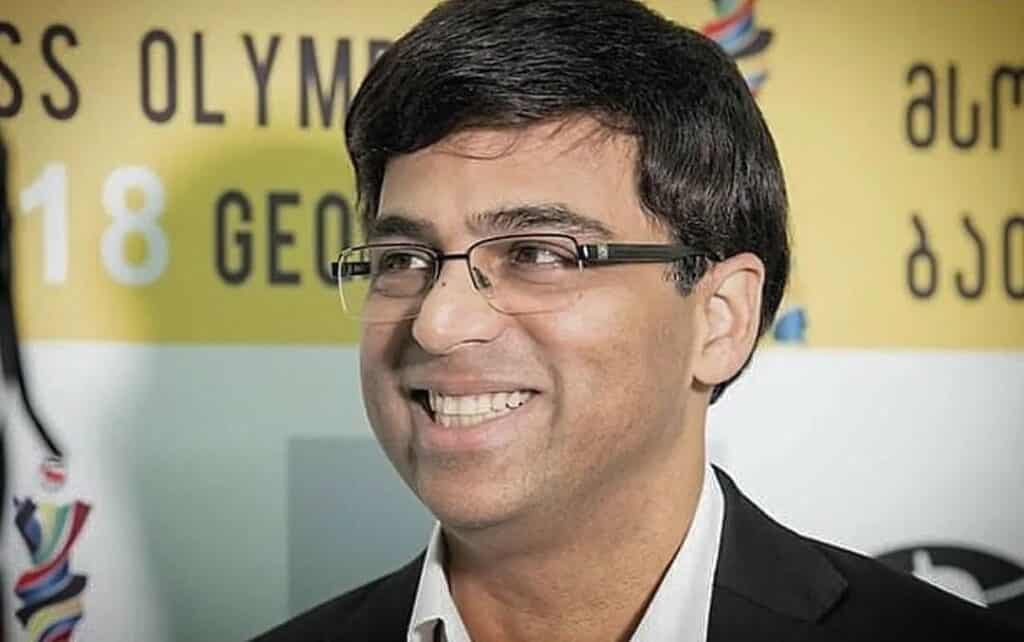
- País
- 🇮🇳 India
- Título
- Grandmaster (GM)
- Nacimiento
- 11 December 1969, Mayiladuthurai (India)
- Estado
- activo
- ELO actual
- 2710 · jun 2026
- ELO máximo
- 2817 · mar 2011
- Campeón del mundo
- 2000, 2007–2013
Some players define an era, and some players define an entire continent. Viswanathan Anand did both: he dominated world chess for nearly a decade and was the pioneer who opened the doors of the global elite to Indian chess. Without him, Gukesh Dommaraju probably wouldn’t exist.
The Tiger of Madras
He was born on 11 December 1969 in Mayiladuthurai, India, but grew up in Chennai (formerly Madras), the city that gave him his nickname: the Tiger of Madras. He learned to play chess at age six, taught by his mother, and his progress was so rapid that by just 16 he was already India’s champion.
In 1988, at 18, he became India’s first Grandmaster in history. It wasn’t just a statistical curiosity: it was a cultural milestone that proved elite chess wasn’t exclusive to the USSR and Eastern Europe.
Five world titles: an unprecedented career
Anand’s list of world titles is one of the most impressive records in modern chess:
| Year | Format | Final opponent |
|---|---|---|
| 2000 | FIDE Knockout WC | Alexei Shirov |
| 2007 | Tournament in Mexico (reunified) | — |
| 2008 | Match | Vladimir Kramnik |
| 2010 | Match | Veselin Topalov |
| 2012 | Match | Boris Gelfand |
In 2007 he won the reunification tournament that ended the schism between FIDE and the classical circuit, restoring a single world champion recognized by everyone.
In 2013 and 2014 he lost the title and the rematch to Magnus Carlsen, but those two defeats don’t tarnish an extraordinary career: very few players have even reached a world championship match, and he did it five times as champion.
His ELO: India’s highest peak
In March 2011 he reached 2817 points, his personal historic peak and for a time the second highest in the world, behind only Carlsen. For a player who learned chess without the resources and infrastructure of the great Soviet schools, that figure is an extraordinary achievement.
Speed as a weapon
What made Anand special at the board was his calculation speed. In an era when players increasingly used all their available time to calculate deeply, he solved complex positions in seconds that took others minutes. That speed wasn’t improvisation: it was the result of exceptional visual and tactical processing.
That’s why he was never just a classical player: in rapid and blitz, his superiority was for years nearly total. Before Carlsen dominated every time control, Anand was the undisputed king of fast chess.
Universal mind
Another trait that defines Anand is his repertoire breadth: while other champions tended to specialize in specific variations, he felt comfortable with practically any opening. One day he could play the Sicilian in depth, the next opt for the Caro-Kann, and then surprise with the King’s Gambit. This versatility made preparing against him a nightmare for his opponents.
The legacy
Anand opened a door that has never closed again. After him, India produced a wave of young grandmasters who have transformed the map of world chess. The training infrastructure, the academies, the chess culture that exists in India today owe much to the path he blazed.
When in 2024 Gukesh Dommaraju won the World Championship at 18, one of the first to congratulate him was Anand. The generational handover, passed from master to disciple, was complete.
Keep exploring
- Gukesh Dommaraju, the new Indian champion
- Magnus Carlsen, the rival who took away his title
- World chess champions
- What is ELO and how is it calculated
- All players
Preguntas frecuentes
How many world titles did Viswanathan Anand win?
Anand won the world title five times: in 2000 (FIDE knockout tournament), 2007 (reunified championship in Mexico), 2008 (match vs Kramnik), 2010 (match vs Topalov), and 2012 (match vs Gelfand). He lost the title to Magnus Carlsen in 2013.
What nickname does Viswanathan Anand have?
He's known as the 'Tiger of Madras' for his calculation speed and instinct for tactical positions. He was one of the fastest players in the world and for years the best rapid and blitz chess player.
Does Viswanathan Anand still play?
Yes. Although he no longer competes for the classical world title, Anand remains active in top-level tournaments, especially in rapid and blitz formats, where his calculation speed remains formidable.