
How the king moves in chess
The king is the most important piece on the board. Without it there’s no game. It’s not about racking up points or having more material: if your king falls to checkmate, you lose, no matter what else is on the board. So before you think about attacking, learn to keep it safe.
How does the king move?
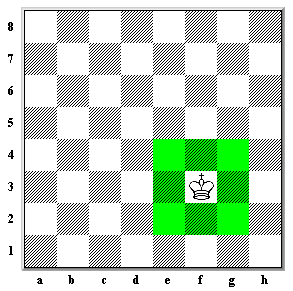
Here’s the fundamental rule: the king moves exactly one square in any direction. Horizontal, vertical, or diagonal. Just one. No more, no less.
Look at the diagram: from the center of the board, the king controls up to eight surrounding squares.
Want to see how all the pieces move at a glance? Check out the guide on how the pieces move.
Which squares can it not go to?
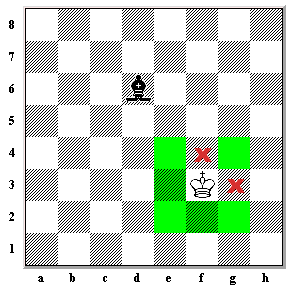
Here’s the key restriction: the king can never move to a square threatened by the opponent. Never.
In the image below, the king can’t go to the squares marked with a cross because a black bishop controls them. If it did, it would be putting itself in check, and that’s not allowed.
How does the king capture?
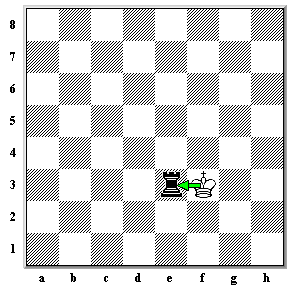
If there’s an enemy piece on a square adjacent to where the king can go, the king can capture it. In the diagram below, the white king can take the black rook.
Careful: not every capture is allowed
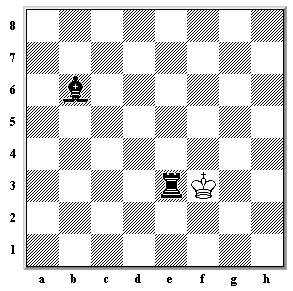
This position looks like the previous one, but there’s a critical difference. The black bishop is protecting the rook. What happens if the king captures the rook? It would be attacked by the bishop — in check. And that’s not allowed. The king can’t go to any square where it would be in danger, even if there’s an enemy piece there.
The two kings never touch
This follows directly from the previous rule: two kings can’t be on adjacent squares. If one king got close to the other, it would be threatened by it, which is illegal. The position in the diagram below can never occur in a real game.
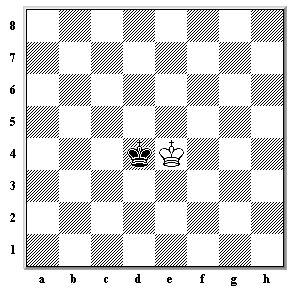
Always remember: the king must be protected at all times. It’s the piece you fight for, not the one you attack with (at least, not until the endgame).
Check and checkmate
When an enemy piece directly attacks the king, it’s said to be in check. It’s an immediate threat: on your next move, you must get out of it. You have three options:
- Move the king to a safe square.
- Block with a piece between the attacker and the king.
- Capture the piece giving check.
If you can’t do any of the three, it’s checkmate. The game ends there. Learning to deliver checkmate is the ultimate goal of the game.
What if the king isn’t in check but can’t move to any square without being threatened? That’s called stalemate: the game ends in a draw.
Castling: the king’s special move
Castling is the only move in chess where you move two pieces at once: the king and a rook. The king advances two squares toward the rook, and the rook jumps to the other side of the king.
What’s it for? To quickly put the king in a safer position, behind the pawns. It’s one of the first concepts I’d recommend learning if you’re starting out.
What is the king worth?
The king has no numeric value. If you want to compare it with the rest, check the piece value guide: there you’ll see the queen leads the ranking, followed by the rook, the bishop, and the knight. But the king is in a category of its own: it can’t be captured, can’t be traded, and losing it means losing the game.
That’s why its value is, literally, infinite.
Preguntas frecuentes
How many squares can the king move?
The king moves exactly one square in any direction: horizontal, vertical, or diagonal. It can't move to a square threatened by the opponent.
What is check?
The king is in check when an enemy piece directly threatens it. You must get out of check on your next move: by moving the king, blocking the attack, or capturing the attacking piece.
What is checkmate?
Checkmate happens when the king is in check and there's no legal move to escape it. Whoever delivers checkmate wins the game.
What is the king worth?
The king has no standard numeric value because it can never be captured or traded. It's the most important piece: losing it means losing the game.