
Squares in chess: what they are and how each one is named
Do you know what each square of the board is called? It’s called a square. That’s the official term, and it’s what everyone means when they say “square” — it’s understood the same way either way.
What a square is
A square is each of the 64 square cells of the chessboard. The board has 8 ranks and 8 files, which gives exactly 64 squares. Light and dark alternate both horizontally and vertically: no two squares of the same color ever touch side by side.
For example, e4 is the square at file e, rank 4. It’s one of the most famous squares in chess: that’s where the classic open opening begins.
Once you learn the system, you can point to any square on the board with just two characters. That’s what lets you understand a written game, follow a chess book, or analyze a position with an engine.
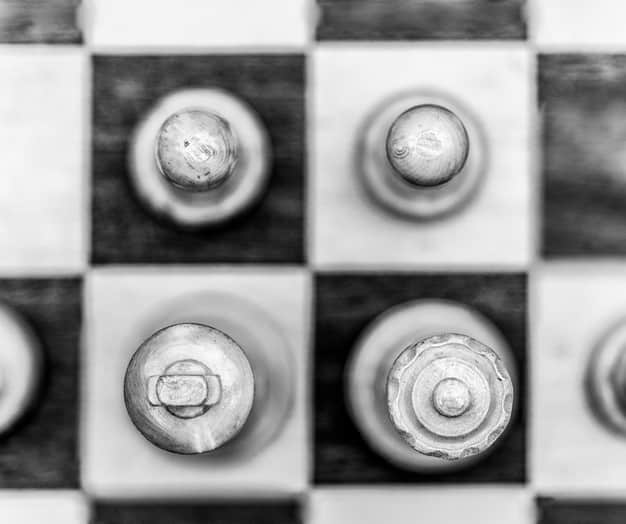
How each square is named
This is where algebraic notation comes in. Every square has a unique coordinate made of a letter and a number:
- The letter (from a to h) indicates the file.
- The number (from 1 to 8) indicates the rank.
Why knowing squares matters
Let’s see why it’s worth learning this well.
When you study the pieces and how they move, the instructions always refer to specific squares. If you don’t know where d5 or f7 is, you’ll get lost. But if you master the coordinates, you can follow any analysis effortlessly.
Also, the rules of chess also use squares: castling, en passant capture, pawn promotion… it’s all described with coordinates. Mastering the naming system is the foundation for everything else.
Once you’re comfortable finding your way around the board, you’ll see that learning chess becomes much faster. Every new concept falls into place.
Preguntas frecuentes
What is a square in chess?
A square is each of the 64 squares of the chessboard. The board has 8 ranks (numbered 1 to 8) and 8 files (named a to h). Each square is identified by its file and rank: for example, e4 or d5.
Why are there squares of two colors in chess?
The board alternates light and dark squares to visually distinguish placement and movement. Bishops, for example, only move on squares of a single color throughout the whole game.