Viking Chess (Hnefatafl): the Norse war game
What is Viking chess?
When people say “Viking chess,” they usually picture the chess we know, just with horned helmets. The reality is far more interesting. Hnefatafl is a completely different strategy game — and if you get to know it, it’ll surprise you.
Vikings weren’t just warriors. They were also strategists, sailors, and traders. And like any culture that values intelligence over brute force, they had their own board game for training the mind.
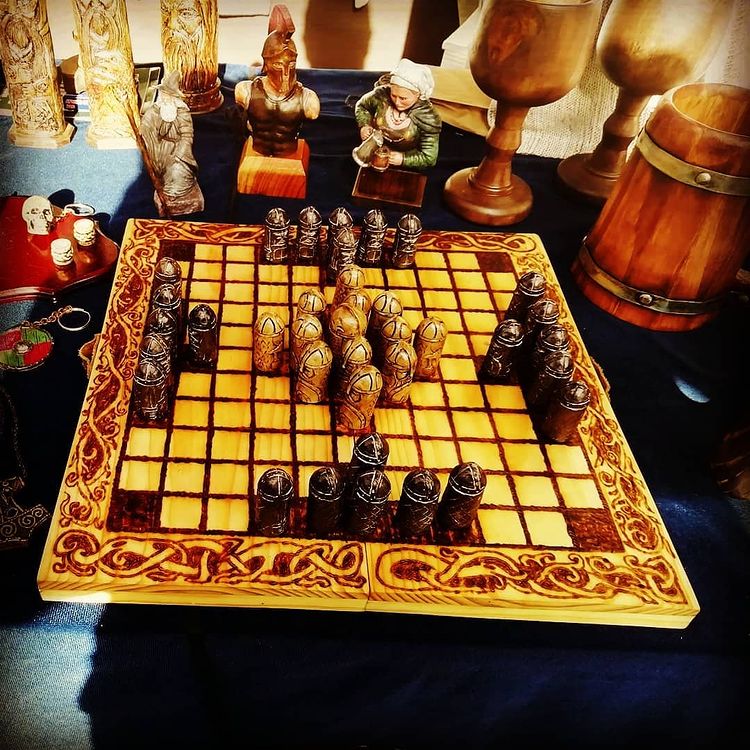
Board and pieces of Viking chess
The word “tafl” means “table” or “board” in Old Norse. And right from the name it tells you something: this is about conquest and defense on a gridded board.
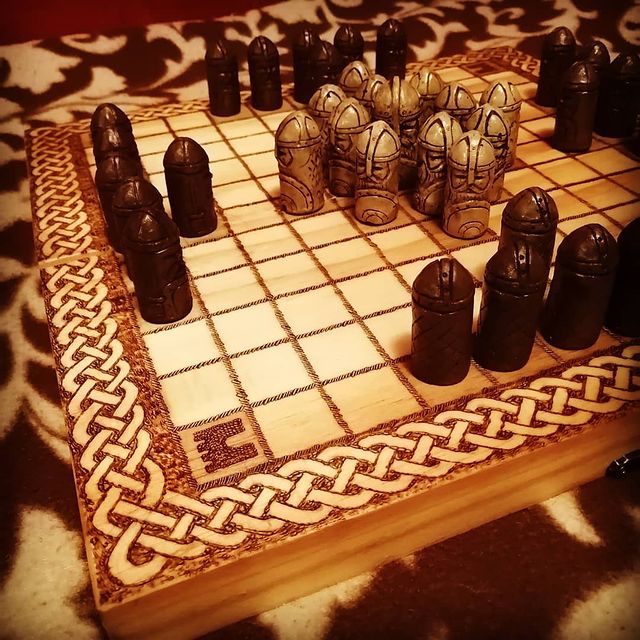
The big difference from modern chess is the starting setup. Here the pieces aren’t placed at the edges — they’re placed in the center. At the center of the board sits the “hnefi” (the king), surrounded by his white guards, the “hunns” or “tæflor”. The attackers, the black pieces, wait at the edges, ready to surround the king.
See the asymmetry? One side defends; the other attacks. That makes it a fascinating game from the very first move.
How do the pieces move in Viking chess?
Let’s start with the basics: all pieces move the same way. You can advance as many free squares as you like in a straight line — exactly like the rook in modern chess.
And how do you capture? If you manage to have two of your pieces flank an enemy piece from two opposite sides, that piece is captured. No jumps, no diagonals. Just flanking.
How do you win at Viking chess?
Here, each side has a different objective. That’s what makes the game asymmetric — and much richer than it looks.
- Black (the attackers) win if they manage to surround the king on all four sides.
- White (the defenders) win if the king manages to escape to one of the four corners of the board.
Simple? In theory, yes. In practice, the game demands thinking several moves ahead. Just like when you first study the rules of chess: the concepts are simple, but the depth will surprise you.
Variants of the Viking game
Let’s look at something really interesting: Hnefatafl wasn’t a single game. It was played across northern Europe with local variants. Each region adapted the board size and the number of pieces.
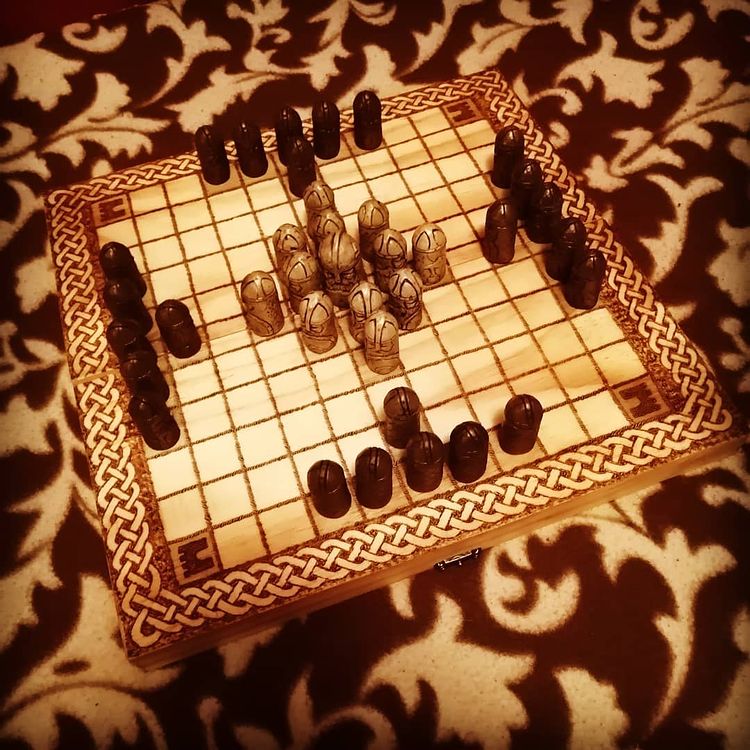
- Ard Ri — Scottish variant. A 7×7 board, with sixteen attackers and eight defenders.
- Brandub — Irish variant. A 9×9 board, with eight attackers and four defenders.
- Tablut — Finnish variant, the best documented thanks to the writings of naturalist Linnaeus. A 9×9 board: sixteen “Muscovites” stalk the “Swedish” king and his eight soldiers.
- Hnefatafl — the classic Viking version, probably the best known. An 11×11 board, with twenty-four attackers and twelve defenders.
- Tawlbwrdd — Welsh variant. Equally large (11×11) but with its own capture rules.
- Alea evangelii — the Saxon version, the most complex of all. A 19×19 board with 48 attackers and 24 defenders.
Each variant is a different answer to the same question: how long will it take you to get the king to the corner?
Preguntas frecuentes
What is Viking chess?
Viking chess is the popular name for Hnefatafl, a medieval Norse strategy game. It isn't the chess we know today: it's an asymmetric game where one side tries to capture the enemy king while the other tries to help him escape. It was very popular in Scandinavia before Arabic chess arrived.
How is Hnefatafl played?
Hnefatafl is played on a square board (usually 11x11). One side has more pieces and surrounds the enemy king; the other side (with fewer pieces) tries to get the king to the edges of the board. Pieces are captured by flanking the opponent on two sides (a flanking capture, not a jump).
When did Viking chess disappear?
Hnefatafl gradually disappeared between the 11th and 12th centuries as Arabic chess (which reached Europe through Spain) grew in popularity. Modern chess offered more tactical variety and ended up replacing Hnefatafl across Europe.