How the bishop moves in chess
The bishop starts on c1 and f1 for White, and c8 and f8 for Black. If you want a refresher on how all the pieces move together, visit how the pieces move.
How does the bishop move?
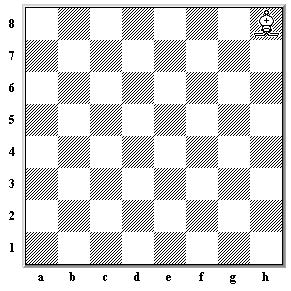
The bishop moves diagonally, as many squares as it wants, forward or backward. Look at the image: from the center of the board it can reach a lot of squares at once.
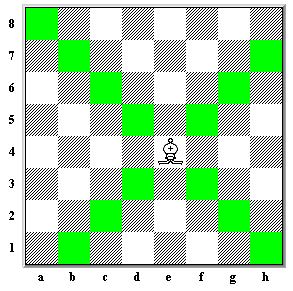
There’s one detail you shouldn’t forget: the bishop never changes color. If it starts on a light square, it will always move on light squares. That’s why each player has two bishops: one for light squares and one for dark squares. Together they cover the whole board.
What happens when the bishop’s path is blocked?
The bishop can’t jump over pieces. If one of your own pieces cuts off the diagonal, it has to stop before it. Look at the diagram below and see how its range shrinks drastically.
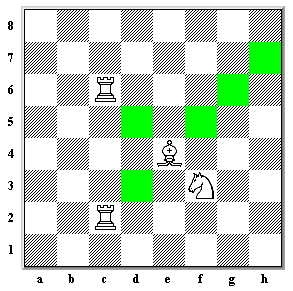
This is the bishop’s big weakness in closed positions. When pawns block the diagonals, the bishop gets boxed in and loses much of its power.
How does the bishop capture?
Here the logic is the same as with movement: if there’s an enemy piece on its diagonal, it can capture it by occupying that square. Same-color pieces, on the other hand, block its path.
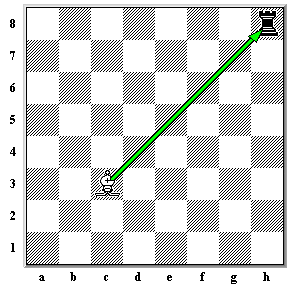
That’s exactly how the bishop eats: it slides along the diagonal to the enemy’s square and removes it from the board.
What is the bishop worth?
The bishop is worth about 3 points. To fully understand the scoring system for every piece, I’d recommend reading about piece values.
How does it compare to the rest? Along with the knight, they’re the two minor pieces in chess: each worth 3 points. Even so, many coaches give the bishop a slightly higher value (3.5 points) because, well placed, it dominates long diagonals and can control areas far from where it stands.
The key is the position. In open positions, with long, free diagonals, the bishop is a machine. In closed positions, where pawns block everything, the knight outperforms it because it can jump over pieces. If you want to dig deeper into this rivalry, I have a full article on bishop versus knight.
The bishop pair: a real advantage
Do you have both bishops while your opponent doesn’t? That’s called the bishop pair, and it’s an important strategic advantage, especially if the position opens up. The two bishops together control squares of both colors and complement each other perfectly. The queen and rook also love open positions, so in those endgames the bishop pair shines especially bright.
The bishop in the opening: the fianchetto
One of the most elegant ideas with a bishop is the fianchetto: instead of developing the bishop to a central square, you bring it to g2 (or b2) after moving the g3 pawn. From there it controls the long diagonal and watches the center without exposing itself. You’ll see it in many modern openings.
The origin of the word “bishop”
In Spanish, this piece is called alfil, from the Arabic al-fil (الفيل), meaning elephant. The name makes sense: chess was born in India, and war elephants were a key piece in armies of the time.
When the game reached Europe, the piece transformed into the English bishop. The reason is that Europeans saw in the piece’s shape the mitre of a bishop. Hence the difference in names across languages.
Curious, isn’t it? But beyond the name, what matters is mastering how to use it. Once you understand the bishop alongside the rest of the pieces — king, queen, rook, knight, and pawn — you’ll be ready to think in real chess terms.
Preguntas frecuentes
How does the bishop move?
The bishop moves diagonally any number of squares. It can never change color: it always stays on the squares of the color it started on.
What is the bishop worth?
The bishop is worth about 3 points, the same as a knight. Having both bishops (the bishop pair) is considered a small advantage in open positions.
Why is the bishop weaker in closed positions?
The bishop needs open diagonals to be effective. In positions with lots of blocked pawns, the bishop becomes limited and can be worse than a knight.