
Closed chess openings (1.d4)
If you’ve played open openings and want to take the next step, closed openings are your next challenge. Here the center doesn’t open in the first moves: pawns block the lines and the game becomes a battle of slow maneuvering, long-term plans and strong squares.
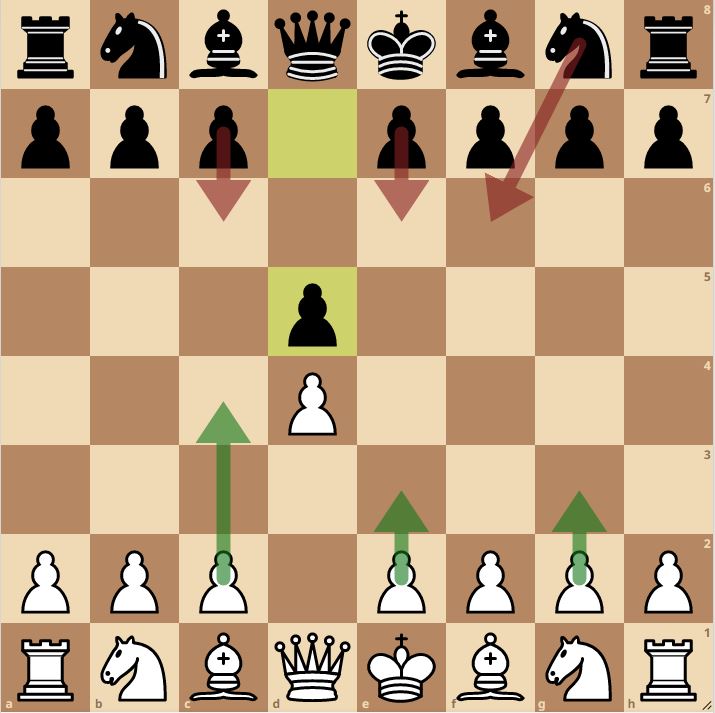
And which pieces benefit from that? Knights. In a closed position there are no big open diagonals for the bishops, so the knight — which jumps over pawns — becomes a fearsome piece once it settles on a strong square nobody can kick it from.
What are closed openings?
Closed openings are those that start with 1.d4 (queen’s pawn) and lead to positions where the central pawns block each other. There are no immediate tactical explosions. The player who best masters positional concepts — pawn structure, active pieces, long-term plans — has every chance of winning.
Let’s be clear: while in open games the center opens up early and pieces clash right away, in closed games everything is more measured. Each side builds their position, places their pieces on the best squares and waits for the right moment to launch the attack. The strategic player feels right at home here.
What are the closed openings?
The queen’s pawn opening is the starting point. When you play 1.d4 and Black responds symmetrically holding the center solidly, the position tends to close up. The central pawns protect each other and nobody can advance the e-pawn without first establishing good support.
Why is 1.d4 such a good move? It controls two key central squares — e5 and c5 — and opens the diagonal for the queen’s bishop. It’s a solid, active first move with many possible continuations.
If you want to dig deeper into the difference between the two great universes of openings, I explain it all here: open openings vs closed openings.
Queen’s Gambit
The Queen’s Gambit is perhaps the most famous closed opening in the world — and not just because it gave its name to a TV series. White temporarily offers a pawn (2.c4) to fight for the center with more energy and gain activity.
Does Black capture that pawn? Sometimes yes, sometimes no. Either way, the fight for the center shapes the whole game. It’s an elegant, deep opening that the best players in history have used.
Here’s the complete list of the main closed openings you can study:
- Stonewall Attack
- Blackmar-Diemer Gambit
- Colle System
- Queen’s Bishop Opening
- Torre Attack
- Trompowsky Attack
- Catalan Opening
- London System
And if you want the full picture, here’s the list of opening types:
- Open openings
- Closed openings
- Semi-open openings
- Semi-closed openings
- Irregular openings
Analiza partidas de esta apertura
Pega cualquier PGN para reproducir y estudiar partidas paso a paso. Encuentralas en Lichess o Chess.com.
Preguntas frecuentes
What are closed openings?
Closed openings start with 1.d4 (or 1.c4, English). The game is more positional and slower than in open openings. They include the King's Indian Defense, Nimzo-Indian, and Grünfeld.
Which are the most important closed openings?
The most played are: King's Indian Defense (1.d4 Nf6 2.c4 g6), Nimzo-Indian (2...e6 3.Nc3 Bb4), Grünfeld (2...g6 3.Nc3 d5), and Queen's Indian (2...e6 3.Nf3 b6).
Are closed openings harder than open ones?
Generally yes: they require more positional understanding and less immediate tactical calculation. They're recommended for players who already know open openings well.