
Mikhail Tal: the Magician from Riga who changed the rules of attack
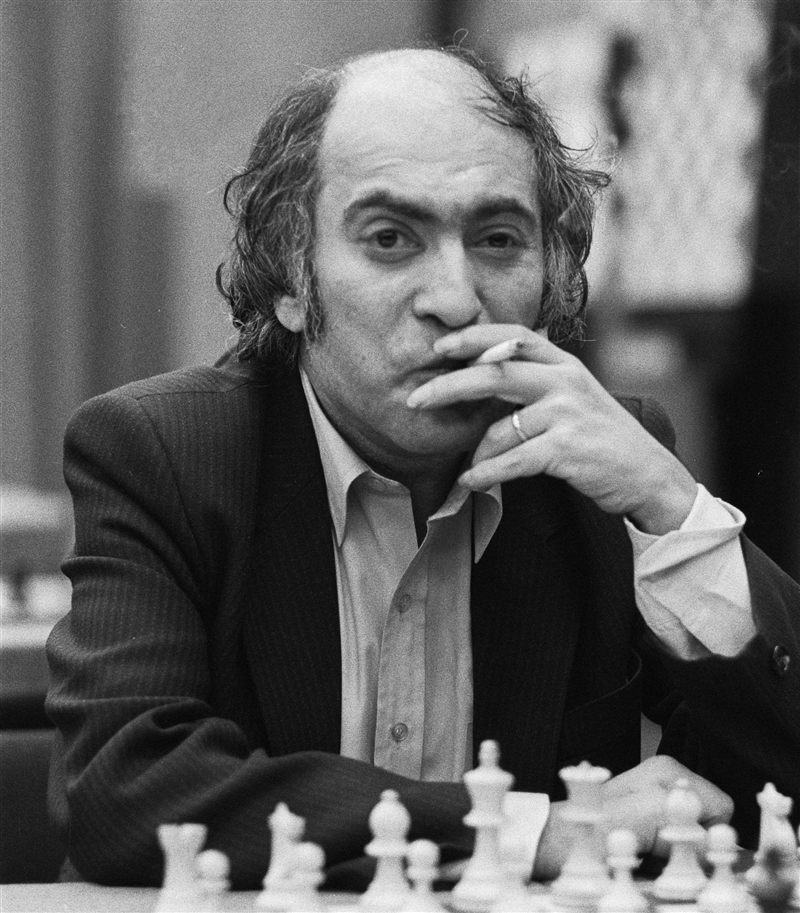
- País
- 🇱🇻 Latvia
- Título
- Grandmaster (GM)
- Nacimiento
- 9 November 1936, Riga (Latvia, then USSR)
- Fallecimiento
- 28 June 1992
- Estado
- fallecido
- ELO máximo
- 2705 · 1980 (first FIDE rating)
- Campeón del mundo
- 1960–1961
There are chess players who win games, and there are chess players who leave you speechless. Mikhail Tal belongs to the second category. No one — before or since — has played chess with the aggression, imagination and beauty that the Latvian displayed in every game. If you’ve ever seen a piece sacrifice that took your breath away, it probably descends from something Tal did first.
Who was Tal
He was born on 9 November 1936 in Riga, capital of Latvia, then part of the Soviet Union. He learned to play as a child and his talent was evident from the start, but what set him apart from other prodigies wasn’t calculation or memory: it was imagination. Where others saw a closed position, Tal saw a sacrifice. Where others saw a solid defense, Tal saw a crack.
At 23 he became the youngest world champion up to that point, defeating the legendary Mikhail Botvinnik in 1960.
The sacrifices: the house signature
What made Tal special? He sacrificed material. A lot of material. All the material.
In elite chess, piece sacrifices are exceptional: a grandmaster might play hundreds of games before risking a knight or bishop for an attack. Tal made them in almost every game. And they weren’t forced or fully calculated sacrifices: they were intuitive sacrifices, based on the evaluation that pressure, piece activity and the vulnerability of the opponent’s king more than compensated for the lost piece.
Did they always work? No. Some were objectively incorrect. But the problem for his opponents was that, sitting across from him with the clock running, they couldn’t prove it. Tal imposed a kind of psychological pressure that no one else could exert.
He himself explained it best in a famous phrase:
“There are two types of sacrifices: the correct ones and mine.”
World champion: the match against Botvinnik
In 1960, at 23, Tal faced the patriarch of Soviet chess, Mikhail Botvinnik, in the world championship match. Botvinnik was a scientific, methodical player who approached chess like an engineer. Tal was exactly the opposite.
| Match | Result | Style |
|---|---|---|
| 1960 · Tal vs Botvinnik | Tal wins 12.5–8.5 | Sacrifices, complications, chaos |
| 1961 · Rematch | Botvinnik wins 13–8 | Botvinnik finds the antidote |
In the first match Tal displayed his natural game and Botvinnik found no answer. But the old champion had something others didn’t: an entire year to study the lost games. In the 1961 rematch, Botvinnik arrived with specific preparation to neutralize the complications, and Tal — recently operated on for a kidney condition — wasn’t in shape to resist.
What Wikipedia doesn’t tell you: why Tal still matters
Here’s the key that sets Tal apart from other world champions. Many historical players are respected but rarely studied by modern fans. Tal is still constantly studied, and there’s a practical reason: his chess teaches something no other champion teaches as well.
Initiative is worth more than material
Tal’s central lesson is that time and activity can be worth more than a piece. In modern chess, where engines say a bishop is worth exactly 3 points, Tal showed that in many positions pressure, multiple threats and the opponent’s disorganization are worth much more than those theoretical 3 points.
If you’re an intermediate-level player and your problem is that you play too passively, studying Tal is probably the most useful thing you can do. Not to copy his sacrifices — which require extraordinary calculation ability — but to internalize the idea that you don’t always have to preserve material.
Psychological pressure as a weapon
Tal knew something that chess programs don’t: that humans make mistakes under pressure. His sacrifices didn’t need to be perfect. It was enough that they were hard to refute with limited time. In practice, the vast majority of his opponents crumbled.
That’s still valid today. If you play chess online, creating complications is one of the most effective weapons, especially in rapid and blitz games.
A life marked by illness
Tal’s biography has an aspect often overlooked. From a young age he suffered serious kidney problems that required multiple surgeries. He played much of his career in chronic pain, went straight from the hospital to a tournament, and on several occasions had to withdraw from competitions midway through.
Despite this, he remained among the world’s best for three decades. In 1980, at 43, he was the world’s third-ranked player with a rating of 2705. In 1988 he was still winning tournaments. He passed away on 28 June 1992 in Moscow, at age 55.
The combination of genius on the board and adversity off it makes Tal a deeply human figure, very different from the stereotype of the cold, calculating grandmaster.
His chess DNA
In our chess DNA system, Tal represents the maximum aggression profile: extreme tactics, constant sacrifices, psychological pressure and a relative indifference to positional solidity. If, when analyzing your play, you discover that your “GM twin” is Tal, it means your style is pure attacker — and that you probably win many brilliant games… and lose a few you shouldn’t.
What to study from Tal
If you want to learn from his chess:
- His games from the 1959 Candidates Tournament — the tournament that earned him the right to challenge Botvinnik. He won with crushing authority.
- The sacrifices against Larsen — several games against Denmark’s Bent Larsen where Tal showed that imagination can beat technique.
- His book of games — The Life and Games of Mikhail Tal is considered one of the best chess books in history, written with humor and intelligence.
Keep exploring
- Garry Kasparov, heir to the aggressive style
- What is rating and how it’s calculated
- World chess champions
- All players
Preguntas frecuentes
Why is Mikhail Tal called 'the Magician from Riga'?
Because his sacrifices seemed to come out of nowhere, like magic tricks. He gave up pieces — bishop, knight, rook, even the queen — in positions where other great masters saw balance, and then an irresistible attack would appear. His opponents knew the sacrifice was incorrect in many cases, but at the board, with the clock running, it was practically impossible to defend against.
What was Tal's playing style like?
Pure aggression. Tal sought complications in every game: open openings (1.e4), speculative sacrifices in exchange for initiative, attacks on the king, and positions where material advantage didn't matter because the psychological pressure was crushing. He is considered the most tactical and imaginative player in history.
Why was Tal's reign as world champion so brief?
He won the title in 1960, but his health was fragile: he suffered from chronic kidney problems that required repeated surgeries. In the 1961 rematch against Botvinnik, he played far below his level and lost clearly. He never disputed a world championship match again, though he remained among the world's best for two more decades.