How the pawn moves in chess
The weakest piece on the board? Only on paper. The pawn is worth 1 point, sure, but I guarantee that once you understand everything it can do, you’ll see it differently. Let’s go through it together.
If you want to review how all the pieces move in general first, take a look at how the pieces move. And if you need to compare piece values, that reference is available too.
How does the pawn move?
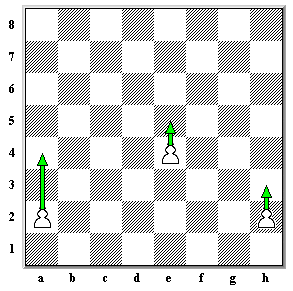
At the start of the game you have 8 pawns, one in front of each piece on your first rank. The basic rule is simple: the pawn only moves forward, one square at a time. It never moves backward. That’s it… except for its first move.
On its first move, the pawn has an extra option: it can advance one or two squares. This gives some flexibility early in the game. From then on, always one at a time.
The blocked pawn
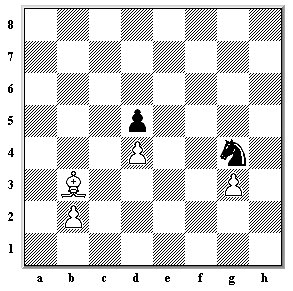
What happens if there’s a piece right in front of the pawn? It can’t move. Neither yours nor the opponent’s: any piece occupying the square ahead blocks it completely. Look at the image: none of those pawns can advance.
How does the pawn capture?
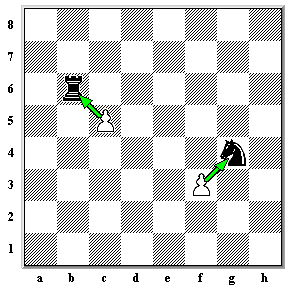
Here’s the part that usually surprises beginners. The pawn doesn’t capture straight ahead; it captures diagonally, one square forward and to the side. Only diagonally.
This makes a lot of sense if you think about it: the pawn advances through the center, but attacks the flanks. In the examples below you can see how the white pawn can capture both the rook and the knight.
Promotion: every pawn’s dream
Now for the pawn’s most exciting move. If you manage to get it to the board’s last rank, you can turn it into any piece of your color, except the king. This is called promoting.
Which piece do you promote to? Almost always a queen, since it’s the most powerful. But there are specific situations where promoting to a rook, bishop, or knight is worthwhile. It happens more often than you’d think in the endgame.
You can go deeper into all this in the article on pawn promotion.
En passant
This is the most special rule in chess. Let me walk you through it.
Imagine your pawn is on the fifth rank and the opponent advances their pawn two squares from its starting position, landing right beside yours. You can capture it as if it had only advanced one square, taking it diagonally. That’s en passant.
There’s one fundamental condition: you can only do it on the very next move. If you wait one more move, you lose that right forever.
I explain it in much more detail in en passant.
The pawn’s real value
The official value of the pawn is 1 point. The lowest of all the pieces. But here’s something important beginners take a while to grasp: pawns are the backbone of your position.
They control space, determine whether the position is open or closed, support the attack, and defend the king. And if you reach the endgame with a pawn advantage, you can decide the game. In fact, pawn endgames are a whole world within chess.
A single point of material advantage can be enough to win. Don’t underestimate the pawn.
Preguntas frecuentes
How many squares does the pawn advance?
Usually one square forward. On its first move it can advance two squares. It never moves backward.
How does the pawn capture?
The pawn captures diagonally: one square forward and to the side. It can't capture straight ahead.
What is pawn promotion?
When a pawn reaches the last rank (rank 8 for White, rank 1 for Black) it turns into any other piece, usually a queen.
What is en passant?
If the opponent advances their pawn two squares from its starting position and yours is right next to it, you can capture it as if it had only advanced one square. Only legal on the immediate next move.