
Bobby Fischer: the genius of American chess
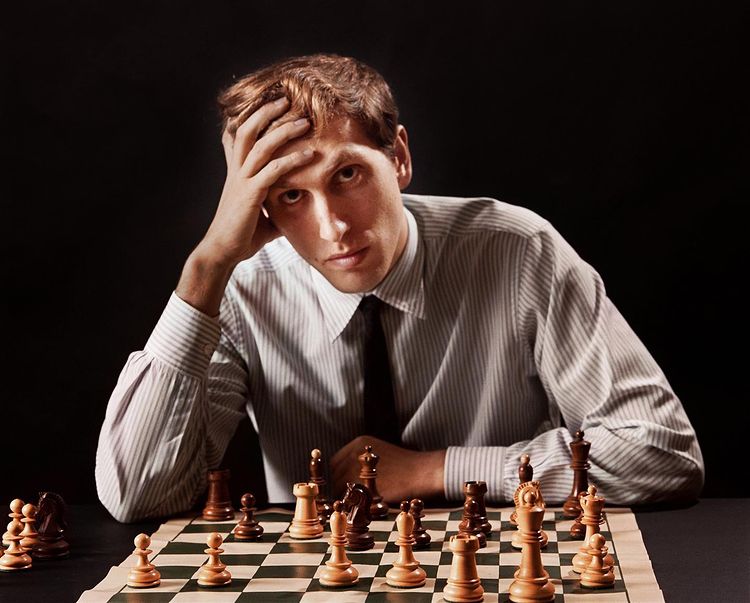
- País
- 🇺🇸 United States
- Título
- Gran Maestro (GM)
- Nacimiento
- March 9, 1943, Chicago, Illinois (USA)
- Fallecimiento
- January 17, 2008
- Estado
- fallecido
- ELO máximo
- 2785 · jul 1972
- Campeón del mundo
- 1972–1975
In chess history there are extraordinary players, and there is Bobby Fischer. A category of his own. An incomparable genius on the board who was, at the same time, one of the most complex and contradictory figures the sport has produced. His life is almost as fascinating — and disturbing — as his chess.
A prodigy in Brooklyn
Robert James Fischer was born on March 9, 1943 in Chicago, though he grew up in Brooklyn, New York. He learned to play on his own, from instructions printed on a chess set box, at age six. No one taught him. No one guided him. He trained by reading books, analyzing games, soaking up theory with an obsessive intensity that would mark his entire life.
At 13 he won his first U.S. Championship. At 15 he became the youngest Grandmaster in history, a record that took decades to fall. That same year he reached the quarterfinals of the World Championship, unprecedented for his age.
The absolute dominance of 1971
If 1972 was his year of glory, 1971 was the year of the definitive demonstration of his superiority. In the qualifiers before the world match he crushed his rivals with terrifying clarity:
- Mark Taimanov (USSR): 6-0. Without conceding a single point.
- Bent Larsen (Denmark): 6-0. Same. Larsen was one of the five best in the world.
- Tigran Petrosian (USSR, former champion): 6.5-2.5. Overwhelming.
Never in elite chess history had such a run of results been seen. Fischer was playing at a level his contemporaries could barely understand.
The Match of the Century: Reykjavik 1972
On July 11, 1972, the most famous match in chess history began in Reykjavik (Iceland): Fischer against Boris Spassky, the Soviet world champion. The context made it more than a sporting duel: full Cold War, with the United States and the USSR staking prestige on every game.
Fischer lost the first game — claiming irregularities and threatening to leave the match — didn’t show up for the second — losing by default — and yet came back to win the title 12.5-8.5. It was one of the great comebacks in 20th-century sport.
The media coverage was unprecedented. For the first time in decades, chess was front-page news around the world.
The title he never defended
In 1975 came the moment to defend the crown against Anatoly Karpov. Fischer demanded conditions FIDE deemed unacceptable: a match format up to seven wins, with no limit on the number of games, and the possibility of the match ending in a draw if both reached ten wins. FIDE gave ground on part of it, but not all. Fischer refused to play. The title passed to Karpov by default, without a single game being played.
From there Fischer disappeared from official chess for two decades. He became a living legend, but also a shadow.
The final years
In 1992 he played an unofficial rematch against Spassky in the former Yugoslavia, amid armed conflict and under international US sanctions. Fischer won, but the legal consequences forced him to live in exile. His final decades were those of a reclusive man, with increasingly erratic public positions.
He died on January 17, 2008 in Reykjavik, the city where he had reached his peak. He was 64, the same number as the squares on a board.
His chess, his legacy
What Fischer left on the board has a purity that’s hard to find. His style was one of absolute clarity: no mysteries, no artifice, pure chess logic taken to the extreme. Extremely deep opening preparation, perfect technique in equal positions, and a tactical relentlessness that made his rivals commit errors they otherwise never would have made.
Many analysts and grandmasters — including Kasparov — consider him the strongest player of all time in terms of relative performance: his gap over the best of his contemporaries was greater than that of any other champion.
Keep exploring
- Garry Kasparov, who broke his ELO record
- The 10 best chess players in history
- Chess world champions
- All players
Preguntas frecuentes
How did Bobby Fischer win the World Championship in 1972?
Fischer defeated Soviet champion Boris Spassky in Reykjavik (Iceland) 12.5-8.5 in what's known as the Match of the Century. It was the first time a Western player had taken the title in decades of Soviet dominance. The match was followed by millions of people at the height of the Cold War.
Why didn't Fischer defend his title in 1975?
Fischer set playing conditions that FIDE did not accept (mainly an unlimited-match clause). With no agreement reached, he was stripped of the title without playing, which passed to Anatoly Karpov by default. He never played an official championship again.
When did Bobby Fischer retire from chess?
His last official appearance was the 1972 world championship. In 1992 he played an unofficial rematch against Spassky in the former Yugoslavia, ignoring US sanctions. From then on he led a wandering, reclusive life, dying in Reykjavik in 2008.