José Raúl Capablanca: the Mozart of chess
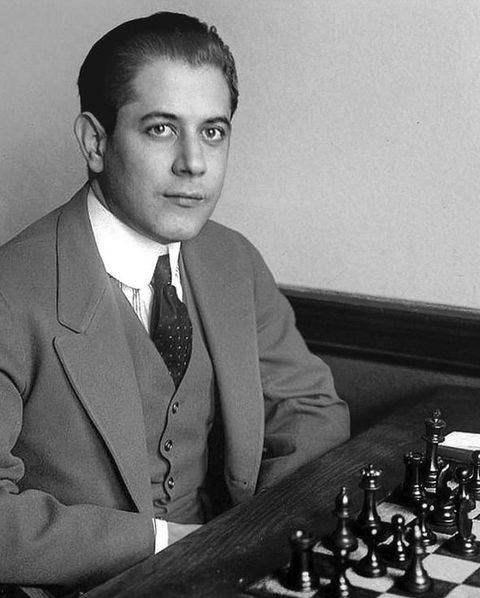
- País
- 🇨🇺 Cuba
- Título
- Gran Maestro (GM)
- Nacimiento
- November 19, 1888, Havana (Cuba)
- Fallecimiento
- March 8, 1942
- Estado
- fallecido
- ELO máximo
- 2725 · 1921 (historical estimate)
- Campeón del mundo
- 1921–1927
If you had to pick the most gifted player in chess history — not necessarily the strongest in absolute terms, but the one with the most natural talent — most grandmasters of every era would say the same name: José Raúl Capablanca. The Cuban who learned to play by watching his father, with no one teaching him, and who over time became a legend still studied a century later.
The boy who discovered chess on his own
José Raúl Capablanca was born on November 19, 1888 in Havana, Cuba. The story of how he learned to play is already part of chess mythology: at four years old, watching a game his father was playing, he noticed that a knight had made an illegal move. When his surprised father asked how he knew the rules, Capablanca replied he had simply worked them out by watching. No one had explained anything to him.
At twelve he was already the best player in Cuba. At twenty-two he defeated American champion Frank Marshall in an official match 8 wins to 1, with 14 draws. Marshall was one of the five best in the world. For Capablanca it was almost a walk in the park.
The streak no one has matched
Between 1916 and 1924, Capablanca played hundreds of games at the highest level without losing a single one. Eight years unbeaten, in tournaments where he competed against the best players on the planet. It’s the longest streak in the history of elite chess.
It wasn’t that his rivals were weak: many were top-tier grandmasters. It was that Capablanca had something the others couldn’t imitate: an intuition that seemed to instinctively separate good moves from bad ones, with no need to calculate endless variations.
The 1921 World Championship
In 1921 came the moment to face world champion Emanuel Lasker, the German who had been at the top for 27 years. The match was held in Havana. The result left no room for debate: Capablanca won 4-0, with 10 draws. Lasker withdrew from the match early, acknowledging the Cuban’s superiority.
The new world champion was 32 years old and his chess was at its peak. The chess world expected him to dominate for decades.
The fall to Alekhine: Buenos Aires 1927
In 1927, in Buenos Aires, Capablanca faced Russian Alexander Alekhine in the championship match. It was a titanic battle: 34 games played, the longest series in history up to that point.
| Result | Detail |
|---|---|
| Alekhine’s wins | 6 |
| Capablanca’s wins | 3 |
| Draws | 25 |
Alekhine won the title. Capablanca, who had entered the match as clear favorite, suffered a defeat he never fully got over. For the rest of his life he sought a rematch that Alekhine systematically refused to grant.
He never became world champion again.
His legacy in chess technique
What makes Capablanca special isn’t his record — although it’s extraordinary — but the quality of his chess. His endgames are studied as perfect models in textbooks. His pawn handling, his sense for simplifying complex positions into won ones, his instinct for favorable trades… it’s all part of the canon of modern chess.
Magnus Carlsen has repeatedly been compared to Capablanca for that same clarity: the ability to extract advantage from positions that look equal, to win where others would sign a draw. Capablanca’s chess was decades ahead of its time.
A note on his historical ELO
The ELO system didn’t exist during Capablanca’s lifetime (the FIDE rating was introduced in 1970). The ELO values on his profile are retroactive estimates calculated with statistical methods applied to his actual results. Different methodologies give different figures; here we use the most conservative standard estimate.
Keep exploring
- The 10 best chess players in history
- Bobby Fischer, another early genius
- Chess endgames: Capablanca’s terrain
- Chess world champions
- All players
Preguntas frecuentes
Why is Capablanca called the Mozart of chess?
Because chess seemed to come to him naturally, almost effortlessly. While other grandmasters studied for hours on end, Capablanca solved complex positions with an intuition his contemporaries couldn't explain. His technique was perfect, and his endgames have been studied for decades as models of efficiency.
How many years did Capablanca go without losing a game?
Capablanca had an eight-year streak without a loss (from 1916 to 1924), during which he played hundreds of games in top-level tournaments. It's the longest unbeaten streak in the history of elite chess.
How did Capablanca lose the world title?
In 1927 he faced challenger Alexander Alekhine in Buenos Aires in an exhausting 34-game match (the longest in history up to that point). Alekhine won 6-3 with 25 draws. Capablanca never got a rematch and never became world champion again.