Mikhail Botvinnik: the patriarch of Soviet chess
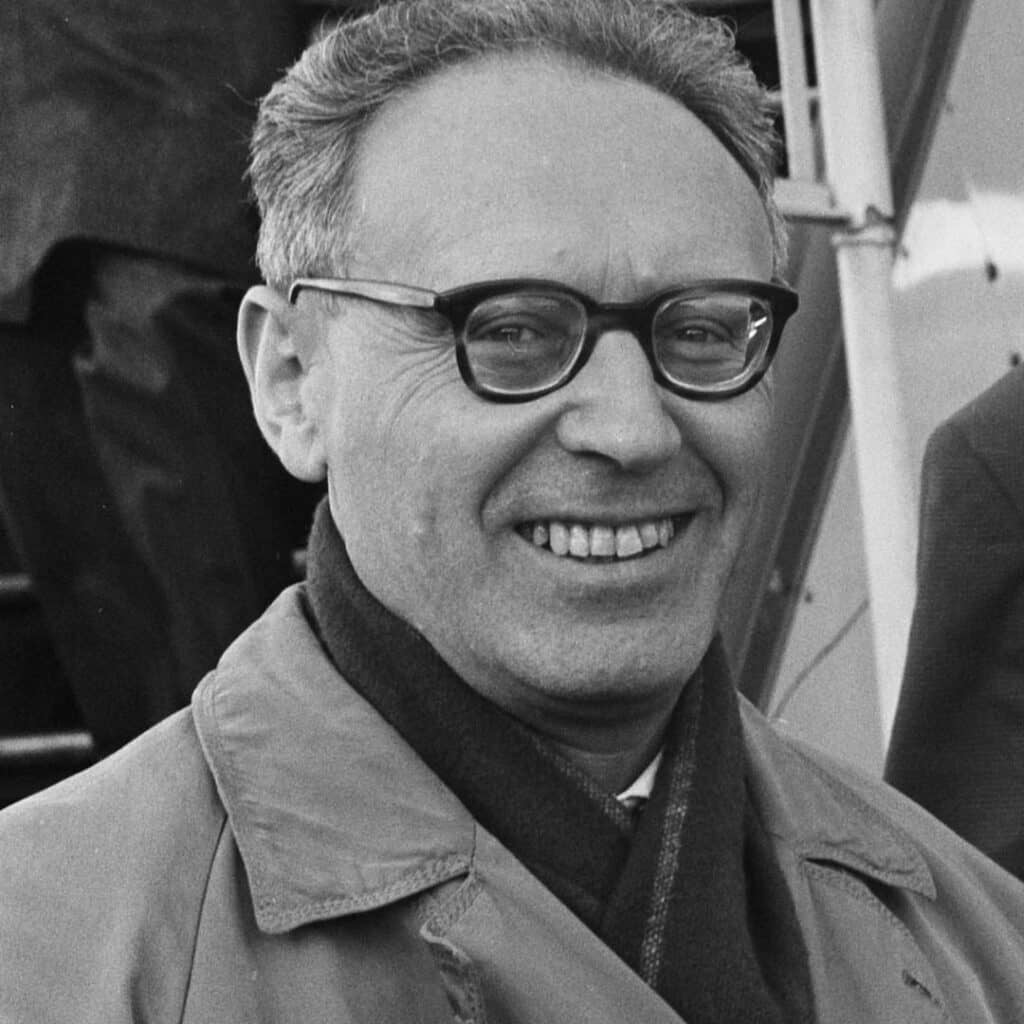
- País
- 🇷🇺 USSR / Russia
- Título
- Grandmaster (GM)
- Nacimiento
- 17 August 1911, Kuokkala (Finland, then Russian Empire; today Repino, Russia)
- Fallecimiento
- 5 May 1995
- Estado
- fallecido
- ELO máximo
- 2630 · 1955–1965 (retroactive estimate / first FIDE rating 1970)
- Campeón del mundo
- 1948–1957, 1958–1960, 1961–1963
In chess there was a before and after Mikhail Botvinnik. Not because he invented new moves or had a spectacular style, but because he was the first to treat chess as a scientific discipline: something that can be studied, systematized and improved with the same rigor as engineering or mathematics. Three-time world champion across three separate reigns, his greatest legacy is perhaps the school that trained the next three Soviet champions.
Who was Botvinnik
He was born on 17 August 1911 in Kuokkala (then part of the Russian Empire, today Repino, on the outskirts of Saint Petersburg). He learned to play at age 12 — late for a future champion — but progressed at a speed that reflected his innate analytical ability. By 14 he was already a candidate master; by 20, one of the best in the Soviet Union.
Alongside chess, Botvinnik built a brilliant academic career: he earned a doctorate in electrical engineering, worked in the field of control systems, and was one of the first to explore computer chess in the USSR. For him, chess and science weren’t separate worlds: both were solved through systematic analysis.
Scientific method applied to the board
What distinguished Botvinnik from his contemporaries wasn’t so much his innate talent as his methodological rigor. While many great masters of his era studied intuitively, Botvinnik built a process:
- Exhaustive opening analysis: he prepared specific lines for each opponent, adapted to their weaknesses.
- Unfiltered self-analysis: he reviewed his lost games with the same coldness as his won ones, looking for specific mistakes.
- Physical preparation: he exercised regularly, something almost revolutionary in a world where the archetypal chess player was sedentary.
- Simulation of tournament conditions: he trained playing in smoke-filled rooms (to get used to real conditions) and interrupted sessions with walks (to simulate breaks).
This approach made him the best-prepared player of his time. He arrived at matches knowing exactly what weaknesses his opponent had and how to exploit them.
Three reigns, three comebacks
The story of champion Botvinnik is singular: he lost the title twice and regained it both times. This resilience record was only possible because at that time FIDE granted an automatic rematch to a champion who lost the title.
| Period | Result |
|---|---|
| 1948–1957 | World champion (The Hague-Moscow tournament) |
| 1957 | Loses to Vasily Smyslov |
| 1958 | Regains the title from Smyslov |
| 1960 | Loses to Mikhail Tal |
| 1961 | Regains the title from Tal |
| 1963 | Loses definitively to Tigran Petrosian |
When Petrosian beat him in 1963, FIDE eliminated the automatic rematch system. Botvinnik accepted the defeat with dignity and retired from world championships, though he continued competing in tournaments for several more years.
The trainer of champions
If three world titles weren’t legacy enough, Botvinnik ran the Botvinnik Chess School for decades, a training center where he trained some of the most important players of the 20th century. Among his most notable students:
- Anatoly Karpov (world champion 1975–1985)
- Garry Kasparov (champion 1985–2000)
- Vladimir Kramnik (champion 2000–2007)
Three consecutive world champions came from his school. It’s a pedagogical legacy without precedent in the history of sport.
His chess DNA
In our chess DNA system, Botvinnik represents the method and scientific preparation profile: extreme solidity, refined technique and unbreakable consistency. If your GM twin is Botvinnik, you stand out for your discipline in study, your ability to arrive at the board prepared, and your methodical, flawless play.
Keep exploring
Preguntas frecuentes
Why is Botvinnik called the 'patriarch of Soviet chess'?
Because he was the first to dominate internationally as a Soviet representative (from the 1930s to the 60s) and because his Chess School — the courses he taught in Moscow — trained three world champions: Karpov, Kasparov and Kramnik. His methodological influence on Soviet chess was as great as his victories on the board.
How did the rematch system work in Botvinnik's world championships?
Botvinnik lost the title in 1957 (to Smyslov) and in 1960 (to Tal), but in both cases FIDE granted him an automatic rematch the following year. He regained it both times. This special rematch system was eliminated precisely when Petrosian took the title from him in 1963 — by then it was no longer Botvinnik who dictated the rules.
What is the 'Botvinnik method' of studying chess?
It's a scientific, systematic approach: Botvinnik analyzed his own games (and his opponent's) with engineering-level rigor, identified specific weaknesses, worked on them during match breaks, and arrived at the board with prepared solutions. He also did regular physical training, unusual for his era. His preparation process was the model that Kasparov — his indirect student — would take even further.