
Good bishop and bad bishop: not all bishops are equal
Two bishops, the same number on the value chart: 3 points each. And yet, in a real game, one can be worth twice as much as the other. Today I’ll teach you to tell them apart.
The bishop travels on a single color, forever
Let’s start with the basics. The bishop moves only diagonally, so it lives the whole game on squares of a single color. A light-squared bishop will never set foot on a dark square, and vice versa.
That’s where today’s whole idea comes from: since the bishop only travels on its own color, what you place on those squares decides whether it breathes or suffocates.
What makes a bishop “bad”
A bad bishop is one whose own pawns are fixed on squares of its own color. Those pawns block its diagonals: the bishop ends up stuck behind its own wall, staring at a barrier.
Take a look at your blocked central pawns. Are they on your bishop’s color? Then that bishop is a prisoner. It’s not weak by nature: it’s your own pawns that have locked it up.
What makes a bishop “good”
A good bishop is just the opposite: its diagonals are clear because its pawns sit on squares of the opposite color. It moves freely and controls long lines from one side of the board to the other.
The textbook example is the fianchettoed bishop: placed on g2 or b2 (or g7/b7), it commands the long diagonal from corner to corner.
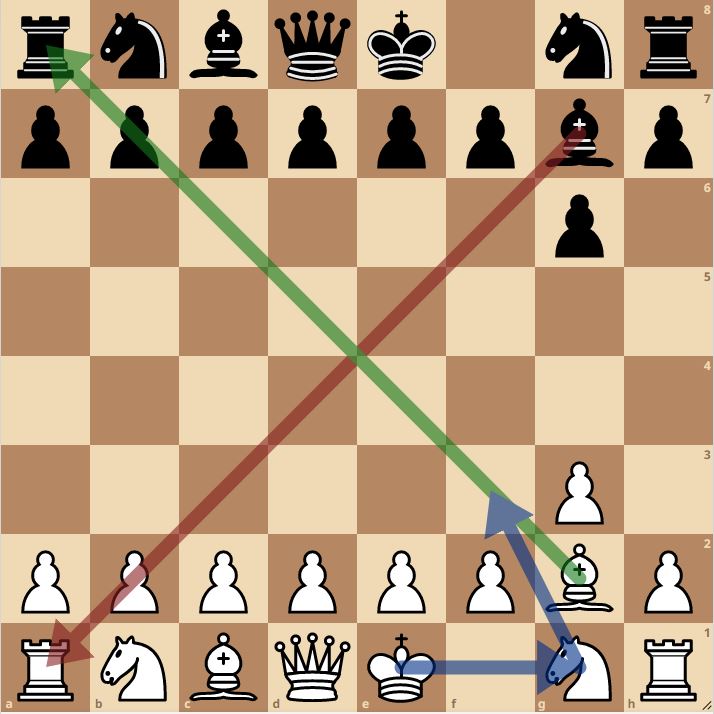
If you want to see this maneuver in detail, I cover it in the fianchetto guide.
What to do with each one
Here’s the practical part, what you can apply right in your next game:
- If you have a bad bishop, improve it or trade it off. You can move the pawns blocking it to squares of the other color, or get the bishop out of the pawn chain before it closes. And if there’s no way, look for a trade: shedding a burden is a small victory.
- If you have a good bishop, keep it. Don’t trade it away without a good reason. It’s one of your strongest pieces.
This idea connects directly with a golden rule: always understand why you’re trading pieces. I go deeper into this in middlegame strategy.
The bottom line
A piece’s value isn’t set in stone: it depends on the position. A bishop can be a giant or a burden depending on where your pawns are. Learning to see this is part of playing with active pieces.
Once you start paying attention to the color of your pawns before every trade, you’ll stop giving away good bishops and stop hauling around bad ones. That small habit is worth many rating points.
Useful links
Preguntas frecuentes
What is a bad bishop in chess?
A bad bishop is one whose own pawns are fixed on squares of its own color. Those pawns block its diagonals and leave it with little mobility. Even though the value chart says it's worth 3 points, in practice it can be almost a useless piece.
And a good bishop?
A good bishop is one with clear diagonals, because its pawns sit on squares of the opposite color to its own. It moves freely, controls long lines, and is usually worth much more than a bad bishop.
Is it worth trading off the bad bishop?
Almost always yes. If you have a bad bishop boxed in, trading it for an active enemy piece removes a burden. Conversely, if you have a good bishop, try to keep it: it's one of your best pieces.