Alexander Alekhine: the master of combination
- País
- 🇷🇺 Russia / France
- Título
- Grandmaster (GM)
- Nacimiento
- October 31, 1892, Moscow (Russian Empire)
- Fallecimiento
- March 24, 1946
- Estado
- fallecido
- ELO máximo
- 2690 · 1927-1937 (retroactive estimate)
- Campeón del mundo
- 1927-1935, 1937-1946
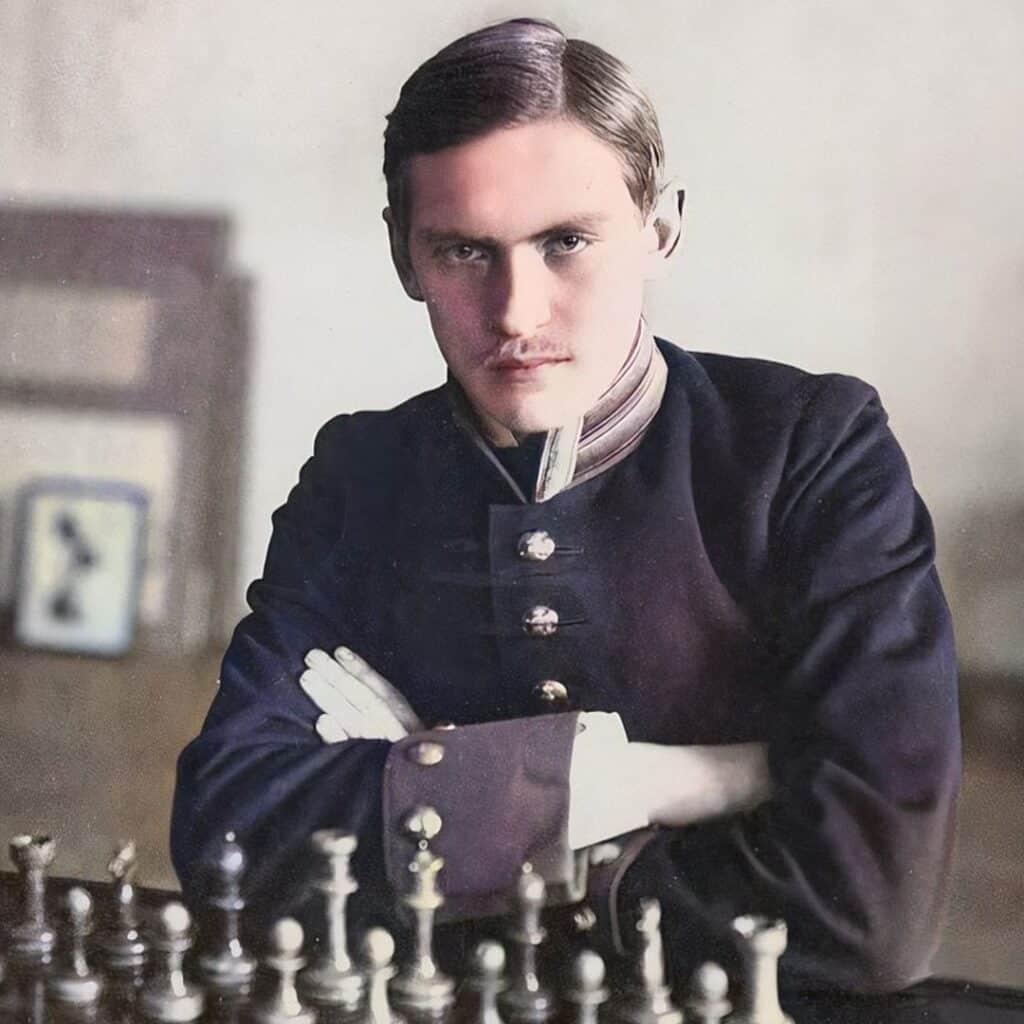
Some players win, and some players dazzle. Alexander Alekhine belonged to both categories at once, something few have achieved in chess history. He was the first grandmaster to combine tactical aggression with deep positional technique; the player who defeated Capablanca — the man many considered invincible — and who died as world champion without ever having lost the title over the board.
Who was Alekhine
He was born on October 31, 1892 in Moscow, into an aristocratic Russian family. He learned to play at seven and by 16 was already competing in top-level international tournaments. His rise was as fast as it was brilliant: by the early 1920s he was one of the best in the world, though he still had to face the great test of his career: José Raúl Capablanca.
The Russian Revolution changed the course of his life. Alekhine emigrated to France in the 1920s, adopted French citizenship, and competed under that flag for the rest of his career. In Paris he also built a solid legal career, though chess was always his true calling.
Combination as art
If one word defines Alekhine’s chess, it’s combination. Not the intuitive sacrifice of Tal — which came from pure instinct — but calculated, deep combination, with plans spanning ten, fifteen, twenty moves that blended attacking initiative with positional restraint.
Alekhine understood, before anyone else, that attack and positional technique aren’t opposites: the best attack is the one that arises from a strategically superior position. His games built the positional advantage first and unleashed the tactical combination afterward, when the opponent no longer had a defense.
This approach made him an innovator. Several opening variations bear his name — among them the Alekhine Defense (1.e4 Nf6), which challenges White’s central pawn from the very first move — because he was the first to systematically explore them.
The match of the century: Alekhine vs Capablanca (1927)
In 1927, Capablanca was practically unbeatable. He’d gone eight years without losing a single game, and many believed chess was approaching “death by draw”: if the champion was so perfect, who could defeat him?
Alekhine proved it was possible. In Buenos Aires, in the longest World Championship match played up to that point (34 games), he prepared a battery of complex positions where his combinative ability outmatched Capablanca’s precise, technical game. He won 6-3 (25 draws) and became world champion at 34.
The defeat was so unexpected that Capablanca never fully accepted it. He demanded a rematch for years, but Alekhine — following the precedent set by Wilhelm Steinitz — never granted it on the terms the Cuban asked for.
The Euwe interlude: the only stumble
In 1935, Dutch mathematician Max Euwe challenged Alekhine for the title. It was the most surprising match of the century: Alekhine arrived in compromised physical condition after years of disorganized living, and Euwe — methodical, well-prepared, with no obvious weaknesses — prevailed 15.5-14.5.
Alekhine’s response was extraordinary: he disciplined himself, prepared with a new rigor, and in 1937 won the rematch with crushing clarity (15.5-9.5). It was the only time in his career he lost the title, and he recovered it with a performance many consider his greatest chess achievement.
A champion who died at the top
The years of World War II were difficult for Alekhine. He lived in occupied Europe, his activities during that period generated historical controversies, and his health deteriorated. He died on March 24, 1946 in Estoril, Portugal, in his hotel room, still holding the world championship title. He was the only champion to die in office.
His chess DNA
In our chess DNA system, Alekhine represents the deep combinative attack profile: maximum aggression paired with exceptional tactical ability, with a solid technique that sets him apart from purely intuitive attackers. If your GM twin is Alekhine, you calculate well in complicated positions, and your greatest strength is coordinated long-term attacks.
Keep exploring
- Mikhail Tal, the magician of sacrifices
- José Raúl Capablanca, his great rival
- Bobby Fischer, another champion who never returned the title
- World chess champions
- All players
Preguntas frecuentes
Why is Alekhine considered one of the greatest in history?
Because he was the first player able to defeat Capablanca — considered invincible — and because he developed a combinative playing style of unprecedented depth. His games show long-term plans that blend aggressive attack with refined technique; a balance no one before him had achieved at that level.
How did the 1927 Alekhine vs Capablanca match go?
It was one of the tensest and longest matches in history. Played in Buenos Aires, it consisted of 34 games, of which Alekhine won 6, Capablanca won 3, and 25 were drawn. Capablanca, who held the record of not having lost a game in 8 years, was stunned by the depth of Alekhine's preparation and his ability to unbalance seemingly equal positions.
Why did Alekhine lose the title to Euwe in 1935?
Largely for reasons outside the board: Alekhine arrived at the match in poor physical and emotional condition due to alcohol. Max Euwe, a methodical, well-prepared Dutch mathematician, prevailed 15.5-14.5. Alekhine recovered, disciplined himself, and in the 1937 rematch won clearly (15.5-9.5). He would never lose the title again.