
Paul Morphy: the first chess genius and why he still matters
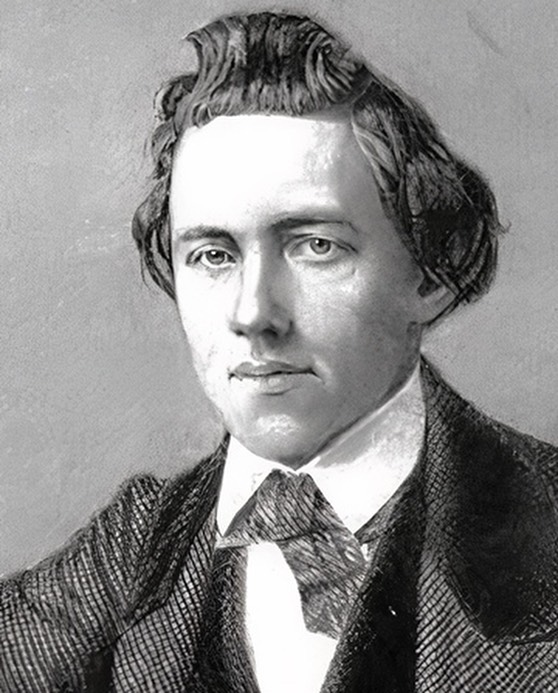
- País
- 🇺🇸 United States
- Título
- Unofficial (pre-FIDE)
- Nacimiento
- 22 June 1837, New Orleans, Louisiana (USA)
- Fallecimiento
- 10 July 1884
- Estado
- fallecido
- ELO máximo
- 2690 · 1858 (Chessmetrics estimate)
If you could travel back in time and place every chess player in their historical context, measuring how much stronger each one was relative to their contemporaries, Paul Morphy would probably be number one. Not because he was better than Carlsen in absolute terms — chess has advanced 160 years — but because the gap between Morphy and his rivals was abysmal. No one in the history of the game has dominated their generation so clearly.
A genius from New Orleans
Paul Charles Morphy was born on 22 June 1837 in New Orleans, Louisiana. His family was cultured and wealthy: his father was a judge of the Louisiana Supreme Court. He learned to play chess at eight, watching games between his father and uncle, and by nine was already defeating the best players in the city.
At twelve he beat Johann Löwenthal, a strong Hungarian master touring the US. Löwenthal was so impressed that he was one of the first to publicly recognize the genius of that child.
The 1858 European tour: the hurricane
In 1857, at 20, Morphy won the First American Chess Congress without losing a single game. But that was just the appetizer. In 1858 he crossed the Atlantic to face the best European players.
The results left no room for doubt:
| Opponent | Result | Context |
|---|---|---|
| Adolf Anderssen (Europe’s best) | Morphy wins 7-2 (2 draws) | Formal match in Paris |
| Daniel Harrwitz | Morphy wins 5.5-2.5 | Match in Paris |
| Henry Bird | Morphy wins 10-1 | Games in London |
| Johann Löwenthal | Morphy wins 9-3 | Match in London |
Anderssen was considered the best player in the world before Morphy’s arrival. After losing 7-2, he unambiguously acknowledged the American’s superiority.
What made Morphy different
Here’s the key, and the reason Morphy still matters 160 years later.
In Morphy’s era, chess players played chaotically. They rushed into attacks before developing their pieces, sacrificed material without calculating whether the compensation was sufficient, moved the same piece three times in the opening while the rest remained on their starting squares. It was the so-called “Romantic chess”: spectacular, but full of mistakes.
Morphy did something radically different. He applied principles we now teach any beginner but that no one understood in his time:
1. Rapid development
Morphy brought out all his pieces to active squares before trying anything. While his opponents moved the queen three times in the first ten moves, he had his knights, bishops, rooks and castled king ready to fight.
2. Control of the center
He didn’t just place pawns in the center: he understood that pieces in the center are more powerful because they control more squares. A bishop on e4 is worth more than a bishop on a1.
3. Opening lines
Morphy sought to open files and diagonals for his pieces, especially the rooks. Once all his pieces were developed and coordinated, the attack came naturally, without the need for forced sacrifices.
The paradox is that Morphy is remembered as a Romantic player — and indeed his games contain brilliant sacrifices — but his sacrifices worked because he was more developed than his opponent. They weren’t tricks: they were the logical consequence of playing with correct principles against someone who didn’t follow them.
The Opera Game: chess’s most famous game
The Opera Game (Morphy vs. Duke of Brunswick and Count Isouard, Paris 1858) is probably the most reproduced and studied game in chess history. Not because it’s the most complex — an engine solves it in seconds — but because it illustrates Morphy’s principles with perfect clarity:
- Rapid development of all pieces.
- Opening of the center.
- Final sacrifice that is the natural consequence of superiority in development.
If you ever teach chess to someone, that’s the first game you should show them.
Retirement at 22
After sweeping through Europe, Morphy returned to New Orleans in 1859. He was 22 years old. And he stopped playing chess.
It wasn’t a dramatic retirement like Fischer’s. Morphy simply considered chess a pastime, not a profession worthy of a Southern gentleman. He tried to practice law, but the Civil War (1861-1865) devastated the South’s economy and his family’s fortune.
His last years were sad. His mental health deteriorated, he developed paranoia and became increasingly withdrawn. He died on 10 July 1884, at age 47, practically forgotten by the society that had once celebrated him.
His chess DNA
In our chess DNA system, Morphy represents the classic attacker: high aggression but with positional foundation, direct style, development as priority. If your GM twin is Morphy, you play with common sense, attack when you’re prepared, and your games have a clarity sometimes mistaken for simplicity. In reality, it’s the cleanest way to play chess.
What Bobby Fischer said about Morphy
It’s no coincidence that Fischer, another absolute genius, said Morphy was one of the players who had influenced him most. Fischer identified in Morphy the purity of principles he himself sought: winning games not with tricks or memory, but with a deep understanding of what chess really is.
Keep exploring
- Bobby Fischer, heir to his American style
- Mikhail Tal, the other genius of attack (but with an opposite approach)
- World chess champions
- All players
Preguntas frecuentes
Is Paul Morphy considered a world champion?
He didn't have an official title because the World Chess Championship wasn't formally established until 1886, when Steinitz beat Zukertort. However, Morphy was universally recognized as the best player in the world in 1858-59, with such crushing dominance that no one disputed his superiority.
Why did Morphy retire from chess so young?
Morphy came from a wealthy New Orleans family and considered chess a pastime, not a profession. After proving his superiority in Europe, he tried to practice law, but the Civil War ruined his family's finances. His mental health deteriorated in the following years and he never competed seriously again.
What's special about Morphy's chess compared to his era?
While his contemporaries sought premature attacks and unfounded sacrifices, Morphy played with principles we now consider basic: rapid piece development, control of the center, opening lines for the rooks. It seemed simple, but it was so superior to the chess of his time that he won almost effortlessly. Bobby Fischer identified him as the player who best understood the fundamentals.