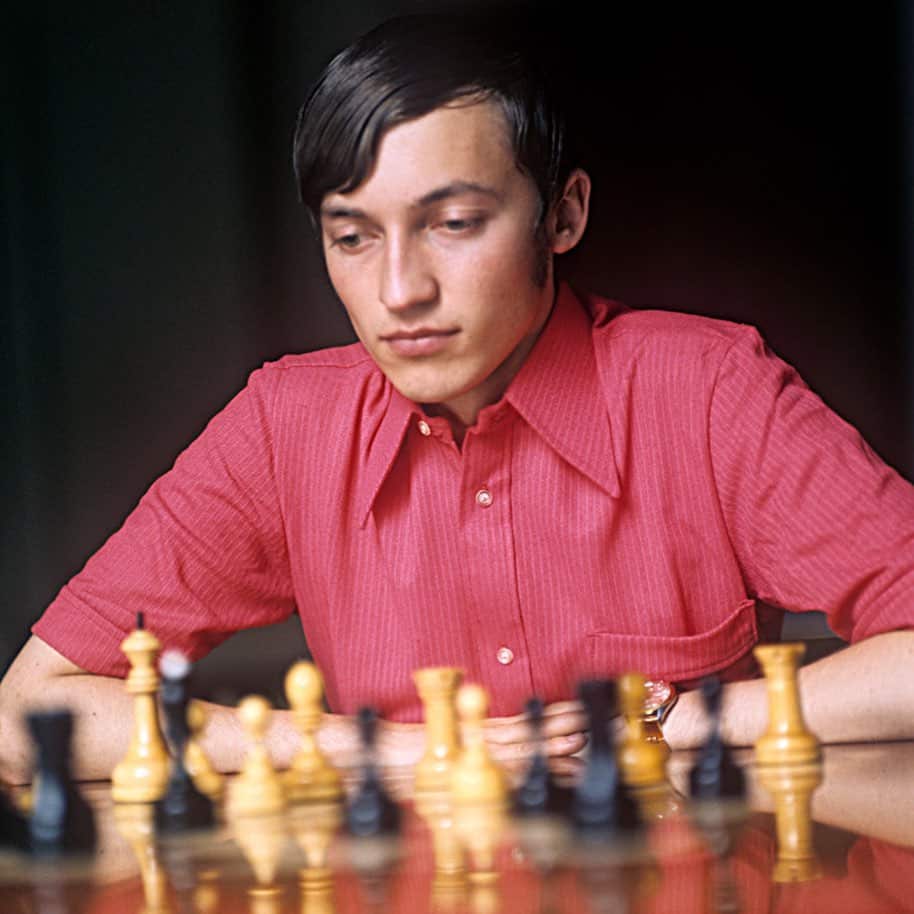
Anatoly Karpov: the boa constrictor of chess
- País
- 🇷🇺 Russia
- Título
- Grandmaster (GM)
- Nacimiento
- May 23, 1951, Zlatoust (Russia, then USSR)
- Estado
- retirado
- Último ELO
- 2617 · Jan 2012 (de facto retirement)
- ELO máximo
- 2780 · Jul 1994
- Campeón del mundo
- 1975-1985 (classical), 1993-1999 (FIDE)
If Tal was fire, Anatoly Karpov was ice. He didn’t need spectacular sacrifices or mating attacks to win: it was enough to suffocate the opponent, step by step, move by move, until the enemy pieces had nowhere to go. He’s one of the most efficient players who ever lived, and understanding his chess means understanding a dimension of the game many fans don’t even know exists.
Who is Karpov
He was born on May 23, 1951 in Zlatoust, an industrial city in the Urals in Russia (then USSR). He learned to play at four and was already an International Master at 15. In 1970, at 19, he became the youngest Grandmaster in the world, a record he would hold until Bobby Fischer retroactively surpassed it in the statistics.
His rise in the 1970s was unstoppable. He won tournament after tournament, eliminated Spassky and Korchnoi in the World Championship qualifiers, and prepared to face Fischer himself.
The title nobody contested
In 1975 Karpov was due to face Bobby Fischer for the World Championship. Fischer, as we’ve told in his profile, imposed conditions FIDE didn’t accept and withdrew from the match without playing. Karpov became world champion by default.
That circumstance followed him for years: many said he wasn’t a “legitimate” champion. Karpov’s response was crushing: he won practically everything he played over the following decade, proving with results that he was, without any possible argument, the best in the world.
The boa constrictor: how Karpov played
The nickname says it all. Karpov didn’t attack: he restricted. His technique was that of a player who controlled key squares, limited the movement of enemy pieces, and made every move a small step toward total suffocation.
This is much harder than it sounds. While a brilliant attack can be copied move by move, Karpov’s style requires a deep understanding of pawn structure, space, and prophylaxis (the art of anticipating the opponent’s plans before they materialize). These are concepts that separate good players from truly strong ones.
What can you learn from Karpov?
If your problem in chess is that you always look to attack and run out of ideas when there’s no direct mate, studying Karpov can transform your game. His games teach something no tactics book can give you:
- Space control: how to gain squares without risking material.
- Playing with minimal advantages: how to convert a passed pawn or an open file into a win.
- Prophylaxis: how to foresee the opponent’s plans and neutralize them before they exist.
- Patience: not every position is won with a strike. Many are won by waiting.
These are the foundations of positional chess, and Karpov takes them to the highest level ever seen.
The rivalry with Kasparov: five world championships
In 1984 began the most extraordinary rivalry in modern chess. Garry Kasparov, 12 years younger than Karpov, qualified to challenge him. What followed was an epic marathon:
| Year | Venue | Result |
|---|---|---|
| 1984 | Moscow | Annulled by FIDE after 48 games (5-3 in Karpov’s favor) |
| 1985 | Moscow | Kasparov wins the title (13-11) |
| 1986 | London/Leningrad | Kasparov retains (12.5-11.5) |
| 1987 | Seville | Tied 12-12, Kasparov retains |
| 1990 | New York/Lyon | Kasparov retains (12.5-11.5) |
The first match is one of the most controversial episodes in chess history. After 48 games, with Karpov physically exhausted (he had lost more than 10 kilos), FIDE president Florencio Campomanes suspended the match without a result. Karpov was leading 5-3, but Kasparov had come back to win three games in a row. Was Karpov robbed of victory, or was he saved from defeat? The debate remains open.
The tournament champion
If we set aside the world championship matches against Kasparov, Karpov’s record is among the most impressive in history. He won more than 160 top-level tournaments, a figure not even Carlsen has matched. His ability to play at a consistently high level for decades — from the 1970s well into the 2000s — says a lot about his depth as a chess player.
In 1994 he reached his all-time peak ELO of 2780, as FIDE champion of the alternative cycle (during the Kasparov-FIDE schism). He wasn’t a number one by circumstance: he was simply the best player left when Kasparov wasn’t on his side of the circuit.
His chess DNA
In our chess DNA system, Karpov represents the extreme solidity and technique profile: low aggression, maximum positional pressure, unshakable consistency. If your GM twin is Karpov, it means your strength is in quiet positions, in control, in squeezing without risk — and your biggest weakness is probably in tactical strike-and-counterstrike positions.
Keep exploring
- Garry Kasparov, the eternal rival
- Mikhail Tal, the opposite pole
- Bobby Fischer, who never faced Karpov
- World chess champions
- All players
Preguntas frecuentes
Why is Karpov considered one of the best in history?
Because he was the most dominant player of the 1970s and 80s: he won more than 160 top-level tournaments, maintained an elite ELO for nearly three decades, and his positional style — restrictive, patient, suffocating — defined an era. Only Kasparov's arrival prevented an even longer reign.
How did the Karpov-Kasparov rivalry unfold?
It's the longest and most dramatic rivalry in chess history. They faced each other in five world championships between 1984 and 1990, playing 144 classical games. The first match (1984) was so long that FIDE annulled it without a result after 48 games. Kasparov eventually prevailed, but the level of both players raised chess to heights never seen before.
Why is Karpov called 'the boa constrictor'?
Because his style was suffocating: he didn't attack directly, but instead restricted the opponent's pieces, taking away space and options until they had no useful moves left. In the end, victory came almost through positional surrender, without the need for a brilliant attack.