Chessboard: how to set it up, name it, and use it
Before you move a single piece, you need to know the battlefield. The chessboard is the first concept we’ll master, and I promise it’s simpler than it looks.
What is a chessboard?
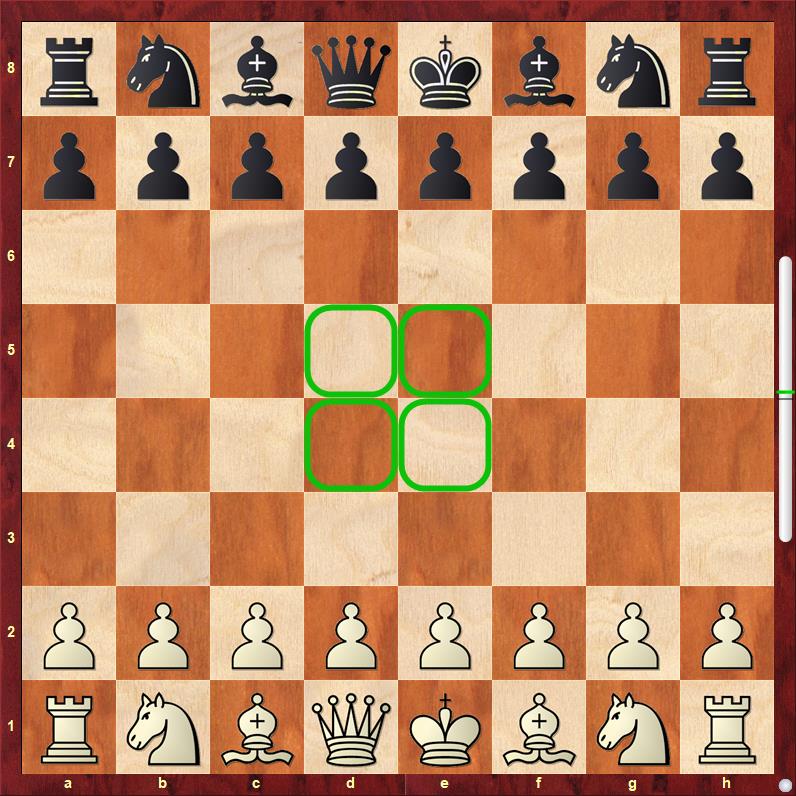
The board is a grid of 8 files by 8 ranks: 64 squares in total. The squares alternate between light and dark, which makes them instantly distinguishable to the eye.
 Chessboard
Why does it matter to know it well? Because every move is described by its origin and destination square. If you can’t orient yourself on the board, you can’t read or record a game. And once you master it, everything else — the pieces, the plans, the traps — starts to make sense.
Division of the chessboard
The board is divided into three strategic zones:
- Queenside — files a and b (left from White’s point of view).
- Kingside — files g and h (right).
- Center — files c, d, e, and f.
Within the center there are four especially important squares: d4, d5, e4, and e5. They’re the heart of the board. Controlling those squares from the opening is one of the most basic principles in chess. The rules of the game don’t force you to fight for them, but the experience of millions of games does.
Naming the squares on a chessboard
Let’s look at how each square is named, because you’ll need it to understand any game.
The system is simple: it combines a letter (file) with a number (rank).
- Files go from a to h, left to right from White’s side.
- Ranks go from 1 to 8, bottom to top (rank 1 is White’s).
For example, b5 is the square on the b-file, fifth rank. The letter always comes before the number: it’s written b5, never 5b.
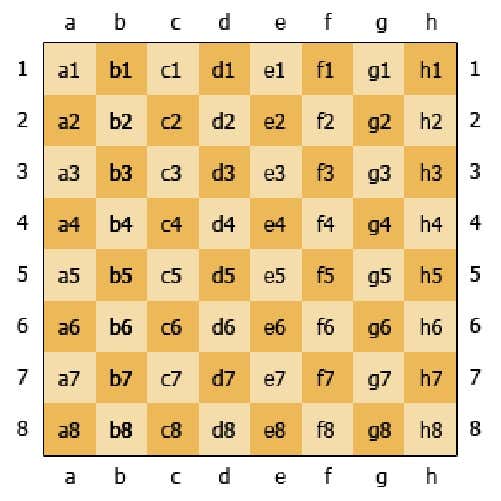
Notice the corners: a1 and h1 are White’s corners; a8 and h8 are Black’s. This algebraic notation is the language of modern chess — you’ll use it to record your games and to read the games of the world’s best players.
Each square on the board is called a square (in Spanish, escaque). It’s the technical term you’ll see in books and articles, so it’s worth knowing from the start.
How to orient the board correctly
There’s a very common mistake among beginners: setting up the board the wrong way around. The rule is easy to remember:
The square in the bottom-right corner must always be light.
If that corner is dark for you, rotate the board 90°. It’s that simple.
Once properly oriented, the white king goes on e1 and the white queen on d1. Remember: the queen goes on her own color — the white queen on a light square, the black queen on a dark square.
Chessboard sizes
If you’re thinking about buying a physical board, here are the official sizes you should know.
The perfect size is one where the king occupies about 75% of the square. That’s the standard ratio between the piece and the square.
For official tournaments, each square must measure a minimum of 55 mm, and the king’s height should be 90 mm (Staunton No. 5). If you want to know more about piece sizes, check this article: What size should chess pieces be?
For school tournaments, a board with 38 mm squares and a 75 mm king (Staunton No. 4) is also valid.
In general, each square’s side should measure between 5 and 6 cm — at least double the diameter of a pawn’s base.
Which chessboard should I buy?
Let’s look at the different types of boards available so you can choose the one that fits you best.
Roll-up boards
The most practical to start with. Cheap, light, and portable, you’ll find them in almost every club and school tournament. A 50 cm vinyl roll-up board is more than enough to learn and compete.
Wooden boards
The most common for home and clubs. They come in a wide variety of woods and finishes. Most are made in Poland, Spain, India, and the United States. An affordable wooden board is a great starting point if you want something more durable.
High-quality boards
High-quality hardwood boards are an artisanal option, built to last decades. They make an ideal gift or a stylish addition to your space.
Demonstration boards
If you teach chess, a wall-mounted demonstration board is essential. They’re usually vinyl and roll up for easy transport between classrooms. The whole class can see the moves at once.
Leather boards
Leather boards, many imported from Italy, pair very well with metal pieces or other exclusive designs. There are also cheaper faux-leather versions.
DGT boards
The DGT electronic board is the standard in top-level competitions — world championships are played on them. It connects to chess software to record and broadcast games in real time. It’s a serious investment, but if you want the best on the market, this is it.
Once you know the board, the natural next step is learning how all the pieces move. And when you want to read or record your games, algebraic notation is waiting. Let’s get to it.
Preguntas frecuentes
How many squares does a chessboard have?
A chessboard has 64 squares: an 8-by-8 grid. The squares alternate between light and dark colors.
How should the chessboard be oriented?
The board is set up so each player has a light square in their bottom-right corner. If the bottom-right corner is dark, the board is turned the wrong way and needs to be fixed.
What are the board's files and ranks called?
Files (vertical columns) are named a to h, left to right from White's side. Ranks (horizontal rows) are numbered 1 to 8, with rank 1 closest to White.