Tigran Petrosian: chess's impregnable fortress
- País
- 🇦🇲 Armenia
- Título
- Grandmaster (GM)
- Nacimiento
- 17 June 1929, Tiflis (Georgia, then USSR)
- Fallecimiento
- 13 August 1984
- Estado
- fallecido
- ELO máximo
- 2650 · 1972 (first FIDE ELO)
- Campeón del mundo
- 1963–1969
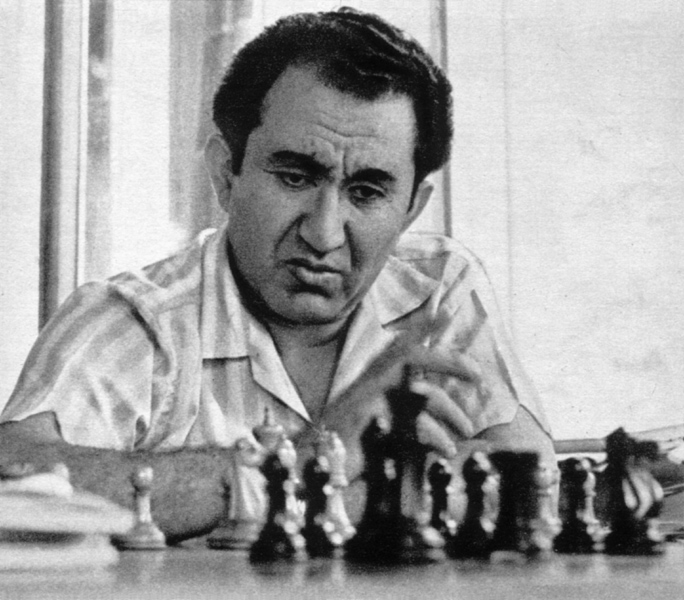
This article is going to be different. Tigran Petrosian won’t impress you with queen sacrifices or eight-move mating attacks. He’s not a player who makes you shout. He’s a player who, if you study him carefully, will make you much stronger. And he’s probably the most underrated world champion in history.
The concept: prophylaxis as philosophy
Before talking about the person, we need to talk about the idea, because without understanding it, Petrosian makes no sense.
In chess, most players think like this: “What do I want to do?” They look for a plan, execute moves, attack. Petrosian thought in a radically different way: “What does my opponent want to do? How do I prevent it?”
That’s called prophylaxis, and it’s, in the opinion of many coaches, the hardest skill to develop and the one that most separates intermediate players from strong ones.
Petrosian took it to the extreme. His games look “slow” or “boring” if you watch them superficially. There are no spectacular tactical blows. But when you analyze them with an engine, you discover something extraordinary: every seemingly harmless move was disabling a specific enemy plan. The opponent simply ran out of options. It’s not that they lost: it’s that they couldn’t play.
Who was Petrosian
He was born on 17 June 1929 in Tiflis (today Tbilisi, Georgia), the son of an Armenian family. He was orphaned as a child during World War II and grew up in very difficult circumstances. He learned to play in the parks of Tiflis, moved to Moscow as a teenager, and made his way through the Soviet chess system on pure merit.
In 1963, after years of attempts, he defeated veteran Mikhail Botvinnik to become world champion. He defended the title in 1966 against Boris Spassky, but lost it in the 1969 rematch to the same opponent. He died in 1984, at 55.
Why Wikipedia doesn’t do him justice
Petrosian’s Wikipedia article will give you dates and results. What it won’t give you is the answer to the question that really matters: why should you care about a player from the 1960s who didn’t play spectacularly?
The answer: because his chess teaches you things no one else can.
1. The exchange sacrifice for positional gain
Petrosian is famous for the exchange sacrifice: giving up a rook (5 points) for a bishop or knight (3 points), not to gain material later, but to improve the position’s structure. In numerical terms it’s a loss. In positional terms, it was often a gain.
This concept is counterintuitive and very hard to master. Most intermediate players cling to material like a lifeline. Petrosian teaches that sometimes material is the least important thing on the board.
2. Defense as a way to win
In modern chess everyone wants to attack. YouTube videos show brilliant sacrifices and mates. Nobody makes videos about “how to neutralize your opponent’s plan without doing anything apparently spectacular.” And yet that skill decides more games than all the sacrifices in the world.
Petrosian won a World Championship by defending. That says everything you need to know about the power of defense when executed at the highest level.
3. Reading your opponent’s plans
Petrosian’s most valuable skill was reading his opponent’s plan. He didn’t need to calculate twenty moves ahead. It was enough to understand what his opponent wanted to do and place his pieces so that it became impossible. It’s a type of thinking that can be trained and that drastically improves any player’s level.
His chess DNA
In our chess DNA system, Petrosian represents the maximum soundness profile: the lowest aggression of the ten archetypes, the highest defense, and an iron consistency. If your GM twin is Petrosian, you have an exceptional defensive fortress, but you probably struggle to generate active play when you have the initiative.
His legacy
Petrosian doesn’t have legions of fans like Tal or Fischer, but he has something more lasting: the unanimous respect of grandmasters. Kasparov, who dedicated an entire volume to Petrosian in My Great Predecessors, considered him one of the hardest players to face. Karpov, whose style is partly inherited from Petrosian’s, studied him constantly. Carlsen has cited his defensive ability as a model to follow.
If you’ve ever wondered why you lose games you “shouldn’t lose,” the answer is probably prophylaxis. And the best teacher of prophylaxis who ever existed is Tigran Petrosian.
Keep exploring
- Anatoly Karpov, heir to his positional style
- Mikhail Tal, his polar opposite on the board
- What is ELO and how is it calculated
- World chess champions
- All players
Preguntas frecuentes
Why is Petrosian called 'the iron fortress'?
Because he was practically impossible to beat. His style was based on prophylaxis — anticipating his opponent's plans and neutralizing them before they materialized. The result was that his positions seemed impregnable: opponents couldn't find weak points to attack. It wasn't spectacular, but it was devastatingly effective.
What is prophylaxis in chess and why did Petrosian master it?
Prophylaxis is the art of thinking about your opponent's plans before your own. Before making your move, you ask yourself: 'What does my opponent want to do?' and act to prevent it. Petrosian took this concept to a level no one has matched: his games look slow and uneventful, but when you analyze them with an engine, you discover that every 'boring' move was disabling a specific enemy plan.
What can you learn from Petrosian's style?
Petrosian is the greatest master of active defense. If you tend to lose games because your opponent attacks you and you don't know how to stop them, studying Petrosian will teach you to read your opponent's plans, to make prophylactic material sacrifices (trading a piece not to gain material, but to eliminate a future threat), and to build positions where your opponent has no way to make progress.