Knight or bishop? Which is better and when to use each
If you look at the value chart, knight and bishop tie: 3 points each. But Capablanca himself, world champion and one of the greatest endgame players in history, knew that’s where the story starts, not where it ends. Which one is better? The honest answer is: it depends on the position. Let’s see what it depends on.
Two pieces, two opposite characters
The bishop and the knight are worth the same, but they’re nothing alike:
- The bishop is long-range: it crosses the whole board in a single move. Its flaw: it lives on one color of squares forever.
- The knight is short-range: it hops only a little, but it hops over other pieces and reaches squares of both colors. Its flaw: it’s slow getting from one flank to the other.
Keep this idea in mind: the bishop wants open space; the knight wants support and fixed squares.
The bishop loves open positions
When the board is clear, the bishop is king of the long distance. From a long diagonal it attacks both flanks at once without moving. The textbook example is the fianchetto:
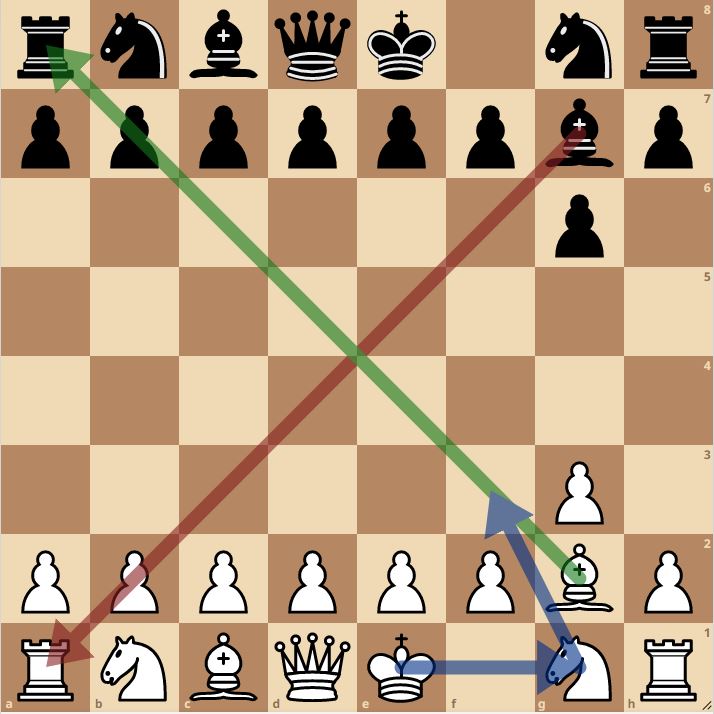
That’s why, if there are pawns on both flanks and open lines, the bishop usually has the edge: it punishes the knight’s slowness, since the knight takes several moves to cross from one side to the other.
The knight loves closed positions
Now flip the situation. If the position is locked, with pawn chains closing off the center, the bishop bangs again and again against walls, both its own and the opponent’s: it turns into a bad bishop. The knight, on the other hand, hops right over everything.
And there’s a place where the knight becomes a monster: an outpost, an advanced square protected by one of your pawns from which no enemy pawn can kick it out. A knight firmly planted in the center can be worth more than any bishop.
The bishop pair
There’s a detail Capablanca valued highly: having both bishops when the opponent only has one left. Since each bishop covers one color, together they watch the entire board with no blind spots. It’s a small but lasting advantage, especially in open positions.
It’s a topic in its own right, so it has its own dedicated page: the bishop pair.
How to use all this in your games
Don’t memorize rules: apply a single idea, the same one as always. Improve your piece and worsen your opponent’s:
- You have bishops and your opponent has knights? Open lines (see control of the center).
- You have knights and your opponent has bishops? Close the center and look for an outpost.
- Does your opponent have a terrible, boxed-in bishop? You might prefer not to trade it off, so they’re stuck carrying it. Have a bad one yourself? Look for a favorable trade.
In endgames this battle matters even more, because with fewer pieces every detail shows: I cover it in bishop vs knight in the endgame.
The bottom line
Forget about “which is worth more” in the abstract. The right question is: what does this position call for? Open, with play on both flanks, hand the reins to the bishop. Closed and locked, trust the knight. That flexibility — reading the position instead of following a fixed rule — is exactly what made Capablanca great.
Useful links
- The value of the pieces (full chart)
- The bishop and the knight
- Good bishop and bad bishop
- The outpost or advanced square
- Bishop vs knight in the endgame
- Favorable piece trades
Preguntas frecuentes
Which is worth more, the knight or the bishop?
On the value chart both are worth 3 points, so on average they're equivalent. But in practice it depends on the position: the bishop is usually somewhat better in open positions with pawns on both flanks, and the knight shines in closed positions and when it gets an advanced square (outpost).
What is the bishop pair?
It's having both bishops when the opponent only has one left (or none). Since each bishop covers one color, together they watch the whole board and complement each other. In open positions it's a small but lasting advantage, highly valued since Steinitz and Capablanca.
When is the knight better than the bishop?
When the position is closed and locked by pawn chains, where the bishop bangs against walls and the knight jumps over them. Also when the knight lands an outpost: an advanced, protected square that no enemy pawn can kick it off of.