
What is check in chess
There’s check when a piece directly attacks the opponent’s king. It’s not the end of the game, but it is an immediate alarm: the threatened player must resolve it that same turn, no excuses or delays.
Don’t resolve it? Then you lose. That’s why it’s worth understanding well from the start.
What happens when your king is in check?
Your king can’t stay under attack. The rules are clear: as soon as you’re in check, you have to get out of it before doing anything else. And for that you have exactly three paths:
- Move the king to a safe square, away from the attack.
- Capture the attacking piece and remove the threat at its root.
- Block with a piece between the attacker and your king, if the type of attack allows it.
Let’s go through each of these options so you have them clear.
Moving the king is the most obvious. You look for an adjacent square where the king isn’t attacked and go there. Simple, but not always possible: sometimes all the nearby squares are also controlled by the opponent.
Capturing the attacking piece is the most aggressive. If you can take the piece giving check, you do it and the problem disappears. Even better if you can do it with a piece other than the king itself.
Blocking with a piece only works when the attack comes from far away: a rook, a bishop, or a queen attacking diagonally or in a straight line. You place one of your pieces in between and block the threat. Careful: if the check comes from a knight or a pawn, you can’t block, because they attack by jumping or from an adjacent square.
If none of these three options exist… then we’re not talking about check anymore. We’re talking about checkmate.
How to block or respond to check
Let’s look at this in more detail, because it’s the part that confuses beginners the most.
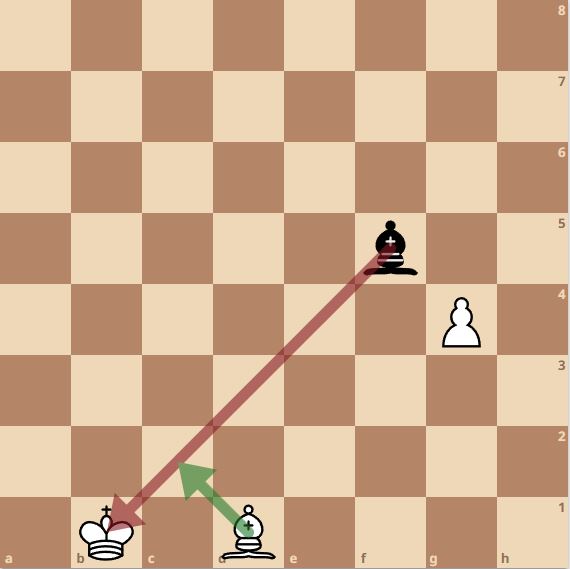
As you can see in the image, faced with a check you always have to evaluate the three options in order: can I move the king to a free square? Can I capture the attacking piece? Can I block it? Whichever one you find available first, you play it.
Once you master this logic, you’ll see that many checks are easy to resolve. The trouble comes when the opponent combines the check with other threats at the same time, or uses it to force you into a worse position.
Practice: deliver a simple check
White to move. Your rook can enter the eighth rank and force the black king to respond. Find the checking move.
How to spot it quickly
To detect a check you don’t need to calculate a long variation. Just look at whether any enemy piece controls the square your king is on. If it does and nothing prevents it, you’re in check.
Why is this habit so important? Because if you don’t check before moving, you might accidentally leave your king exposed. That mistake is called “leaving the king in check” and it’s illegal: you’d have to take the move back.
Get in the habit of making that check before every move. At first it feels slow, but with practice it becomes automatic.
Check is not checkmate
This distinction is essential and you’ll run into it many times:
- Check: your king is threatened, but you still have a legal defense.
- Checkmate: your king is threatened and there’s no legal defense at all.
There’s also a special situation worth knowing: stalemate. It happens when the player isn’t in check but has no legal move either. In that case the game ends in a draw.
Learning to respond well to check is one of the first steps to stop losing games unnecessarily. Once you master it, the next level is studying how to give check yourself, how to chain it, and how to reach mate.
If you want to continue, the natural next article is checkmate, and it also helps to review castling, the special move that lets you put your king in safety.
Preguntas frecuentes
What does it mean to be in check?
It means your king is under attack from an enemy piece and you can't ignore that threat.
How do you get out of check?
You can move the king, capture the attacking piece, or block with a piece if the type of attack allows it.