
Can you move two pawns at once in chess? The myth cleared up
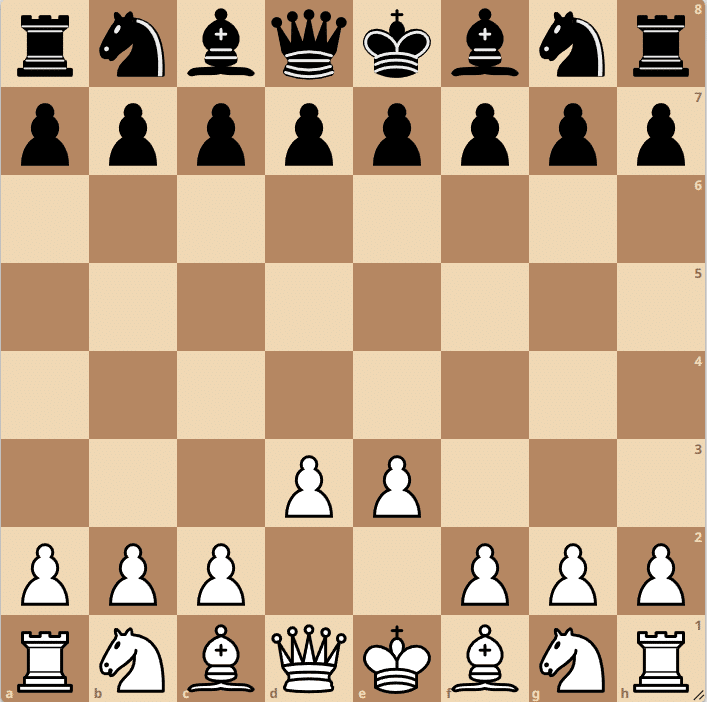
Has anyone ever told you that you can start the game by moving two pawns at once? I’ll give you the answer up front: it’s illegal. That move doesn’t exist in chess. The rules are clear: on every turn you move a single piece, no exceptions.
Let’s break it down together so you never have doubts about it again.
Where does this myth come from?
I’ve seen this misunderstanding dozens of times. Someone learns to play without supervision, hears from another beginner that “you can move two pawns when opening,” and takes it as fact. If nobody corrects them, they repeat it. And so the mistake spreads.
I myself remember doubting as a kid whether it was legal or not. Until someone who actually knew chess set me straight on the rules.
The confused player usually reasons like this: “the pawn can advance two squares on its first move, so I’ll split those two squares between two different pawns.” It has a certain internal logic, but it’s completely wrong. If you want to properly understand how the pieces move, we explain it all in detail at that link.
Let’s imagine for a moment it were legal
Would it be a good idea to move two pawns at once? Let’s do the exercise.
It might seem useful because:
- Faster development. With a single turn you control more space and free up squares for knights and bishops.
- Tempo savings. You move two pieces for the price of one move.
But the problems would be huge:
- You lock in your bishops. If you advance two central pawns one square each, the bishops stay blocked behind them. To free them you need extra moves like b3 or g3. You lose time.
- You lose control of the center. Without a pawn on e4 or d4 you don’t fight for the center. And whoever doesn’t control the center doesn’t control the game.
- You end up without the initiative. Without developed bishops, without a center, and with your queen boxed in, you’re going to react to whatever your rival does. White usually carries the attack. That’s how you’d lose it.
As you can see, it wouldn’t even be a good idea. But let me stress: it is completely illegal.
The final answer
No, you can’t move two pawns at once. On every turn you move a single piece. Always.
The only move in which “two pieces move at once” is castling, where the king and rook move together. And that has its own conditions and limitations.
One more thing that confuses beginners is the en passant capture. It’s a special move between pawns that also isn’t intuitive, and it’s worth knowing.
If you want to understand chess well from scratch, I recommend starting with openings. Once you master the basic opening principles, you’ll see the game has a beautiful logic to it.
Preguntas frecuentes
Can you move two pawns at once in chess?
No. In chess you can only move one piece per turn, no exceptions. Moving two pawns at once is an illegal move. The only case where 'two pieces move' in one turn is castling, where the king and rook move simultaneously under the official rules.
Can a pawn move two squares on its first move?
Yes, but only one piece (one pawn) in a single turn. Any pawn that hasn't moved yet can advance one or two squares on its first move. This doesn't mean moving two pieces at once: it's still the movement of a single pawn on the player's turn.
Where does the myth of moving two pawns at once come from?
The myth probably arises from confusion with the pawn's first move (which can advance 2 squares) being interpreted as 'moving two pawns.' It may also come from informal variants of the game or from mistakes made while learning the rules without supervision. It's one of the most common misunderstandings among absolute beginners.