How chess pieces move
Pulsa cualquier pieza para ver sus movimientos legales resaltados.
How do chess pieces move?
If you’re just starting out, the first thing you need to know is how each piece moves. It seems like a lot at first, but I promise once you practice a couple of times you’ll have it down. Let’s go piece by piece, at a steady pace.
Before continuing, if you’re still not clear on how the board is organized, I’d recommend reading that guide first. And if you want the full rules on hand, they’re available too.
How does the pawn move?
The pawn is the humblest piece on the board, but don’t underestimate it. It advances one square forward, and only if that square is empty. That said, on its first move it has a special option: it can advance two squares at once.
Note this well: the pawn never moves backward. Once it advances, there’s no going back.
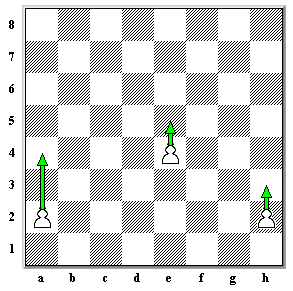
And how does it capture? Here’s the surprise: the pawn doesn’t capture forward, but diagonally. If there’s an enemy piece on the diagonal square ahead, it can take it. You have the details in how the pawn captures.
There are also two special pawn moves you need to know: en passant and promotion, which happens when a pawn reaches the far end of the board and turns into any piece you want (almost always a queen).
How does the rook move?
The rook is a powerful, very direct piece: it moves in a straight line, horizontally or vertically, as many squares as it wants. It can’t jump over other pieces, so it needs a clear path.
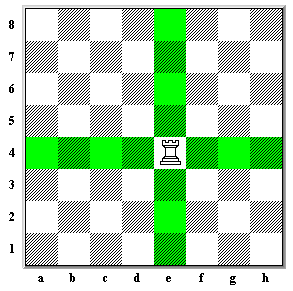
Once you master the rook, you’ll see it’s especially deadly on open files, where there are no pawns blocking it. If you want to see how it captures, you have all the details in how the rook captures.
How does the knight move?
The knight is the most special piece on the board. Its L-shaped move confuses any beginner: two squares in one direction and one perpendicular (or vice versa). You can think of it as a ninety-degree turn at the end.

Most important: the knight is the only piece that can jump over others. It doesn’t matter if there are pieces in the way, it jumps and lands where it needs to. It also changes the color of its square with every move.
And how does it capture? I explain it in how the knight captures.
How does the bishop move?
The bishop moves only diagonally, as many squares as it wants, forward or backward. Each player has two bishops: one that always travels on light squares and another on dark ones. That means they never cross paths.
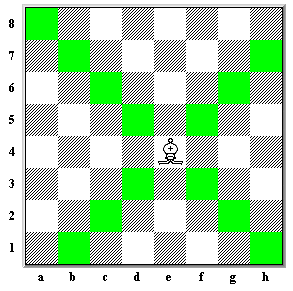
The bishop shines in open positions, where its long diagonals give it plenty of reach. Like the rook, it needs a clear path: it can’t jump over pieces. If you want to see how it captures, check how the bishop captures.
How does the queen move?
The queen is the most powerful piece on the board, and rightly so: it combines the rook’s and bishop’s movement. It moves in any direction, horizontal, vertical, or diagonal, as many squares as it wants.
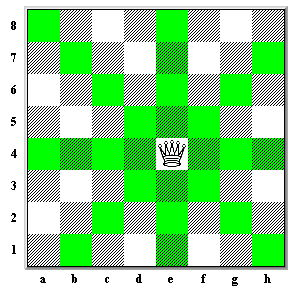
Look at the diagram: the queen can reach almost any square on the board from where it stands. That’s why you need to take good care of it. If you want to know more about piece values and why the queen is worth 9 points, there’s a full guide. To see how it captures, check how the queen captures.
How does the king move?
The king can only move one square in any direction: forward, backward, sideways, or diagonally. It’s slow, but it’s the most important piece in the game.
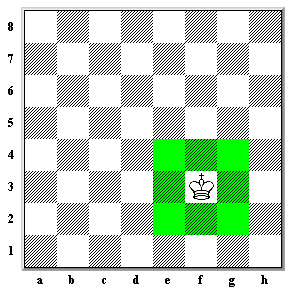
Why is it so important if it moves so little? Because if your king ends up trapped with no escape, the game is over. That’s called checkmate, and it’s the objective of every game.
The king also has a special move it shares with the rook: castling. It’s the only move where you move two pieces at once, and its main purpose is to put the king in safety. I explain it in detail in that guide. To see how it captures, check how the king captures.
Now that you know how each piece moves, here are the next suggested steps:
- How to play the Italian Game
- How to play the Ruy Lopez opening
- Free chess course
- The value of chess pieces
Preguntas frecuentes
How does the knight move?
The knight moves in an L-shape: two squares in one direction and one perpendicular. It's the only piece that can jump over others.
Which piece can move in every direction?
The queen can move in any direction (horizontal, vertical, and diagonal) any number of squares. It's the most powerful piece.
What is the order of piece values?
From highest to lowest: queen (9), rook (5), bishop (3), knight (3), pawn (1). The king has no numeric value because it can never be captured.
How should I move pieces for the first time?
In the opening, the most effective approach is to move the central pawns first (e4 or d4 for White) to open lines, then develop knights and bishops toward the center.
Which piece moves first in chess?
White always moves first. There's no mandatory piece: the most common move is the king pawn (e4) or the queen pawn (d4).