
Fool's Mate: the fastest mate with White
What is Fool’s Mate?
Fool’s Mate is the fastest checkmate White can suffer: it happens in just two moves. Yes, two. Sounds impossible? It happens more often than you’d think among beginning players.
The name says it all: you have to make very specific mistakes to fall for it. But that’s exactly why it’s so valuable to know. If you understand why it works, you’ll never fall for it.
Fool’s Mate step by step
Let’s see how it unfolds. White hastily moves two kingside pawns and exposes a diagonal that Black’s queen exploits instantly.
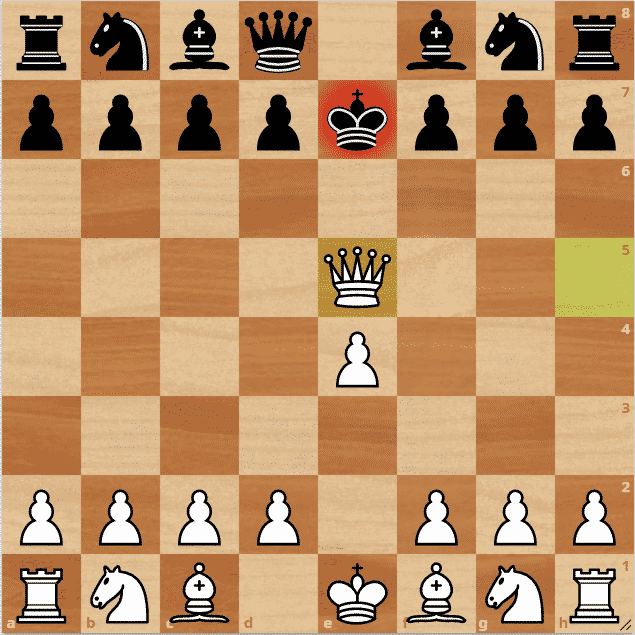
Look at the diagram: the final position is devastating for White.
1. The two mistakes that make it possible
For Fool’s Mate to happen, White has to weaken the natural protection of their king far too soon. With just two wrong moves, they open a diagonal they can’t close in time.
What are those mistakes? Very simple:
- 1.f3 — takes away the knight’s best development square and weakens the h4-e1 diagonal.
- 2.g4 — opens that diagonal even further and doesn’t serve any useful purpose.
Two pointless pawn moves. That’s all it takes to get mated.
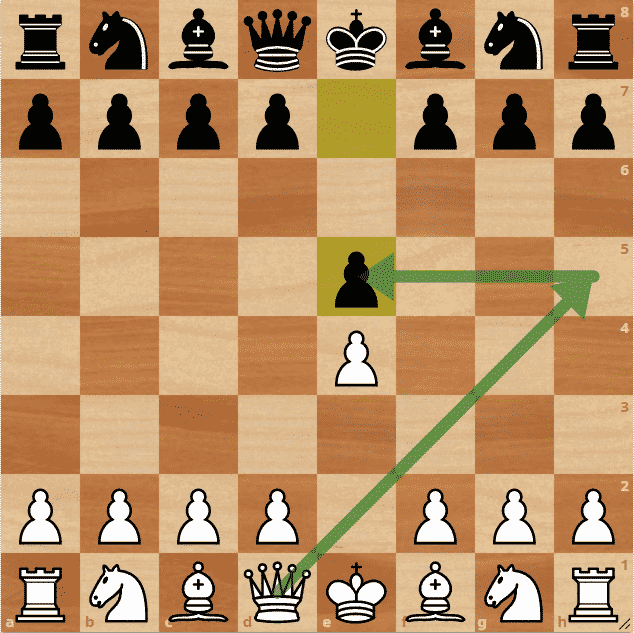
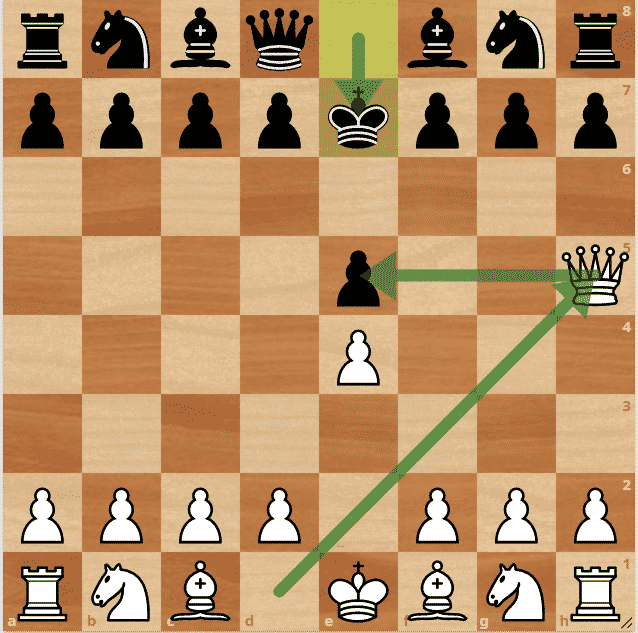
2. How Fool’s Mate is executed
Now it’s your turn. Practice the full sequence: White makes the two mistakes and you, playing Black, punish them with Qh4#.
You play Black. White makes the two fatal mistakes (f3 and g4). Punish them with Qh4#.
The important lesson isn’t memorizing the trap as if it were magic. It’s understanding that two badly pushed pawns can open an immediate path to mate. Once you internalize that idea, you’ll recognize similar dangerous structures in your own games.
Example game with Fool’s Mate
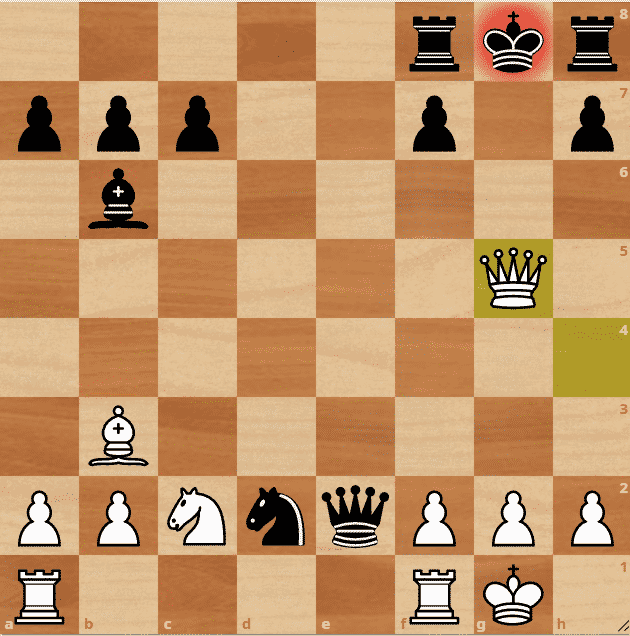
You won’t see this mate in high-level chess, of course. But similar pawn structures do appear, creating the same dangers. Here’s an example so you can see how those kingside weaknesses can cost the game even when the mate isn’t so immediate.
Notice how exposed the king ends up when the pawns that protect it are missing.
How to avoid Fool’s Mate
The rule is very simple: don’t move f3 or g4 in the opening without a clear reason. Those two pawns protect the h4-e1 diagonal and kingside castling. Push them without purpose and you hand the enemy queen a highway.
More generally, if you want to avoid this kind of early disaster, I’d recommend studying the most common quick mates. Fool’s Mate is a close cousin of its mirror version and Scholar’s Mate: all three exploit the same principle, that the queen and bishop are lethal when the enemy king hasn’t finished developing.
Spending some time on these patterns is one of the best investments you can make as a player. Once you know them, you’ll never fall for them again.
Preguntas frecuentes
What is Fool's Mate?
Fool's Mate is checkmate in the fewest possible moves: White gets mated on move 2 with Qh4# after the mistakes 1.f3 and 2.g4.
In how many moves is Fool's Mate delivered?
In 2 White moves (f3 and g4) plus 2 Black moves (e5 and Qh4#). Total: 4 moves on the clock, but Black actually delivers mate on their second move.
How do you avoid Fool's Mate?
Simply don't play f3 followed by g4. They're two serious weaknesses: f3 takes away the knight's development square and g4 opens the black queen's diagonal toward h4.